Humanity is Born in Africa-- Africans Travel the World
A Study Guide
Developed by Kaba Hiawatha Kamene
(aka Booker T. Coleman, Jr.)

A Study Guide
Developed by Kaba Hiawatha Kamene
(aka Booker T. Coleman, Jr.)

This Study Guide is an on-going Process of Becoming. It is dedicated to the Beloved Creator, Ancestors, Original Human Family, Today's Human Family and the Human Family Yet to be Born.
Part 1 – Introduction to Humanity is Born in Africa, Africans Travel
World – A Systematic View of an African Centered Curriculum
Part 2 – Forty Seasons – A Forty Year Curriculum Guide
Part 3 – DVD Catalog – Materials that Support This Curriculum
Introduction to Africa - Overview
Course Objectives: This is an introductory course that begins with the origins of Human life in African presence in the Asia. It is a course that explores the cultural contributions Africa and Africans made to this ancient continent. Civilizations will include those originating in Arabia, India, Persia, Chaldea, Media, Babylonia, China, Japan, Vietnam, and many other places in the Far East. Students will also learn how to develop a lesson plan centering on one aspect of the course. Students will implement interesting and unique teaching/learning methods (i.e. Multiple Intelligences, Emotional Intelligences and Bloom's Taxonomy.
Partial Book List


Course Syllabus
Class 1 – Introduction
Class Question – How did Africa Impact the History of the Earth?
-Readings
Intro to Africa
-JGJ (John G. Jackson) – p 3-59
Wonderful Ethiopians
-DDH (Drusilla Dunjee Houston) – p i-v, 3-14
When We Ruled,
Introduction, P 3-16
Appendix – Chronological Table – P 672-68
Class 2 – Origin of Life in Africa
Class Question – How and Why did Life Originate in Africa?
Readings
Intro to Africa - JGJ – 60-92
Wonderful Ethiopians -DDH – Chapters 1, 2, 3, and 4, p 15-65
When We Ruled – Robin Walker -Ch. 4 – "Land of the Blacks" – P 103-129
Ch. 5 – "Cradle of the Human Race" – P 130-147
Class 3 – The Origin of the Planet Earth
-Class Question –What Impact Does Carbon 14/Nitrogen14 Have on Dating
Artifacts and Objects?
Readings
-Intro to Africa, John G. Jackson, p 3-59
-Human Development from an African Ancestry, Gerald Kraus, p X-XV.
-Civilization or Barbarism, Dr. Diop, p ix-xvi, 1-58.
-Man, God and Civilization, John G. Jackson, p 3-27.
-Life's History Notes, p1/2
-CB - Big Bang, Superclusters, Clusters, Galaxies, Stars, Planets, Organic Life
Class 4 -Ages and Stages of the Earth – Pangaea/Continental Drift
Class Question # 1-After the Earth Formed, What Were the Various Changes that
Occurred?
# 2-What Are the Geological Eras of the Earth?
Readings
-When We Ruled, Dr. Walker, Pgs. 130-147.
-History of Africa, Dr.Asante, P 1-14, 351.
-CB-Ages and Stages of the Earth (Cl-2)
CB-Pangaea (Cl-2)
CB-Continental Drift (Cl-2)
Class 5 - The Miocene Age On Earth
Class Question # 1-When Did the Miocene Age Occur/What Happened During
This Period?
# 2- What is the History of Humanity's Life During the Miocene Period?
Readings
-Human Dev., GK, p 109-142, 150-154.
-Life History Notes, p 2/3 – Humanity's Ancestors
-CB-Miocene Age, Mitochondria DNA, Kinds of Primates, Fossil Monkeys
Apes, Ape Family Tree, African Apes, Gorillas
Class 6 - Great Lakes Region – Rift Valley/Hapi (Nile) Valley
Class Question # 1- Where Is the Great Lakes Region/How Did Human Life Begin
and Become Living In This Area?
# 2 – What is the Geographical/Geological and Anthropological Evidence of Africans in theRift/Hapi(Nile) Valley?
Readings
-Human Dev., GK, p 3-47, 143-146.
-CB-Development of Hands and Feet, Development of Hands and Doing
 Class 7 - Hominid/Hominoid
Class Question - Who Are the Living Beings that Comprise the Hominid/Hominoid Tree?
Readings
- Human Dev., GK, p 48-99, 146-149.
- Life History Notes - Appendix #2 Gloger, Allen and Bergmann's Rules,
p 16, 17, 18
- CB-Walking Upright, Bi-Pedalism, Bodily Trunk Proportions, Bipedal
Anatomy and Locomotion, Hominid Locomotion (Pelvis/Lower Limbs,
Hominid Locomotion-Footprints and Foot Bones
Class 8 - Morphological Changes – From Animal to Human
Class Question #1 - What Changes Impacted Primates? What is the Difference Between Hominid and Hominoid - Animal to Human Animal, Ultimate Transformation?
Readings
-Scientific America, "The Naked Truth," p 42-49.
-Notes, p4-Power to Grasp, Hind Limbs, Recession of Snout Region,
Perfection of Upright Posture,
-Notes, p5,6,7 - Loss of Tail,
-Notes, p7,
-Notes, Appendix #1,11,12,13,14,15
-CB-Comparative Anatomy, The Savannah Mosaic, Measuring Time
Class 9 - Australopithecines (Robustus/Gracile)
Class Question #1 -Who Are the Two Members of the 1st Human Group?
#2 - What Occurred During Their Life's History?
#3 - From Robust to Graceful?
 Readings
-Origin of Humankind, GK, p ix-xvi, 1-58.
-Life History Notes – p 7, 8, and 9 - What is the Chronology of Humanity's Life History,
Six (6) Physical Transmutations of the Human Family
-CB - Australopithecine-Cranial and Facial Comparison, Australopithecine
Adaptation, Olduvai Gorge, Lake Turkana, Kenya, West Lake Turkana,
Kenya, Afar Triangle, Ethiopia
Class 10 - Homo Line- Part 1 (Habilis/Erectus)
Class Question #1 - Who Are the Two Members of the Middle Human Group?
#2 - What Occurred During their Life's History, From Tool Maker an Erect Human Being?
 Readings – National Geographic, "The Evolutionary Road," p 35-62.
-Laetoli Notes
-Life History Notes p 3,4, Development of Brain,
-Life History Notes, p 7 10, and 11 - Six (6) Physical Transmutations of the Human
Family
-CB-Hominid Sites, Early Hominid Behavior, Hominid Locomotion
Ardipithecus Ramidus, Lucy, Laetoli Footprints, Brain Evolution
Special Focus Class
Class 11 - The Laetoli Footsteps of Ancient Tanzania
 "Following in the Footsteps of our Ancestors
We could not have made it without them;
Leaving Footsteps for our Descendants to Follow
They can not make it without us."
Class Question - What are the Laetoli footsteps of early humans found in Tanzania, East Africa?
Purpose - The students will study the ancient Laetoli footprints made by early humans in Africa. These footprints today unravel the questions scientists have regarding the process of life from ancient days to today's human family. All of humanity has followed in these footsteps and could not have made it without these peoples called, "Australopithecus Afarensis," The recurring theme is the DVD, "The Historic Journey."
Vocabulary List:
Science – volcano, cinders, anthropology, paleontology, archeology, fossil, hominid, Australopithecus Afarensis, speculation
Geography – Laetoli, Kenya, Tanzania, Uganda, Rift Valley, Sadiman, latitude, longitude,
Language Arts - erect, impressions, shuffle, ancestor, descendant
Questions
Determine what the main ideas are by answering the following questions
1) Where is Tanzania in Africa-Latitude/Longitude lines?
2) Where is Laetoli in Tanzania-Latitude/Longitude lines?
3) What does it mean to following in someone's footsteps?
4) What would the student want to achieve in life that would inspire future generations
to follow in their footsteps?
Academic Standards:
Geography – Locate Tanzania and Laetoli in Africa. Cite the Latitude and Longitude
Lines
History/Math – Using a Timeline/Number line, identify the time period when these footsteps were made.
History/Culture/Anthropology - Students will be able to identify the species/family group that made these footsteps.
Science/Geology – Students will research volcanoes and the ash/residue left behind. Students will describe how footsteps were preserved for over 3.7 million years.
Science/Archeology – Students will compare and contrast Australopithecus Afarensis feet with the feet of todays human.
Holistic Activity
Exit Project - Project includes a (1) Written Essay, (2) Graphic Organizer and
(3) Oral Presentation
Language Arts- Figurative Language (Flashback/Foreshadow) – Students will research the Laetoli footsteps, describing how all humans have followed in the footsteps of early humans in Africa. This activity will conclude with the students describing the Legacy they plan to leave for future generations to follow and complete. Students will compare and contrast the story told in the DVD, "The Historic Journey."
Background Information – Laetoli Footsteps

The Laetoli footsteps are located about thirty (30) miles south of Olduvai. Of all the fossil sites in the Rift system, Laetoli has always been the odd one. Laetoli was dry then and greener now. Today there are several small lakes in its vicinity and a good deal of vegetation. Laetoli has attracted students of the ancient world for more than forty years because its deposits were b believed to be very old. The hominid fossils have been dated to be approximately 3.7 million years old. Laetoli was the first place where an adult Australopithecine tooth ever found. What set Laetoli apart from the other sites in the world are some footprints that have been found there.
Laetoli has a nearby volcano, "Sadiman." It is extinct today. About four (4) million years ago it was active. One day it spat out a cloud of carbonite ash. This stuff has a consistency not unlike that of very fine beach sand, and it powdered down over the surrounding landscape in a layer that reached a thickness of about half an inch before the eruption stopped. This fall of superfine cinders must have been extremely unpleasant for the local animals and birds while it was coming down, but there is no evidence that it did more than make them uncomfortable, b because they stayed in the area. That first puff of ash – probably not lasting more than a day – was followed by a rain.
The ash became wet and, almost like a newly laid cement sidewalk, began taking clear impressions of everything that walked across it: elephants, giraffes, antelopes, hares, rhinos, pigs. There were also terrestrial birds like guinea fowl and ostriches, and even the small tracks of millipedes.
However, by a wildly improbable linkage of events, these footprints were made. Sadiman had to blow out a particular kind of ash. Rain had to fall on it almost immediately. Hominids had top follow on the heels of the rain. The sun had to come out promptly and harden their footprints. Then another blast from Sadiman had to cover and preserve them before another obliterating shower came along. All this had to happen over a period of only a few days. All things considered, the preservation and recovery of the Laetoli footprints are nothing short of a miracle. They confirm that hominids were fully erect walkers at three million years Before the Christian Era and even possibly earlier.
The footprints are like modern human footprints. There is well-shaped modern heel with a strong arch and a good ball of the foot in front of it. The big toe is straight in line. It doesn't stick out to the side like an ape toe, or like the big toe in so many drawings you see of australopithecines. The hominids of Laetoli were imperfect walkers because the footprints show that they walked with a shuffle. The direction of the prints indicate that their maker had been walking north under some sections of land that had not yet been eroded. There were two hominids, they were probably walking together; one (with slightly larger prints) was a male; the other, possibly pregnant, was a female. They probably had been erect walkers for at least a million years.
All of this is speculation; there is still a lot more research to be done! Are you interested in archeology, paleontology or anthropology? How about African History?
Follow in the footsteps of yesterday's scientists and study the past. You can't make it without them…Leave your intellectual footsteps behind. Your present becomes your descendant's past. Their present will be your future. We can't make it without each other!!!
Life History of Human Family
Prehistory is such that all that is written about it, all theories, and all theses are of necessity provisional and preliminary. These theories ad theses are arrived at by fossils.
Technically, a fossil may be any evidence of [past life. But, were mammals are concerned, such evidence almost always consists of bones and teeth, the most durable tissues of the body. Fossils may be dated one of two ways;
1) They may be assigned an age in years. Year dates are generally obtained from the rocks in which the fossils are found rather than from the fossils themselves.
2) They may be placed relative to each other I the unfolding sequence of geological events.
There are two (2) methods of dating fossils.
1) Carbon 14/Nitrogen 14 dating is useful only in fossils less than 40,000 years of age. This radio carbon dating is based upon the fact that all living organisms assimilate the radioactive isotope of Carbon (C14) at a fixed rate during their lifetimes. The assimilation of the isotope ceases at death. This isotope has a half-life of 5,538 years, give or take 30 years. Therefore, by measuring the amount of C14 remaining in a sample of organic substance, a determination may be made as to the number of years which have elapsed since the death of the organism from which the samples originated. The technique is useful for measuring the ages of bone samples, wood fragments, cereal grain etc.
2) Potassium40/Argon 40 dating is used for rocks older than 250,000 years of age.
Both techniques assess the decay of naturally occurring radioactive isotopes, which takes place at very steady rates. Not all fossils can be radioactively dated, and their age must, therefore, be estimated by geological and paleontological comparisons with other regions.
The oldest fossils of the human family were located in Africa. Austolopithecus Ardi…Lucy, named, "Danknesh," by the indigenous Africans (Lucy: The Beginnings of Humankind, Donald Johansson and Maitland Edey, (Simon and Schuster: NY), 1981. Danknesh's importance in paleontology resets on two (2) factors,

1) She has been dated to be 3.5 millions years of age.
2) Her skeleton is the most complete ever found of any hominid older than 75,000 years of age.
But, to truly investigate the life history of the human family, it must be understood that we must study the multi-layered disciples of anthropology, pre-history and population genetics that some crucial lines of evidence are being pursued, half hidden from the view of the enlightened public, which seek to minimize, undermine and negate the African contribution to humanity (Civilization or Barbarism, Dr. Chiekh Anta Diop)
Humankind was born under the latitude of the Great Lakes Region [(Kenya, Uganda and Tanganyika). Tanzania = the country of Tanganyika + the island of Zanzibar], almost under the Equator, is necessarily pigmented and African; Gloger's Law requires that warm-blooded animals be pigmented in a warm climate. All other races are descended from the African race by more or less direct relationship and the other continents were populated from Africa, as much at the time of Homo erectus as Homo sapiens and Homo Sapiens Sapiens, who appeared around 150,000 years ago: the earlier theories which made Humans come from somewhere else are no longer valid. Africa is the only continent where there is evidence, in unbroken chronological sequence, of all stages in the development of man.

The oldest and most numerous human and pre-human fossils are found principally I the Great Rift Valley, which extends from southern Zambia, through Ethiopia and into present day Israel, (yesterday it was "Palestine", day before yesterday "Canaan". In this valley are the Olduvai, Omo and Hadar fossil sites, the richest such sites in the world.
Humanity's Life History and the Miocene Period
The Miocene Period, beginning about 25 million years ago, was known as the, "Period of the Ape." The Life History of the human race began in the Miocene, approximately 14-15 million years ago. During the Miocene, the earth was largely covered with luxurious forests. Two major lines of advanced primates co-existed: ape-tending pongids and man-tending hominids. During this period, the pongids were superior to the hominids. The apes proliferated mightily and spread all over Africa; hominids were well down the road to extinction. Pongids eagerly adapted to the forest world while hominids remained stubbornly primitive.
There is little doubt that if the Miocene had lasted longer, the hominids would have perished entirely. But, it did not last. The Miocene Period became the Pliocene period; neither the pongids, nor the hominids had the least responsibility for the change. The world's climate altered. At this point, the earth entered a drought millions of years long. Forests dwindled and the pongids swindled with them. By the sheerest accident, hominid liabilities during the Miocene became assets during the Pliocene. It is often said that our failure to adapt the forests left our adaptional options open for the new environmental conditions of the Pliocene/\.
It is truer to say that the conditions of the Pliocene happened to favor our primitive characteristics. Humans are primitive and unspecialized primates. The anthropoid apes have four (4) genera; gibbon, orangutan, chimpanzee and gorilla. The gibbon and orangutan anthropoids have trace back to the Oligocene, having developed from small Tarsoids of the Eocene. The anthropoid ancestors of the gibbon, orangutan, chimp, gorilla and man, branched from the common ape stock about 25 million years ago, in the Miocene Period. Man descended from a Miocene Ape-like Ancestor. We find the first traces of human fossils in the Pliocene period, after which came the Pleistocene period (Ice Age).
HUMANITY'S ANCESTOR
 Somewhere between 14 and 4 million years ago, it is theorized that Humanity's most ancient ancestor moved almost entirely out of the forest and into open savannah. In so doing, they became entirely upright, bi-pedal walkers; a unique development in primate growth. When our ancestor emerged as a ground dweller, he/she differed from the other ground dwelling apes by being more willing to venture into this open savannah. This led to his/her dietary change. This change was reflected in the morphology of their back teeth. These dietary and habitat changes also led to selection pressures that caused changes in other parts of their skeleton such as, arms, legs, pelvic girdle and skull.
We can see this in the ground-dwelling apes by the arboreal apes and in our ancestor by other ground dwelling apes. Our ancestor, while having many pongid features, differed from the true pongids, enough to be considered the first hominid or proto-hominid. The earliest specimen of our ancestor was found in Olduvai Gorge in Tanzania though others were founded from a later period in Asia and Europe. Our ancestor represents an early evolutionary divergence from pongids. Before we go through the evolutionary path, let us examine a hypothesis of how this divergence showed itself in the development of human morphology. To do this, we must return to the Triassic period of the Mesozoic Age.
From Animal to Human Animal: The Ultimate Transformation
An anthropology student of world renowned educator, Professor William Leo Hansberry of Howard University, wrote a paper dated, December 20, 1923. He titled his work, "A Discussion of the Morphological and Physiological Changes that Are Supposed to Have Taken Place in the Transformation of Ape-Like Creatures to Man." We would like to highlight some of the important ideas presented in this paper.
Sometime in the Triassic Period, there lived in South Africa a group of animals called, "Therapsidae". These animals presented a blend of primitive reptilian and primitive mammalian characteristics. They lived mainly in the water, but, were capable of surviving on land. They possessed, like all reptiles and mammals, four (4) limbs, but, they were short and mobile, capable of producing motion, but, not of supporting the weight of the body.
As time passed these animals, for reasons unknown, either voluntary or involuntary, took to a terrestrial habitat. In an attempt to adapt themselves to the now conditions and environment, its organs and limbs began to specialize so to support the body and carry it clear off the ground. But, in doing this, stability was gained and mobility was lost. Successful though it was, this feat was very gradual. The limbs, at first, supported the body, only during the act of propelling. Its body sunk to the ground when progression was completed. Soon the limbs became strong enough to0 support the body continuously and hence stability became fixed. As stability became fixed, however, the limbs gradually became less mobile.
They had been capable of moving in any direction, but now were only able to move in a forward, backward motion.

This creature became the ancestor of the quadrupeds or pronograde animals. But, not all of the Terapsidae species followed the above course. Some, while returning the mobile limbs, took to climbing, first over objects in the pathway, and then in bushes and trees. In the climbing process, the animals reached ahead with one or the other of the mobile fore-limbs for a new grasp. While doing this, the weight of the body was temporarily shifted to the hind limbs. Simultaneously, became specialized for supporting organs and became stable. The first part of this is called, "The emancipation of the fore-limbs." This habit of climbing saved the fore-limbs their mobility and prevented them from becoming organs of more stability. It also handed them over for further adaptation of the inherent potentialities.
It was such a condition as this, that kept the stock which culminated in man from becoming a four legged pronograde animal, and gave to his/her particular stock such potentialities as afterwards developed and made him leader of the world.
The specific morphologically and physiological occurrences growing in full or in part, out of these arboreal habits which counted most in the development towards man were as follows the:
1) Development of the power to grasp
2) Development of the hind limbs as supporting and balancing organs, and the loss of the prehensile (wrap around adapted for seizing or holding) character of the great toe.
3) Recession of the snout regions and modifications in the shape of the spine and base of the skull.
4) Perfection of the up-right posture.
5) Loss of the tail.
6) Loss of body hair
7) Evolution of the human brain
1) The Development of the Power to Grasp
The animals that took to the trees, thereby preserving the mobility of the fore-limbs, were able, in climbing, to place the palm of the hand, because of the power of rotation, against the new hold at a variety of angles. In climbing, the fingers were also flexed, in order go make grasping more perfect.
The power to grasp was first used in grasping the limbs and branches of the trees in which the creature climbed; but, once attained, it was also to grasp leaves and fruits, for carrying food to the mouth, for scratching the body, etc... These activities gave rise to the "feel," of the body and the shape and form of the body. The hand, then, is an extraordinary survival of a very primitive feature which goes far back into the mammalian series. It is the retention of a condition so primitive that it is matched only among its immediate sin and by types situated in vertebrae stock at the point of mammalian divergence.
The hand of man is more is more like the hand of Armanda and Tortoise than like that of a dog, pig, or horse, these being in this particular respect, more highly specialized.
2) The Development of Hind-Limbs
The body of a pronograde is at the right angles to the lower limbs, while the body of an orthograde is in a straight line with the lower limbs. Now, the extensions of the leg upon the trunk and the anatomical adaptations it involved were the outcome of the arboreal habit. In Therapsidae, the hind –limbs were mobile and more or less at right angles with the axis of the trunk.
With the coming of the climbing habits, the relations between these parts of the body were changed and the legs were extended upon the trunk in a more or less straight line. The animal thus became orthograde instead of pronograde in posture. In reaching out for a new grasp while in this position, the weight of the body was thrown upon the hind limbs. Under these conditions, ancestral mobility of the hind limbs was a great handicap in the way of affecting the stability required for the hind limbs. As time passed these disadvantages were overcome thought morphological changes in the joints which limited mobility and augmented stability.
While these developments had their origin in the adaptations to purely arboreal habits, their completeness did not take place until the terrestrial progression had been assumed. As a matter of fact, stability is still in progress. This can be proven by a study of the morphological development of the extremities of the hind-limbs, the feet and toes. The feet in the early arboreal stages, were in all probability built on the same pattern as the hand, having the same digit formula…namely, 3, 4, 2, 5, 1. The ability of the foot to grasp even after it had become a supporting organ was still very pronounced. The sole was turned upward, giving the foot an inverted appearance. The big toe retained its opposite character. These arrangements made climbing and progression habit, both of these characteristics gradually disappeared, the inverted position of the foot and the opposite character of the big toe no longer having any value.
3) Recession of Snout Regions
Most pronograde animals have long snouts ad faces, while most orthograde animals have relatively short jaws and faces. These last features are in general most pronounced in the higher primates and reach the height of their development in the human being. Because of the use of the fore-limbs for conveying food to the mouth, by the orthograde animals, instead of the use of the mouth for grasping food as is done by the pronograde animals, the size of the jaws and the size and number of the teeth of the latter were greatly reduced in the former. The nearer towards man we come, the smaller are the teeth in size and number.
Therefore, in typical mammals there are forty-four teeth, comprising the upper and lower sets of three incisors. One canine, four premolars, and three molars; while in apes and human beings there are, including the upper and lower sets, two incisors, one canine, two premolars, and two molars or a total of thirty-two. The jaws and mouth became smaller, naturally with the atrophy of the teeth.
These general changes of the mouth brought about certain other changes of considerable importance…the change in the size of the mouth cavity, accompanied by a modification of the musculature of the tongue, throat, and neck affecting to some degree the articulation in speech; the changes in the general location of the eyes, bringing them from a position on the sides of the face to a position in front of the face and in more or less the same plane and balance.
4) The Perfection of the Upright Posture

Another change brought about by the general changes of the snout regions and which has caused one of the most striking differences between the pronogrades and the orthogrades is the change in the position of the head on the spine. This change made possible the perfection of the upright posture by homo-sapiens and is one of the most magnificent changes brought about by the recession of the snout regions.
5) The Loss of Tail
The tail being a prolongation of the tail bone, folds back upon the back of the human embryo. This is a process of recapitulation. The loss of the tail is due to the upright posture of the primates.
6) The Loss of Body Hair
By the time Australopithecus emerged, the body hair characteristic of the pongid ancestors had diminished considerably. In the savannah and woodlands, these hominids were almost constantly exposed to the heat on the sun. It, therefore, became necessary for their bodies to develop a more efficient heat loss system. This was achieved by the gradual loss of the body hair and the multiplication of bodily seat glands. This loss of body hair, however, posed an additional problem; how to protect the underlying skin from the direct rays of the sun since the hairy covering was disappearing. The response was to develop a melanin synthesis capability in the skin. See
Appendix #1
7) The Evolution of the Human Brain
From Australopithecus Robustus through Homo Sapiens Sapiens the human brain grew in size, however, the most important aspect was the development of its denseness of consciousness. While becoming dense the human brain's indentations got deeper. The more the conscious thought, the deeper the indentations became. The more the indentations became, the more their thought became conscious and this interdependent cycle continues to this very day.
The Chronology of Humanity's Life History
The basic model upon which humanity is patterned clearly on the African model. The abundance of archeological records report that no skeletal remains older than 500,000 years can be found outside of Africa, but multiple records of humanoid remains in Africa date back over four (4) million years.
The oldest reported human skeletal finding outside of Africa was in Java, the so called, "Java Man." He was a 500,000 year skeleton of the human called, "Homo Erectus." However, human foot prints have been found in Ethiopia preserved in volcanic ash floors dating beck 9-12 million years. To truly understand the phenomenon of evolution, let us take a chronological look at the Life History of the Human Family.
The central postulate of Humanity's Life History is that all species, living and extinct, are related through descent, to a common ancestor. In a branching pattern of descent, relationships between any pair of species may be one of two kinds:
1) One species is the ancestor of the other.
2) Both are descended, at some point, from a common ancestor.
Closely related species, those with a recent common ancestry, tend to look more alike than those more remotely related since usually they will have inherited a larger proportion of characteristics of their common ancestor.
 (download illustration for a more detailed view.)
Life's History reveals itself in a call and response pattern: Nature signals to living species through her/his continual changes, and the species, if they are to survive, initiate adaptive changes both at the micro and macro level, mediated through the agents of heredity, the genes.
Humans belong to the order, "Primates." The larger group contains the living lemurs and their allies (the lower primates) as well as, the monkeys, apes and us (higher Primates). The earliest known primates lived alongside the last dinosaur, over 65 million years ago.
There are currently five (5) species of apes belonging to the Pongidae family. Three of these species, the gorilla, chimpanzee and orangutan are classified as the great apes. Two of the great apes, the gorilla and the chimpanzee are found only in Africa and these are the two that are closest to humans.
We know that the primate ancestors of the pongididae and hominidae had lived almost exclusively in trees, subsisting on a diet of fruit and leaves. But, by 20 million years ago, the great apes had nearly completed a trend, begun by their ancestors of spending increasingly more time on the ground. They lived near trees to jump up to avoid predators eventually they became totally ground dwellers. Humanity's ancestor emerged 14 million years ago as a ground dweller. Soon he/she went to open savannah. But, something else happened to these early hominids swelling in a hot, sparsely forested environment.
Apes and humans, together called hominids, share the same basic structure, but, compared to apes, humans are specialized in a number of features,
1) Large and internally reorganized brain
2) Bi-pedal walking modified body skeleton
3) Reduced face and canine teeth
4) Manual dexterity leading to use and manufacture of sophisticated tools.
The acquiring of the ground-dwelling habitat necessitated the transformation of the foot from a prehensile (seizing, grasping) to a supporting organ. Relatively little change took place in the arms and hands. The complete freedom of the hand brought about the further opposability (Opposite) of the thumb, which became long and opposed to the other digits (fingers), and increasingly useful on that account. The freedom of the hand led to tool-producing and to tool using habits, and opened the door to the creation of cultural history.
Initially, our ancestors would have been classified as another species of ape, but, a sequence of three (3) changes launched than in the direction of modern humans.

1st change – Occurred by around four (4) million years ago. The structure of fossilized limb bones show that by then our ancestors, in contrast to the gorilla and chimps, were habitually walking upright. The upright posture freed our fore-limbs to do other things, among which tool-making would eventually prove to be the most important.
2nd change – Occurred around three (3) million years ago, when our lineage split in two. There were two (2) species of humans, Australopithecus Robustus and Australopithecus Gracile. Australopithecus Gracile transmuted into the denser brained Homo Habilis (Human of Ability).
3rd change – Occurred around two and half (2.5) million years ago. Very crude stone tools appear in large numbers in areas of East Africa.
Humankind was initiated by the Australopithecus who had a massive skeletal structure and a cranium resembling an arrowhead; It has been in existence for 3.5 million years. This is the age attributed to "Lucy/Ardi" in Ethiopia. Two and a half (2.5) million years ago, three (3) hominids were in existence: They were Australopithecus Robustus, Australopithecus Gracile (who had a denser cranium than the former and a more developed bone structure), and Homo Habilis, decidedly more advanced than the former two, with a denser cranium.
These three (3) specimens that represented the very beginning of humankind cannot be found in Europe, Asia, America or anyplace else in the world, because they never left Africa. These three (3) hominids were followed by Homo Erectus, Homo Sapiens and Homo Sapiens Sapiens. There is an anatomical difference between Homo Sapiens and Homo Sapiens Sapiens. Homo Sapiens, the fifth (5th) species, did not have a frontal lobe in his/her brain, which is the seat of creative intelligence. Bu the time the sixth (6th) species, Homo Sapiens Sapiens transmuted, his/her brain expanded and housed the lobe that would enable him/her to transcend nature and activate their pineal gland. This creative intelligence or Husia allowed Homo Sapiens Sapiens to develop civilizations; including the Arts and Sciences and all that it implies (Math, Spirituality, Astronomy, Language, Philosophy, etc.).
The Six (6) Physical Transmutations of the Human Family
Australopithecine refers to the ancient hominid genus Australopithecus or to a grade of early hominids preceding the genus Homo. The so-called robust australopithecines are distinguished by having larger teeth and a more heavily built jaw structure than the species known as gracile australopithecines.
The Australopithecine Line
 With the appearance of Australopithecus some four (4) of more million years ago, we reach the dawn of humankind. There are certain things we can say about the Australopithecines,
1) They were efficient bi-pedal walkers.
2) Their habitat was largely open savannah and woodland.
3) They lived in hunting/gathering societies
It is also felt that from the Australopithecines onward, hominids developed patterns of food sharing had a profound effect on hominid history since it created a whole now cooperative arena of behavior.
Australopithecines were probably herbivorous; the bulk of their nutrition depended on gathering vegetables and fruits. Their environment was largely open savannah.
Through the comparisons of Australopithecine skulls demonstrated beyond all argument that while they had some ape-like features, Australopithecines were definitely not an ape, but a hominid in the process of moving closer to human that ape.
The Homo Line
Homo Habilis

The earlier of the two extinct species of our genus normally recognized is Homo Habilis. It first appeared in the fossil record at about 2 million years and seems to have persisted for under half a million years. Homo Habilis means, "Human of Ability." Their remains can be found in Kenya, Ethiopia, Uganda and parts of Southern Africa. They were given this name because they were the first tool maker. Making and using tools is clearly one of the diagnostic features of humanity. Habilis differed little from Australopithecus Gracile in the teeth, but, had a significantly expanded brain, a less projecting face and a more modern body skeleton. Homo Habilis actively hunted small and medium sized animals as well as collecting a variety of plant foods and butchering dead or disabled larger animals. Homo Habilis, like those of Australopithecus, are confined entirely to Africa. Homo Habilis were the first producers of the rudiments of human culture.
Homo Erectus
Homo Erectus appeared in Africa about 1.7 million years ago. He/She has also been found in Eastern Asia. Homo Erectus is perhaps the most distinctive of all fossil human species. Robust, but, essentially modern in its body skeleton, it possessed a long, low skull, angled sharply at the back and constructed of thick bone. The brain of Erectus was larger, but, its teeth were small than Habilis. Erectus was apparently the earliest form of human to not only use fire (documented as early as 1.4 million years in East Africa), but also to live in caves as well as in open sites. A more complex stone tool kit appears in Africa at around the same time as fossils of its probable maker, Homo Erectus. These tools are larger and more carefully shaped than Homo Habilis and made from a greater variety of stony materials. Many tools were made for butchering, digging and skin cleaning tasks. Such tools have been found across Africa, Europe, India, China and South East Asia.
Homo erectus was the first to stand fully erect called, "Bipedalism." Bipedalism is the ability to stand or walk on two legs rather than four (Quadrupedalism). Humans exhibit habitual bipedalism-that is, they stand and walk on two legs all the time. Habitual bipedalism evolved independently in several lineages of vertebrates, including the ancestors of certain lizards and dinosaurs and the ancestors of the birds and humans.
Homo erectus' height ranged from 41/2 to 5 feet. He/She was an avid, highly skilled tool maker and was like his/her hominid predecessor, black in complexion. Homo Erectus developed the migratory habit, for his fossils have been found in Europe and Asia. Leading scholars reject the idea that this evolution stopped at the Homo Erectus stage and that "Sapienization," took place at the level of each continent. It is believed that the work of Dr. Leakey and other experts have resulted in the triumph of the "Monogenetic," theory of humanity in Africa; they were by necessity black before becoming lighter in complexion through environmental adaptation at the end of the Wurm glaciations in northern Europe.
After one million years, Homo Erectus was the sole hominid in possession of the earth, until the appearance of Homo Sapiens 200-150 thousand years ago. His/Her intellectual level represented a quantum leap over that of his/her ancestors and he/she was, consequently, a more efficient exploiter of his/her culture rather than being a passive participant in it. Although Homo Erectus migrated out of Africa into other parts of the Old World, the Homo Erectus population was 5-10 times as high in Africa as elsewhere.
Homo Sapiens/Homo Sapiens Sapiens
The two other Homo species that evolved out of Homo Erectus were Homo Sapiens and Homo Sapiens Sapiens. Although Homo Erectus shared the same habitat with Homo Sapiens for about 100,000 years, they died out entirely between 40-30,000 years ago. The big difference between Homo Erectus and Homo Sapiens or Homo Sapiens and Homo Sapiens Sapiens, is less a case of brain weight than the absence of the prefrontal lobe in the brain of Homo Sapiens.
Homo Sapiens means, "Thinking Human." All modern populations belong to the species Homo Sapiens Sapiens. The oldest Homo Sapiens Sapiens population is found in Africa, dating back to at least 150,000 years ago and perhaps 200,000. No Homo Sapiens Sapiens fossils of comparable antiquity can be found outside of Africa. The accumulation of the best information now makes it very clear that humankind had his/her origin in Africa. This African almost unilaterally people and influenced the world from 5 million years ago to the glacial thaw of the Wurm glaciations period that ended about 10,000 years before the Christian era.
APPENDIX
Appendix #1 – Loss of Body Hair
Taken from Scientific American, February 2010, "The Naked Truth: Why Humans Have No Fur, And How Evolving Bare Skin Led to Big Brain," Nina G. Jablonski, pg 42-49.
Key Concepts
- Humans are the only primate species that has mostly naked skin.
- Loss of fur was an adaptation to changing environmental conditions that forced our ancestors to travel longer distances for food and water.
- Analyses of fossils and genes hint at when this transformation occurred.
- The evolution of hairlessness helped to set the stage for the emergence of large brains and symbolic thought
Pg 42 - …naked skin itself played a crucial role in the evolution of other characteristic human traits, including our large brain and dependence on language.
Pg 44 - Benefits of Hairlessness
Naked human skin is better at riding the body of excess eat than is fur-covered skin. Mammals possess three types of glands for the purpose: apocrine, eccrine and sebaceous. In most mammals the outermost layer of the skin, known as the epidermis, contains an abundance of apocrine glands. These glands cluster around hair follicles and coat the fur in a lather of oily seat. Evaporation of this sweat, which cools the animal by drawing heat away from the skin, occurs at the surface of the fur.
But the more the animal perspires, the less effectively it eliminates heat because the fur becomes matted, hampering evaporation. In the human epidermis, in contrast, eccrine glands predominate. These glands reside close to the skin surface and discharge thin, watery sweat through tiny pores. In addition to evaporating directly from the skin surface, this eccrine sweat vaporized more readily than apocrine sweat, thus permitting improved cooling.
Pg 44 – In marine mammals that never venture ashore, such as whales, naked skin facilitates long-distance swimming and diving by reducing drag on the skin's surface. To compensate for the lack of external insulation, these animals have blubber under the skin. In contrast, semiquatic mammals – otters, for example – have dense, waterproof fur that traps air to provide positive buoyancy, thus decreasing the effort needed to float. This fur also protects their skin on land.
Pg 44 – the largest terrestrial mammals-namely, elephants, rhinoceroses and hippopotamuses-also evolved naked skin because they are at constant risk of overheating. The larger an animal is the less surface area it has relative to overall body mass and the harder it is for the creature to rid its body of excess heat…During the Pleistocene epoch, which spans the time between two million and 10,000 years ago, the mammoths and other relatives of modern elephants and rhinoceroses were "wooly" because they lived in cold environments, and external insulation helped them conserve body heat and lower their food intake.
Pg 44 – Human hairlessness is not an evolutionary adaptation to living underground or in the water-the popular embrace o0f the so-called aquatic ape hypothesis notwithstanding. Neither is it the result of large body size. But our bare skin is related to staying cool, as our superior sweating abilities suggest.
Pg 44 – Sweating It Out
Keeping cool is a big problem for many mammals, not just the giant ones, especially when they lie in hot places and generate abundant heat from prolonged walking or running. These animals must carefully regulate their core body temperature because their tissues and organs, specifically the brain, can become damaged by overheating…Sweating cools the body through the production of liquid on the skin's surface that then evaporates, drawing heat energy away from the skin in the process. This whole body cooling mechanism operates according to the same principle as an evaporative cooler (also known as a swamp cooler), and it is highly effective in preventing the dangerous overheating of the brain, as well as of other body parts.
Pg 45 - Mammalian skin contains three types of glands-sebaceous, apocrine, and eccrine-that together produce sweat. In most species, sebaceous and apocrine glands are the dominant sweat glands and are located near the base of hair follicles. Their secretions combine to coat hairs with an oily, sometimes foamy, mixture (think of the lather a racehorse generates when it runs). This type of seat helps to cool the animal. But its ability to dissipate hear is limited.
 Pg 45 – Humans, in addition to lacking fur, possess an extraordinary number of eccrine glands-between two million and five million-that can produce up to 12 liters of thin, watery sweat a day. Eccrine glands do not cluster near hair follicles; instead they reside relatively close to the surface of the skin and discharge sweat through tiny pores. This combination of naked skin and watery sweat that sits directly atop it rather than collecting in the fur allows humans to eliminate excess hear very efficiently…our cooling system is so superior that in a marathon on a hot day, a human could out compete a horse.
Pg 45 – Aquatic Ape Theory – holds that around five million to seven million years ago tectonic upheavals in the Rift Valley of East Africa cur early human ancestors off from their preferred tropical forest environments. As a result, they had to adapt to a semiaquatic life in marshes, along coasts and in floodplains, where they lived for about a millions years.
Pg 46 – The transformation seems to have begun with climate change. By using fossils of animals and plants to reconstruct ancient ecological conditions, scientists have determined that starting around three million years ago the earth entered into a phase of global cooling that had a drying effect in East and Central Africa, where human ancestors lived, With this decline in regular rainfall, the wooded environments favored by early hominids gave way to open savanna grasslands, and the foods that our ancestors the australopithecines subsisted on-fruits, leaves, tubers and seeds-became scarcer, more patchily distributed and subject to seasonal availability, as did permanent sources of freshwater,
In response to this swindling of resources, our forebears would have had to abandon their relatively leisurely foraging habits for a much more consistently active way of life just to stay hydrated and obtain enough calories, traveling ever longer distances in search of water and edible plant foods. Increased walking and running, during which muscle activity builds up heat internally, would have required that hominids both enhance their eccrine sweating ability and lose their body hair to avoid overheating.
Pg 46/47 – This metamorphosis occurred about 1.6 million years there was an early member of our genus called Homo ergaster who evolved essentially modern body proportions, which would have permitted prolonged walking and running. Moreover, details of the joint surfaces of the ankle, knee and hip make clear that these hominids actually exerted themselves in this way.
Thus, according to the fossil evidence, the transition to naked skin and an eccrine-based sweating system must have been well under way by 1.6 million years ago to offset the greater heat loads that accompanied our predecessors' newly strenuous way of life. The humnMC1R gene is among the genes responsible for producing skin pigmentation. It was found that a specific gene variant always found in Africans with dark pigmentation originated as many as 1.2 million years ago. Early human ancestors are believed to have had pinkish skin covered with black fur, much as chimpanzees do, so the evolution of permanently dark skin was presumably a requisite evolutionary follow-up to the loss of our sun shielding body hair.
Pg 47 – How did hominids evolve bare flesh? Hints have emerged from large-scale comparisons of the sequences of DNA "code letters," pr nucleotides, in the entire genomes of different organisms. Comparison of the human and chimp genomes reveals that one of the most significant differences between chimp DNA and our own lies in the genes that code for proteins that control properties of the skin. The human versions of some of those genes encode proteins that help to make our skin particularly waterproof and scuff resistant-critical properties, given the absence of protective fur. This finding implies that the advent of those gene variants contributed to the origin of nakedness by mitigating its consequences.
Pg 47/48 – The outstanding barrier capabilities of our skin arise from the structure and makeup of its outermost layer, the stratum corneum (SC) of the epidermis. The SC has what has been described as a bricks and mortar composition. In this arrangement, multiple layers of flattened dead cells called corneocytes, which contain the protein Keratin and other substances, are the bricks; ultra thin layers of lipids surrounding each of the corneocytes make up the mortar. Most of the genes that direct the development of the SC are ancient, and their sequences are highly conserved among vertebrates. That the genes undergirding the human SC are so distinctive signifies, therefore, that the advent of those genes was important to survival. These genes encode the production of a unique combination of proteins that occur only in the epidermis, including novel types of keratin and involucrin. Human hair keratins were not as important to survival as the hair keratins of other primates were over the course of evolution and this became weak.

Pg 48 – How did human skin come to contain such an abundance of eccrine glands? Almost certainly this accumulation occurred through changes in the genes that determine the fate of epidermal stem cells, which are unspecialized, in the embryo. Early in development, groups of epidermal stem cells in specific locations interact with cells of the underlying dermis, and genetically driven chemical signals within these niches direct the differentiation of the stem cells into hair follicles, eccrine glands, apocrine glands, sebaceous glands or plain epidermis. Hair in the armpits and groin probably serves both to propagate pheromones (chemicals that serve to elicit a behavioral response from other individuals) and to help keep these areas lubricated during locomotion.
As for hair on the head, it was most likely retained to help shield against excess heat on the top of the head. That notion may sound paradoxical, but having dense hair on the head creates a barrier layer of air between the seating scalp and the hot surface of the hair, thus, on a hot, sunny day the hair absorbs the heat while the barrier layer of air remains cooler, allowing sweat on scalp to evaporate into the layer of air.
 Tightly curled hair provides the optimum head covering in this regard, because it increases the thickness of the space between the surface of the hair and the scalp, allowing air to blow through. Much remains to be discovered about the evolution of human head hair. But it is possible that tightly curled hair was the original condition in modern humans and that other hair types evolved as humans dispersed out of tropical Africa. People with the least body hair tend to live in the tropics, whereas those with the most tend to live outside the tropics. Yet hair on non-tropical people provides no warmth to speak of. These differences in hairiness clearly stem to some extent from testosterone, because males in all populations have more body hair than females do.
Pg 49 – Going furless was not merely a means to an end; it had profound consequences for subsequent phases of human evolution. The loss of most of our body hair and the gain of the ability to dissipate excess body heat through eccrine sweating helped to make possible the dramatic enlargement of our most temperature-sensitive organ, the brain. Whereas the australopithecines had a brain that was, on average, 400 cubic centimeters-roughly the size of a chimp's brain-Homo ergaster had a brain twice that large. And within a million years the human brain swelled another 400 cubic centimeters, reaching its modern size. No doubt other factors influenced the expansion of our gray matter-the adoption of a sufficiently caloric diet to fuel this energetically demanding tissue, for example. But shedding our body hair was surely a critical step in becoming brainy.
Our hairlessness also had social repercussions. Although we can technically raise and lower our hackles when the small muscles at the base of our hair follicles contract and relax our body hairs are sop thin and wispy that we do not put on much of a show compared with the displays of our cats and dogs or of our chimpanzee cousins. Neither do we have the built-in advertising-or camouflage-offered by zebra stripes, leopard spots, and the like. Indeed, one might even speculate that universal human traits such as social blushing and complex facial expressions evolved to compensate for our lost ability to communicate through our fur. Likewise, body paint, cosmetics, tattoos and other types of skin decoration are found in various combinations in all cultures, because they convey group membership, status and other vital social information formerly encoded by fur. We also employ body postures and gestures to broadcast our emotional states and intentions. And we use language to speak our mind in detail. Viewed this way, naked skin did not just cool us down-it made us human.
Pg 46 – When Nakedness Evolved
Protohumans such as the australopithecines probably led relatively sedentary lives, as today's apes do, because they lived in or near wooded environments rich in plant foods and freshwater. But as woodlands shrank and grasslands expanded, later ancestors, such as Homo ergaster, had to travel ever farther in search of sustenance-including meat. This species which arose by 1.6 million years ago was probably the first to possess naked skin and eccrine sweat, which would have offset the body heat generated by such elevated activity levels.

Pg 46 – Beating the Heat
Naked skin is not the only adaptation humans evolved to maintain a healthy body temperature in the sweltering tropics where our ancestors lived. They also developed longer limbs, increasing their surface-to-volume ratio, which in turn facilitated the loss of excess heat. That trend seems to be continuing even today. The best evidence of this sustained adaptation comes from populations in East Africa, such as the Dinka of southern Sudan. It is no coincidence that these people, who live in one of the hottest places on earth, also have extremely long limbs.
Why do modern humans exhibit such a wide range of limb proportions? As our forebears migrated out of tropical Africa into cooler parts of the world, the selection pressures changed, allowing for a variety of body shapes to evolve. [See Appendix #2 – Bergmann's rule]
Appendix #2
Gloger's Rule – named after zoologist Constanin Wilhelm Lambert Gloger, who first remarked upon this phenomenon in 1833 in a review of covariation of climate and avian plumage color.
Gloger's rule is a zoological rule which states that within a species of endotherms (mammals and birds), more heavily pigmented forms tend to e found in more humid environments, e.g. near the equator. Gloger found that birds in more humid habitats tended to be darker than their relatives from regions with higher aridity. Over 90% of the species researched conform to this rule. An explanation of Gloger's rule in the case of birds appears to be the increased resistance of dark feathers to feather-or-hair degrading bacteria (Bacilis licheniformis). Feathers in humid environments have a greater bacterial load, and humid environments are more suitable for microbial growth; dark feathers or hair are more difficult to break down.
Eumelanin is the most abundant type of melanin in the human body. Eumelanin is a dark brown or black pigment composed of an aggregate of small subunits (polymers). Eumelanin imparts varying shades of brown to hair and skin, with high concentrations found in the skin of darkly pigmented people. More resilient eumelanins are deposited in hot and humid regions.
Pheomelanin are the reddish or yellow type of melanin found in the hair and skin of lightly pigmented people. Pheomelanin is a polymeric pigment composed of multiple smaller subunits. Pheomelanin generates rather than neutralizes free radicals when it is exposed to UVR and thus may be implicated in the development of skin cancer in lighter complexioned people.
Ultra Violet Radiation (UVR) is the type of solar radiation that is of shorter wavelength and therefore greater energy than visible light. UVR comprises the range of wavelengths from 100 to 400 nanometers. There are three types of UVR;
1) UVR A – Ultraviolet radiation of relatively low energy, spanning wavelengths from 315 to 400 nanometers.
2) UVR B – Ultraviolet radiation of relatively high energy, spanning wavelengths from 280 to315 nanometers.
3) UVR C – The highest ultraviolet radiation, spanning wavelengths from 100 to 280 nanometers.
Free radicals are short-lived, highly reactive molecules that have one or more unpaired electrons ad are common by-products of normal chemical reactions occurring in cells. Among the most common are the superoxide and hydrogen peroxide ions. In scientific literature, they are often called reactive oxygen species. Free radicals are produced by UVR and can damage DNA. In arid regions, pheomelanin predominate to the benefit of crypsis.
Among mammals, there is a marked tendency in equatorial and tropical regions to have a darker skin color that pole ward relatives. In this case, the underlying cause is probably the need to better utilize the sun's UV radiation with decreasing latitude. Absorption of a certain amount of UV radiation is necessary for the production certain vitamins, notably Vitamin D.
[Vitamin D is an essential vitamin that is responsible for the absorption of dietary calcium from the digestive system and is necessary for the growth and strength of bones. The manufacture of vitamin D begins from cholesterol precursors in the skin, triggered by UVRB in sunlight. The bioactive form of the vitamin, vitamin D3, is produced via a series of chemical transformations that take place in the liver and kidney after the process is initiated in the skin.]
This principle is also vividly demonstrated among human populations. Populations that evolved I n sunnier environments closer to the equator tend to be darker-pigmented than populations originating farther from the equator.
Allen's Rule
Allen's rule is a biological rule posited by Joel Asaph Allen in 1877.
It states that endotherms from colder climates usually have shorter limbs (or appendages) than the equivalent animals from warmer climates.
Allen's rule states that endothermic animals (mammals and birds) with the same volume may have differing surface areas, which will aid or impede their temperature regulation.
In cold climates, the greater the exposed surface area, the greater the loss of heat and therefore energy. Animals (and Humans) in cold climates need to conserve as much energy as possible. A low surface area to volume ratio helps to conserve heat.
In warm climates, the opposite is true. An animal will overheat quickly if it has a low surface area to volume ratio. Therefore, animals in warm climates will have high surface area to volume ratios so as to help them lose heat.
In a nutshell, it simply means there is a ratio between body surfaces to body mass. For example, Fur or Tutsi people of Africa release body heat more readily because their ration is high. However, Eskimos and Inuit have a lower ratio and therefore retain body heat.
Bergmann's Rule
Bergmann's rule is a zoological rule named after a biologist named Christian Bergmann who first formulated the rule in1847.
It is an ecogeographical rule that correlates latitude with body mass in animals. Broadly it asserts that within a species the body mass increases with latitude and colder climate, or that within closely related species that differ only in relation to size that one would expect the larger species to be found at the higher latitude. The rule is often applied only to mammals and birds (endotherms), but some researchers have also found evidence for the rule in studies of ectothermic species.
Larger animals have a lower surface area to volume than smaller animals, so they radiate less body heat per unit of mass, and stay warmer in cold climates. On the other hand, warmer climates impose the opposite problem: body heat generated by metabolism needs to be dissipated quickly rather than stored within. Thus, the higher surface area-to-volume ratio of smaller animals in hot and dry climates facilitates heat loss through the skin and helps cooling of the body.
The Movement of Ancient Humanity
Life Along Hapi (Nile)
Africa has remained a land area since the Ordovician period (approximately 480 million years ago) and much of it since the Precambrian age going back some two (2) billion years ago. Hapi Valley Basin is 6825 Km in length from the Lucronza River in Tanzania to the Mediterranean Sea, draining an area of three (3) million square km passing through six (6) different regions that differ from each other in natural and geological history,
1) The Lake Plateau
2) The Sudd
3) Central Sudan
4) Ethiopian Highlands
5) The Cataracts
6) Kemet (Egypt)
 The Holy Land of the ancient Kemites was named, "Holy," because it was the birthplace of the Human Race. The "Khui Land", located in the Great Lakes region of Africa at the head of Hapi, birthplace of the ancestors of the Kemites, the Twa people. The Twa are the original parents of all humanity. This same site is where current science has found the oldest human skeletal remains of humans in the world millions of years in age. The source of Hapi, the equatorial provinces, where the great lakes and papyrus swamps were, was their Kemetic, "Ta Neter", or Holy Land. The sky as the Great Celestial water was also divided into two great lakes, one to the north, Lake of Khuru and the lake to the south, Lake of Ru. No doubt this was founded on the two great lakes in central Africa, Lake Mwanza (Victoria) and Lake Nyanza (Rudolph).
The ancient Kemites clearly defined their African origin in the Papyri of Hunefer and Turin (Italy). The ancient Kemites proclaimed in these two documents, "We came from the beginning of Hapi, where the Neter (God) dwells, at the foothills of the "Mountains of the Moon". These" Mountains of the Moon" are" Kilimanjaro" in Tanzania and "Rwenzori" in Rwanda/Uganda. There is a cultural kinship all groups of Africans north, south, east west and central. These linguistic, cultural, sociological and political factors reveal the kinship that binds these African populations that are presently separated by enormous geographical distances. West African legends report that Africans migrated from the region of the "Great Waters". These "Great Waters" are the Hapi (Nile River).
No matter where we collect legends on the genesis of African people, those who still remember their origins, say they came from the east and that their forebears found Twa people in the country. African legends ancient and modern, Reveal the Twa were probably their forebears found Twa people in the country. African legends ancient and modern, reveal the Twa were probably the first to occupy the interior of the continent, at least at a certain period. They settled in this area prior to the development of the larger Africans, either through migration of historical evolution.
Africanist, Dr. Cheikh Anta Diop, used language as one of his approaches to the relationship among different West African People. One of these groups is the Yorubas of present day, Nigeria. A chain of events lead to the conclusion that they must have settled for many years in that part of the continent known as Ancient Kemet. In his book, "The Religion of the Yorubas," by J. Olumide Lucas, Dr. Lucas presents the facts leading to this conclusion. These facts may be grouped under the following Heading:
1) Similarity or identity of language
b) Similarity or identity of religious beliefs
c) Similarity or identity of religious ideas and practices
4) Survival of customs and names of persons, places, objects, etc.
Abundant proof of intimate connection between the ancient t Kemites and the Yorubans may be produced under this head. Most of the principal Essences were well known at one time to the Yorubans. Among these Essences are. Wsir, Aset. Heru, Shu, Tehuti, Khepera, Amen, Anu, Khonsu, Khnum, Khopri, Het-Heru, Sokaris, Ra, Seb, the four (4) elemental essences and many others.
 These Africans, born within the region of Kenya, Uganda, Tanzania and Ethiopia [including Somalia (ancient Punt)], then traveled along a north-south axis. They developed the foundations of what would later become civilizations from Azania in the south, to Kemet in the north. Some ventured to West Africa. It is clear that any human born that had its birth in this region would not have survived without pigmentation. Nature does not do anything by chance. It is for that reason that humanity of the sub-equatorial region was given melanin to protect her/his skin. We know scientifically that ultra-violet rays of the sun would have destroyed the human organism in the equatorial regions, if this organism had not been protected by the Melanin cover.
It is only after African men/wombedmen left the continent of Africa to people other parts of the northern lands, which had a different, and later, dramatic climate, that men/wombedmen changed. They had a different look; they lost their pigmentation. The peoples of Africa did not leave because they were trying to flee the effects of the sun. During these times, the sun was a blessing. The region of the Great Lakes was an earthly paradise, food was in abundance there.
When we study the ways in which these early humans traveled, we see that if after every 25 years, at the beginning of a generation, Africans moved 25 kilometers, looking in one direction or another for nourishment; at the end of 10,000 years these small movements (25 km per generation for 10,000 years) would take this African as far as China in the Far East. It is only 15 km across the water from Gibraltar to Europe. In understanding the previous information, five factors should be highlighted,
1) How Africa was peopled
2) How the first humans in Africa confronted Nature
3) How they tool on the challenge of nature to create civilizations
4) How these civilizations spread across Africa and eventually to other parts of the world
5) How did Africans people the world?
The Kemetic Hapi derives its waters almost exclusively from the rains which fall over two elevated areas, the Equatorial plateau of Central Africa and the Ethiopian plateau. The rainfall over the two main regions follows the sun, coming broadly speaking to a maximum, after the sun is in its zenith and falling away as it recedes. Consequently, there are two wet seasons over the Equatorial plateau that correspond closely with the two equinoxes; although of the two, the spring rains are the more pronounced: while the summer solstice sets the sun at its zenith in the northern Hemisphere.
The largest quantity of Hapi waters is contributed by Blue Hapi, and the smallest amount by the Atbara. During the low time of the year, Feb-Jun, Blue Hapi is the more important source of life. The Atbara does not contribute water from Jan-Jun. On the average, 84% of the water of Hapi comes from Ethiopia and 16% from the Lake Plateau of Central Africa. The Equatorial Plateau contributes a small, but, regular amount to Hapi in Kemet; and if this source were to be cut off it can hardly be doubted, unless new sources came into operation, Hapi would run dry in the spring months. The rainfall of the Ethiopian Highlands on the other hand, produces the regular flood effect on which, until recent times, the whole agricultural system of the country depended.
Furthermore, the rich deposits of silt, brought down every year from the disintegration of the hill (mountain, Kilimanjaro, Ptah) were both the architect and fertilizer of the Hapi floodplain which makes Kemet a habitable country.
Presently, Hapi discharges about 86 million cubic meters of water a year into the Mediterranean. 98% of the water supply of Kemet is supplied by Hapi. One of the tributaries of Hapi is White Hapi, originating in Equatorial Africa, in the Sudd region where the Bahr-el-Ghazal, bringing water from Hapi/Congo divide and the Sobat bringing water from the Ethiopian Highlands join the northern part of the Sudd, a region of swamps and marshes, through which Hapi passes. It has its origins in the Great Lakes region. It continues to the northern region of the Sudd, Bahr-el-Gebel. In 'Sudan (Nubia), White Hapi is joined by Blue Hapi. This powerful tributary which comes from the Ethiopian Highlands constitutes the principle source of the waters, cause the annual rise and fall in the level of the river downstream of the junction.
Egypt is the gift of Hapi (Nile River). This seat of ancient culture is six hundred miles long, and is hemmed in by two ranges of barren limestone hills, which alternately approach and retreat from each other, maintaining between them an average breadth of seven miles. In the north, they spread out and finally disappear, giving way to a marsh-like plain which extends to the Mediterranean Sea.
As we go southward (up Hapi), the limestone hills are replaced by those of granite; and these hills finally approach each other until they almost touch. Through this gorge, the river, during the season of inundation, rushes into the valley and runs northward to the sea. In the winter and spring, the river rolls along sluggishly through a dry and dusty plain; but, it the summer all this changes, by then the waters begin to move swiftly. Hapi first turns red in color, later it lakes a green hue, and eventually it overflows its banks and floods the valley to the bases of the hills. The whole valley becomes a huge lake from which the villages rise like islands, being in fact, built on artificial mounds.

The sources of Hapi are two great lakes located deep in the heart of Africa; Lake Mwanza (Victoria) and Nyanza (Rudolph). As the clouds laden with moisture pass over Equatorial Africa, they release their waters. This results in a rainy season of ten month's duration. The deluge finds its way into the great lakes, and they discharge their excess waters, which flow northward as Hapi. As this stream flows through a thirsty land, the parched soil drinks it up, but, the waters continue to flow forth, and so push the river across a great desert stretching from the latitude of Lake Chad to the Mediterranean Sea.
Hapi owes its existence to the Great Lakes, but, the inundation is produced by a separate cause, in which the lakes do not participate. In between Hapi and the mouth of the Arabian Gulf are the Highlands of Ethiopia, which rise toward the heavens thousands of feet above sea level. Clouds floating in from above the Indian Ocean are intercepted by these mountains as they travel northward. The clouds release this burden of moisture, and during the rainy season, these rivers rush through their arid beds and roar into Hapi. The great river moves northward between rocky walls as it traverses the Nubian Desert, and when the lowlands of Kemet are reached, it overflows its banks. The two Ethiopian tributaries make respectively important and unique contributions. The waters of White Hapi are crystal clear; but; the Atbara and Blue Hapi systems bring along rich black silt from the Abyssinian Highlands. This sediment finally settles over the land of Kemet as rich topsoil. When the waters recede, the farmers scatter their seeds over the fertile land and then wait for the solar energy to bring forth their crops. But, for white Hapi, the rivers of Ethiopia would be absorbed by the thirsty desert; and without the Ethiopia waters, the White Hapi would be a barren water course. The river is generated by the Equatorial rains. The land, on the other hand, is produced by the precipitation of the tropical rains on the slopes of the Ethiopian mountain pile. In that Hapi valley fattened by a top soil, brightened by eternal sunshine, watered by terrestrial rains, the people were able to obtain a year's food in return for a few days' toil. In effect, they ere provided with a wealth of time which was essential for the construction of their nation's growth. This growth would lead to African peopling not only their continent, but also the rest of the world.
The First Migration

The first migrations moved along tropical latitudes enabling Africans to inhabit India, Southeast Asia and ultimately, Australia and the Pacific Islands. Africans could have inhabited Eurasia by migrations through the Straits of Gibraltar the Isthmus of Suez and perhaps Sicily. Africans survived everywhere in Europe in Europe and Asia until the Neolithic Period. Their remains can be found in Spain, Portugal, Belgium, the Balkans, Slovakia, Northern Rumania, Poland, Moravia, Austria, Siberia, China, Eastern Europe, the Near East, Crimea, Grimaldi and Java..
 There was an early migration to Europe and Asia by the African Grimaldi Man/Wombedman and the Aurignacian industry of painting; other materials can be radio carbon dated for an absolute chronology. Europe did not see the birth of Homo Sapiens Sapiens until the African appeared by migration. The first so called, "white people," the "Cro-Magnon," human did not appear until around 20,000 years ago, probably as a result of the physical transformation by adaptation to the cold environment. This racial differentiation was achieved in Europe, probably in southern France and in Spain, at the end of the last Wurmian Glaciations between 40,000 and 20,000 years ago.
There is absolutely no doubt that the white race which appeared for the first time during the Upper Paleolithic period around 20,000 years ago was the product of a process of depigmentation. This date could be much earlier (about 30,000 years ago. Of course, it would be difficult it not impossible, to provide exact data on the numerical proportion of these proto-whites to their black ancestors at that period in Europe. However, there can be no doubt that the cultural outlook of these proto-whites was eventually conditioned during the glacial epoch by the extremely harsh conditions of their Northern cradle, until the moment of their migratory movements towards the southern areas around 1500 years before the Christian era.
The Africans of Grimaldi left their countless traces on the whole area of Europe and Asia, from the Iberian Peninsula to Lake Baikal in Siberia, passing through France, Austria, Crimea, and the Don River Basin. In these two last regions, the late Soviet professor, Dr. Guerassimov, a scholar with a rare objectivity, identified the African type of skull found in the middle Mousterian period. But, to truly understand who these Grimaldis were, let us look at the work done by Professor William Leo Hansberry of Howard University. Please keep in mind that this work was done somewhere between 1921 and 1959.
Professor Hansberry believed that classifying human beings into races was arbitrary and artificial. In his research, he found many ethnologists differing in the number of races. He cited Cuveir and Quatrefage as listing 3, Bluembach had 5, Buffon 6, Prichard, Hunter and Peschel 7, Agassiz 8, Desmoulins and Pickering 11, Haeckel 12, Bory St. Vincent 15, Math Brun 16, Topinard 18, Morton 32, Crawford 60 and Gliddon an unbelievable 150 different races within the human race. Hansberry said that with such different findings, there was no way to determine how many races of human beings existed. He went on to state that there was only one race with many different complexions. He said this original race had its beginnings in Africa and were in fact, Africans.
In seeking to substantiate his theory, Hansberry mace extensive use of the findings of geologists citing the climatic changes during the Old Stone Age. Hansberry found that the glacial and interglacial periods of the Wurm glaciation had a profound effect on Humankind during the Pleistocene period.
The dramatic changes in climate in Africa, Asia and Europe accelerated the tendencies towards physical differentiation and the creation of differing ethnic groups. Hansberry theorized that the only people indigenous to their land were Central East Africans who migrated to other parts of the world with various climates. These colder climates affected their body's melanin content and created a lighter complexion resulting in the Asian and CaucAsian ethnic stocks.
Professor Hansberry discussed his theory further by examining the discovery of the European Cro-Magnon race that was first brought to light in 1868 in a French village called Les Eysies.
During the construction of a railroad from Agen to Perigueux, a human skeleton was unearthed in a rock shelter that the local inhabitants called Cro-Magnon. The digging was stopped and a geologist, Dr. Laganne was called in for his opinion. Dr. Laganne reported his findings to an archeologist, Mr. Louis Lartet. Together they uncovered remains of five individuals who seemed to have been murdered all at once. Their bodies were left where they had fallen. The scientists found the following;
1) A skeleton of a healthy old man
2) Skull fragments of another old man
3) An incomplete skeleton of a man abut 10 years old
4) A skull and fragmented skeleton of a middle-aged woman
5) A fragmented skull of an unborn child
In close proximity, stone implements were discovered that were assigned to the Upper/Late Aurignacian stage. All five members were said to have belonged to the same family. These individuals, who were named Cro-Magnon, exhibited a combination of African and CaucAsian physical traits.
More human remains were found at Grimaldi, located on the seacoast near the Italian and French border. Nine caves (rock shelters) were found at this site named, "Grotte De Grimaldi." These finds were so impressive that in 1883, Prince Albert I of Monaco financed and supervised the excavations at this site. He invited the leading European scientists to participate in these excavations. Canon de Villeneuve was assisted by M. Lorenzi. Professor Marcellin Boule of Paris was to appraise and report the findings on the geological and paleontological evidence and M. Emile Cartailhac was hired to describe the findings. The report was to be given to the physical anthropologist Dr. R. Verneau. The entire project was completed in 1902. The results were published at Prince Albert's expense in 1906. The following were the reports published,
-Les Grotes de Grimaldi – Baousse Rousse
-Historique et Description – L. de Villeneuve
-Geologie et Palentologie – M. Boule
-Anthropologie – R. Verneau
-Archaeologie – E. Cartailhac
 Along with other skeletons dating back to the Old Stone Age, new information was discovered relating to the climatic history of Southern Europe and the animals living in that part of the world during that period.
The Cro-Magnon species of Homo-Sapiens was thought to be the first evidence of modern man in Europe. This Aurignacian type culture was distinguished by its emphasis on art (Nassa shells, type of burial, etc.). However, in the curse of the excavations, evidence was brought to light inferring that Cro-Magnon was preceded in Europe by a more African type group known as Grimaldi. Professor Hansberry believed that the Grimaldi brought the Aurignacian type culture to Europe.
When Canon de Villeneuve and Lorenzi first arrived at the Grimaldi caves in 1895, they discovered that the deposits in the largest rock shelter, "Grottes du Prince," had been left untouched. They began their excavation there by removing the deposits from top to bottom. They found many fossil bones belonging to animals, but no human remains. The "Grottes des Enfants," had the evidence of the Grimaldi presence in Europe.
The first was of two children approximately five to six years old. In 1884, two Frenchmen, M. M. Julian and Bonfils found seven skeletons on the same level. In 1892, Signior Abbo found a second skeleton at the same depth. Signor Abbo reported his finds to M. Verneau who subsequently found two more skeletons. Verneau then found three skeletons near this site.
M. Riviere also excavated at this depth, but he only went as far as the first level. Villaneuve went to the cave's rock bottom. He distinguished twelve more stratified layers. The first level was the skeleton of the children. On the second level, he found bones of an old woman. On the third, fourth, fifth, sixth and seventh level he found fossil remains of a reindeer, horse, wild boar, wolf, fox, wild ass and cave lion. On every level except the fifth, fire hearths and other artifacts of Aurignacian influence suggested human habitation. On the eighth level another man's skeleton was found with nassa shells and animal teeth adorning his head and neck. On the ninth level, Villaneuve found two well preserved skeletons. One skeleton was a woman; the other was a boy about sixteen years old. Both were buried with their legs and arms tightly folded. Professor Hansberry noted that this type of burial was extensively practiced in the Late Paleolithic, Neolithic, and Proto-Historic periods in Africa, Western and Southern Europe and Southern and Southwestern Asia.
The most important aspect to this find was that the old woman and boy differed noticeably from the other skeletons found in the higher levels. Their physical traits were not a mixture of African and Caucasian, like Cro-Magnon, but predominantly African. Dr. Verneau pointed this out at the Thirteenth International Congress of Prehistoric Anthropology and Archeology in Monaco, in April of 1906. He said they were so African they belonged in a separate ethnic group. He named them, "L'Homme de Grimaldi," or the Grimaldi cultural group.
Below this ninth layer more animal remains such as the rhinoceros was found. This animal did not flourish in Europe after the Mid-Pleistocene Age. It was theorized that the lowest deposits were laid down towards the end of the Middle Paleolithic period and the superincumbent layer and two African skeletons in the ninth level dated back to the beginning of Europe's upper Paleolithic period.
Prior to this no other human remains were found anywhere in Europe. This made it possible to date them back to the beginning of the upper Paleolithic age. This was a time when the Aurignacian culture first appeared on the European continent. All of the Cro-Magnon remains found up to that date verified that the Aurignacian culture was already widely established in Europe. The two Grimaldi skeletons dated back to a time when this culture was in its earliest stages.
Professor Hansberry's theory was that the Grimaldi (African) was older than the Cro-Magnon (African/Caucasian). He also believed that the Grimaldi was the first to introduce the Aurignacian culture to the European continent. He said that as Africans moved into Europe, climatic changes, (Wurm Glaciation) had a biological effect on them. Their dark pigmentation evolved into a lighter complexion resulting in the Grimaldi becoming the Cro-Magnon. The mutation of the African into the Cro-Magnon did not take place in a day. There was a long transition period of more than 15,000 years corresponding to the appearance of several intermediary types between the African and Eurasian. However, Cro-Magnon did not come from anywhere. She/He was the product of transformation of the Grimaldian African where he/she was found and no pre-historical archeology has provided any other explanation for her/his appearance.
A group of these Cro-Magnons probably moved toward the north, with the retreat of the cold around 10,000 years before the Christian era. This stock would give birth to the Scandinavian and Germanic branch (see Af Pr In Early Europe). A first group will become separated from this Nordic branch at an undetermined time, but certainly well after 10,000 years before the Christian era (BCE) and will occupy the eastern part of Europe, then will descend to Scythia, to the confines of the southern cradle. Other branches probably descended by means of the Rhine and Danube to the Caucasus and into the Black Sea, from there, the secondary migrations of the Celts will set out, Iberia and other Indo-European nations. Around 2,200 BCE, the Greeks became separated from the Nordic branch and in a north-south migration arrived in Greece.
The Life History Of The Caucasoid
 The life history of the Caucasoid occurred in an ice age environment near the southern limit of the great line of Eurasian glaciers in an area of southwestern Russia near the 51st parallel. This glacial line extended through southern England, northern Germany, Poland and southern Russia. White skin was more favorably adapted to the ecological conditions of this region during the critical period. This proto-Caucasoid population experienced a more or less prolonged period of isolation that enabled it to develop into a distinct sub-species or ethnic group.
From 1.75 million to 12,000 BCE, the earth experienced a prolonged period of cooling known as the ice age. This ice age was divided into four (4) glacial periods, each separated by four (4) warm "interglacial periods." During the glacial periods, the ambient temperatures of the earth dropped and great sheets of ice, more than a mile thick, extended down from the Artic to a line roughly defined by the 51st parallel. For our purpose we need only be concerned with the Wurm I Interstadial, 50,000-40,000 years ago; it is believed that Caucasoid history was decisively affected by the ice age ecology of the mid-Wurmian period, 50,000-20,000 years ago.
Homo Sapiens Sapiens first emerged in Africa more than 150,000 years ago, resembling the Twa and San populations of central and southern Africa, but it is not known at what exact periods she/he began to migrate our of Africa. The first appearance of Homo Sapiens Sapiens thus coincided with the late Riss glacial in Europe which ended about 120,000 years ago.
One of the most vital functions of the skin is the production of Vitamin D from a biochemical substance called, "7-Dehydrocholestrol". 7-Dehydrocholestrol is a biochemical substance. It is a zoosterol. Sterols or steroid alcohols are a subgroup of steroids. Sterols of plants are called phytosterols and sterols of animals are called zoosterols. An important sterol is "cholesterols". Cholesterol is a lipid found in the cell membranes of all animal tissues, and is transported in the blood plasma of all animals. Cholesterol is also a sterol (a combination steroid and alcohol). The name originates from the Greek chole=bile and sterols=solid and the chemical suffix ol=alcohol.
7 Dehydrocholestrol functions in the serum as a cholesterol precursor, and is converted to pre-vitamin D3 in the skin, therefore functioning as pro-vitamin-D3. The presence of this compound in human skin enables humans to manufacture vitamin D3 from ultra-violet rays in the sunlight, via an intermediate isomer pre-vitamin D3 (Cholecalciferol). It is also found in the milk of several mammalian species.
Cholecalciferol is a form of Vitamin D, also called Vitamin D3. It is structurally similar to steroids such as testosterone, cholesterol and cortisol (though vitamin D3 itself is a secosteroid.
Cholecalciferol has several forms,
1) Calciol, is an inactive, unhydroxylated form of vitamin D3,
2) Calcidiol is the blood calcium form
3) Calcitriol is the active form of D3
How it metabolizes,
-7-Dehydrocholestrol is the pre-cursor of vitamin D3 and only forms the vitamin after being exposed to solar UV radiation. This creates calciol.
-Calciol is then hydroxylated in the liver to become calcidiol.
-Calcidiol is once again hydroxylated, this time in the kidney, and becomes calcitriol. Calcitriol is the active hormone from vitamin D3; for this reason Vitamin D is often referred to as a prohormone.
Cholecalciferol is the form of Vitamin D normally added during fortification of foods. Cholecalciferol is produced industrially by the irradiation of 7 De-hydrocholestrol extracted from lanolin found in sheep's wool. In products where animal products are not desired the alternative is to use ergocalciferol (Vitamin D2) derived from his fungal sterol ergosterol
Cholesterol is a lipid found in the cell membranes of all animal tissues, and is transported in the blood plasma of all animals[Lipid=organic compounds found in all living things, it contains 2X the amount of energy in (energyÊlories) than proteins and carbohydrates].
Most of the cholesterol in the body is synthesized by the body and some has dietary origin. Cholesterol is more abundant in tissues which either synthesize more or have more abundant densely-packed membranes, for example, the liver, spinal cord and brain. It plays a central role in many biochemical processes, such as the composition of cell membranes and the synthesis of steroid hormones. Since cholesterol is insoluble (insolubleÊn not be broken down) in blood, it is transported in the circulatory system.
Cholesterol is required to build and maintain cell membranes; it regulates membrane fluidity over a wide range of temperatures. Cholesterol is required in the membrane of mammalian cells for normal cellular function.
Location
 The skin consists of two primary layers: the inner layer called the dermis, composed largely of connective tissue, and the outer thinner epidermis. The thickness of the epidermis ranges from 0.08mm to more than 0.6mm (0.003 to 0.024 inches)
The epidermis consists of five strata (layers). From outer to inner,
1) Stratum corneum
2) Stratum lucidum
3) Stratum granulosum
4) Stratum spinosum
5) Stratum basale
The highest concentrations of 7-Dehydrocholestrol are found in the epidermal layer of skin, specifically in the stratum basale and stratum spinosum, the production of pre-vitamin D3 is greatest in these two epidermal areas.
Synthesis of pre-vitamin D3 in the skin involves UVB radiation which effectively penetrates only the epidermal layers of skin. 7-Dehydrocholestrol absorbs UV light most effectively at wavelengths between 270-290 nm and thus the production of vitamin D3 will only occur at those wavelengths. The two most important factors that govern the generation of pre-vitamin are the1) Quantity (Ra's intensity), 2) Quality (Appropriate wavelength) of the UVB irradiation reaching the 7-Dehydrocholestrol deep in the stratum basale and stratum spinosum. Another important consideration is the quantity of 7-Dehydrocholestrol in the skin (about 25-50 mg/cm2 of skin).
By interaction with the ultraviolet light of the sun, virtually all of the significant Vitamin D in the body is produced in the skin by sunlight. Simply put black skin in an ice age type of northern environment would become a liability, rather than an asset, from an evolutionary perspective.
These assertions are powerfully supported by the fact that Africans in northern latitudes are 2-5 times more susceptible to rickets than are whites. We assume that it was under conditions of intense selection pressure, such as would have been found in the ice age environment of southwestern Eurasia, that the black skin of the Homo Sapiens Sapiens, who had migrated there sometime after the beginning of the Wurm I Interstadial, would have changed to white skin. This Africoid Homo Sapiens Sapiens would have become isolated in this environment and in this threatening ice age ecology two adaptive choices would have presented themselves:
1) exploitation of dietary sources rich in Vitamin D which were not available in the inner recesses of Eurasia
2) Loss of the melanin cover, i.e., black skin
For this surviving marginal population, this loss of black skin is what is surmised to have occurred. The color variations found in the hair, skin and eyes of typical Caucasoids are manifestations of the incomplete penetrance and variation of expression of the genes that control this albino condition. It has been suggested that the facial morphology of this group also evolved in response to the climatic signals in this frigid environment since the smaller nasal index (narrower nose) of the Caucasoid is apparently more effective in warming cold inspired air.
The Caucasoid type of humanity resulted from the appearance of albinoids out of an original Africoid sock, in the ice age environment of southwestern Eurasia because the whitened skin of the albinoids was better adapted to Vitamin D production. The development of this new human stock was made possible by prolonged isolation from other human groups, leading to an inbreeding within the albinoid group which continually heightened the albinoid characteristics.
The importance of sunlight to the survival of early Homo Sapiens in northern lands and the limitations that it placed on his/her further expansion, cannot be exaggerated. These numerous European Neanderthal skeletal findings of rickets is critical physical evidence that the first people in Europe were black skinned.
 During the last ice age, the only entrance into the Artic was through this warmer corridor in Siberia. Mongoloid men/wombmen lived in this area and were able to follow the warmer weather into the north and inhabit the geographical area of the Artic. Conditions were so bitter in Europe that many thousands of miles of ice separated Europe from the Artic and prevented Man/Wombman, no matter how "Cold Adapted," from crossing the sterile ice barrier.
World climate has cooled periodically over geological time. The most recent ice age, accompanied at high latitudes and elevations by the spread of ice sheets, began to affect temperate Eurasia about one (1) million years ago, well after the beginning of the geological epoch known as the Pleistocene period (1.6 Million years ago). Since that time, the climate has alternated regularly between cold phases of ice sheet buildup and warmer periods comparable to today. On average it has taken about 100,000 years to pass from one period of maximum cold to the next.
During cold phases, ice sheets advanced over Eurasia as far south as central Germany and northern China, pushing the vegetation zones (tundra and temperate forests) before them. Further, worldwide sea levels dropped (often by several hundred feet) as a result of the locking up of precipitation in the expanding glacier. Thus advancing ice sheets not only fragmented human populations living in more northerly areas, but allowed humans to colonize regions such as Java, which was apparently reached at around one (1) million years ago and had previously been isolated by shallow seas. In tropical areas (Africa), the colder periods had increased rainfall.
In conclusion, the accumulation of the best and most accurate information now makes it very clear that humankind had her/his origin in Africa. This African almost unilaterally peopled and influenced the world from five (5) million years before the Christian era to the glacial thaw of the Wurmian glaciation period that ended about 10,000 years before the Christian era.
The Life History of the Asian
 Chancelade man, who probably is the prototype for Today's Asian ethnic stock appeared in the Reindeer period, about 15,000 years ago, during the Magdalenian period. She/he could have been a combination (cross breed), born under a cold climate, of the Grimaldi Man/Wombman (African) in Europe and of the new Cro-Magnon (African/Eurasian). In fact, Asian peoples have the pigmentation of mixed peoples, so much so that the comparative biochemical analysis would be unable to reveal any great difference in the quantity of melanin. No systematic study of blood groups in mixed people has been made to date. It would have permitted an interesting comparison with those of the Asian stock.
The ethnic features of Asians including lips, nose, and prognathism are those of a mixed people. Their faces (high cheekbones, puffed eyelids, Mongolian pucker, small eyes, depression of the bridge of the nose), could merely result from the effect of thousands of years in a climate that blows cold winds on the face. The crispation of the face as result of the wind would suffice to explain the prominent cheekbones and puffed eyelids which form two correlative ethnic traits.
Beating against the face in cold weather, the wind can escape through the corner of the eye only by following an oblique upward movement, after the molecules of air have been warmed. In the long run, this mechanical force could produce a formation of the eye in the same direction. Such an action by the climate could be even stronger on a young human child. This explanation assumes the heredity of acquired characteristics.
It is known, moreover, that these features, called Mongolian, change from northern to southern Asia following to some extent a climatic curve. It has been observed that wherever there are Asian people, one still finds small pockets of Africans and Eurasians who seem to be residual elements of the Asian stock. This is the case throughout southeast Asia. The Niors live in the mountains of Vietnam where in addition, it is curious to encounter such names as Kha, Thai, and Chem. The Negritos and Ainus live in Japan. There is a famous Japanese proverb, "For a Sumarai to be brave, he must have a bit of Black Blood." Chinese chronicles report that an African empire existed in the south of China at the dawn of that country's history;
Proto-Aryan + Proto-Dravidian + cold Climate = Asian Ethnic Stock
From southern Asian groups of Africoids migrated northward into the northern Asian stepped in present day Mongolia, during the Wurmian glacial and underwent a series of adaptations that produced the Mongoloid type of humans; short in stature, with lank black hair (a direct inheritance from the Asian African) epicantal folds around the eyes, to help protect against the constant wind of the steppes and a yellowish complexion. After a certain time, the Mongoloids probably made contact and intermingled with Caucasoids from the western reaches of the great Eurasian plains. They would have also made contact from tine to time with Africoids in Southern Asia
Neanderthal/Homo Sapiens in Eurasia
 The Neanderthals, also classified as Homo Sapiens originated in one of the following ways.
1) By mixture of European/Caucasian stock with Eastern Sinanthropus-Asian stock
2) By indigenous evolution in Europe itself from Homo Sapiens stock or from some
more ancient stock due to selection for cold survival qualities (Grimaldi/Cro-Magnon)
The oldest Neanderthal fossils of Europe scarcely seem to date back beyond the Interstadial Wurm I/II (80,000 BCE). There is an increasing body of scientific data suggesting that this group of men/wombmen did not develop in a narrow zone of cave fires and the savage cold of the Wurm I ice age. We will attempt to show that glacial evolution demanded certain special adaptations of Neanderthal wombmen/men and that present day Eurasians still show physical and mental vestiges of these adaptations. The Neanderthals apparently died out with the warmer weather of the Wurmian Interstadial and more modern kinds of men migrated into Europe. The last Wurmian cold snap from about 30,000-8,000 BCE was endured by essentially modern men/wombmen who were the ancestors of Europeans today.
Class 12 - Homo Line - Part 2 (Homo Sapiens/Homo Sapiens
Sapiens
Class Question – What Brain Developments Elevated the Thinking Capacity of the
Two Final Phases of the Human Being?
Readings
-Origin of Humankind, GK, p 59-118.
-Life History Notes, p 11 - Homo Sapiens Sapiens
-CB-African Origin of Homo Sapiens
Class 13 - Human Movement North/North West Across the African Continent
Class Question - Where Did Africans Migrate To In Africa?
Readings
-Pre-colonial Africa, Dr. Diop, p 212-236.
-Life History Notes, p 18, 19, 20 and 21– Life Along Hapi
-CB-Expansion of Homo Sapiens(Cl-10)
Class 14 - Human Migration Out of Africa - Part 1
Class Question - Where Did Africans Migrate In Asia (Eastern Asia)?
Readings
-African Presence in Early Europe, IVS, p 17-35, 288-314.
-Life History Notes, p 28, 29, 30, 31, 32, 33 – Melanin
-CB-Development of Hands and Tools, Early Homo Line in Africa
Hominids Leave Africa
Class 15 - Human Migration Out of Africa - Part 2
Class Question -Where Did Africans Migrate In Europe (Western Asia)?
Readings
-Origins of Humankind, GK, p – 119-157.
-Life History Notes, p 21, 22, 23, 24– First Migrations,
-Life History Notes, p 29, 30
-CB-Neanderthals-A Distinct Species, Neanderthals and Modern Humans
Class 16- The Four (4) Ice Ages
Class Question -What Happened During Earth's 4 Major Ice Ages
Geographically, Geologically, Historically?
Class 17 - The 51st Parallel Latitude – Dividing Line of the
Northern and Southern Cradle
Class Question -What Is the Two Cradle Theory (Northern/Southern)?
What Happened North Above the 51st Parallel Latitude Line?
Readings For Class 13 and 14
Civilization or Barbarism, Dr. Diop, Part 1
CB- Human Skin
Class 18 - Ethiopia and the Origin of Civilization
Class Question – How Did Civilization Originate In Ethiopia (Northern Kenya,
Ethiopia, Somalia, Djibouti, Eritrea, Sudan, Southern Kemet?
Readings
Intro to Africa – JGJ – 93-156
Wonderful Ethiopians - DDH – Chapters 5, 6, and 7, p 66-110
When We Ruled - RW
Ch. 1 – "What Is Black History" – P 17-45
Ch. 6 – "Early History of the Nile Valley" P – 140-180
Ch. 15 – "East African Antiquities" – P 455-482
Ch. 16 – "Medieval Nubia" – P 483-512
Course Outline
Kemet (Ancient Egypt) will remain a mystery until the people/land of Kush (Nubia) is geographically and culturally adjoined to the people/land of Kemet (Egypt). This course will explore the role that Africans played in the development of these civilizations along the Northeastern region of Africa called the "Hapi (Nile) Valley." Books, E-Res' and Presentations and DVD's will include the most recent research regarding African populations during the Pre-Dynastic and Dynastic Periods (6,000 BCE-525 BCE).
Course Objectives
1) Discuss the outline of Northeast African History from Southern Nubia (Sudan) to Northern Kemet (Egypt).
2) Describe the Geographical and Historical impact on Northeast Africa by the indigenous people in speaking and writing.
3) Articulate an understanding of the Interrelationship between Science and Technology encoded within the pyramids, temples, buildings and artifacts in Kush and Kemet.
4) Locate materials relevant to the course in library databases.
5) Critique books, magazine and E-Res articles and DVD's orally and in writing.
6) Create a plan and develop an art project as an overall course project directly related to objective #3 above.
Book List
The African Origin of Civilization: Myth or Reality, Dr. Cheikh Anta Diop, Lawrence Hill and Company: USA, 1974.
Kush: The Jewel of Nubia, Miriam Ma'at Ka Re Monges, African World Press: NJ, 1997.
Egypt Revisited,
"Origin of the Ancient Egyptians," Cheikh Anta Diop
"Working Chronology of the Royal Kemetic Dynasties, Runoko Rashidi
"Waset, The Eye of Ra and the Abode of Ma'at: The Pinnacle of Black Leadership in the Ancient World, Asa G. Hilliard
Blacks In Science,
"Namoratunga: the First Archaeo-Astronomical Evidence in Sub-Saharan Africa," B.M. Lynch and L.H. Robbins
Egypt, Child of Africa,
"African Origin of Ancient Egyptian Civilization," Ivan Van Sertima
"Nile Genesis: Continuity of Culture from the Great Lakes to the Delta," Charles Finch
"The Racial Identity of Ancient Egyptian Populations based on the Analysis of Physical Remains," Keith W. Crawford
"Black Land of Antiquity: A Brief Historical Outline of Dynastic Kmt," Runoko Rashidi
"The Sixth Napatan Dynasty of Kush," Peggy Brooks-Bertram
"Pre-Dynastic Egypt; An Afri-Centric View," James Brunson III, Reviewed by Regina Blackburn
"Egypt and the Mountains of the Moon," F.D.P. Whitaker, Reviewed by Anthony Richards
"Seven Times Seven, the Seven Hermetic Principles of Ancient Egypt, "Wayne Chandler
Course Syllabus
Class 19 - Introduction/Overview
Class Question – Why Is Kush Important to Understanding Kemet?
Readings
Kush, Re-Monges – "Glossary", pg-189-192
Myth or Reality, Dr. Diop
"Translator's Preface,"pg ix-xi, "Preface," pg xii-xvii,
"Notes," pg 297-299
Ch XIII-"Early History of Humanity," pg 260-275
Class 20 – Kush: Birthplace of Kemet…Kemet: Child of Kush
Class Question - Why Is Kemet Important to Understanding Kush?
Readings
Kush, Re-Monges
Ch 1-"Ancestral Beginnings," pg 1-18,
Ch 2-"Clearing Muddled Perspectives," pg 19-62,
Ch 3-"Emancipating the Study of African Culture and History," pg 63-68.
Class 21 - The Nation of Kerma
Class Question – What Impact Did the Nation of Kerma Have On Kush?
Readings
Kush – Re-Monges
Ch 4 – "African Commonalities," pg 69-88
Ch 5 – "Divine Kingship," pg 89-124
Class 22 - The Nation of Napata
Class Question – What Role Did Napata Have On Kush and Kemet
Readings
Kush – Re-Monges
Ch 6 – "Matriarchy," pg 125-154
Ch 7 – "Totemism," pg 155-184
Ch 8 – "Not the End," pg 185-187
Class 23 -The Nation of Meroe
Class Question – Why Was Meroe Impotant to the Development of Kush?
Readings
Blacks in Science, ed. IVSertima – "Lost Pharaohs of Nubia," Bruce Williams
Class 24 - Qustal/Nubia – The Origins of the 1st Dynasty of Kemet
Class Question – What Evidence Exists That Support an African Origin of the
1st Dynasty of Kemeti?
Readings
African Origin of Civilization, Cheikh Anta Diop
Ch XI – "Contributions of Ethiopia, Nubia and Egypt, pg 230-235.
Ch I – "What Were the Egyptians," pg 1-9
Ch II – "Birth of the Negro Myth," pg 10-42
Class 25 –Kemet (Egypt) and the Origin of Technology, Part 1
Class Question – How Did Kemet Impact ancient and Modern Technology?
Readings
Wonderful Ethiopians– DDH – Chapters 8, 9 and 10, p 111-159
When We Ruled - RW
Ch. 7 – "The Later History of the Nile Valley" – P 181-224
Ch. 8 – "Egyptian Chronology" – P - 225-264
Class 26 – African Egypt? Myth or Reality
Class Question – Was Kemet An African Nation? Is It Still In Question?
Readings
African Origins, Cheikh Anta Diop
Ch III – "Modern Falsification of History," pg 43-84
CH VII – "Arguments Supporting a Negro Origin," pg 134-155.
CH VII – "Arguments Opposing a Negro Origin," pg 156-178.
Class 27 – Cultural Origins of the Kemites (Egyptians)
Class Question – What Is The Cultural Impact Of Africans On Kemet?
Readings
African Origins, Cheikh Anta Diop
Ch IV – "Could Egyptian Civilization Have Originated in the Delta,"pg 85-99.
Ch V – "Could Egyptian Civilization Be of Asian Origin," pg 100-128.
Ch VI – "The Egyptian Race as Seen and Treated by Anthropologists," pg 129-133.
Class 28 – The Old Kingdom – Dynasties 1 and 2
Class Question – What Are The Contributions of The Old Kingdom On
Kemet?
Readings
Blacks in Science, ed. IVSertima, "The Pyramids: Ancient Showcase of African Science

And Technology," Beatrice Lumpkin.
Class 29 - Pyramid Dynasties – Dynasties 3 through 6
Class Question – What Impact Have The Pyrmaids had On Technology?
Readings
Kemet and the African Worldview - ed Carruthers,J nd Karenga,M
"1st and 2nd Intermediate Period," Josef Ben Levi
Egypt Revisited, "The Middle Kingdom: A Photo Essay," Runoko Rashidi
Class 30 - The 1st Intermediate Period and the Middle Kingdom
Class Question # 1– What Happened during the Intermediate Period?
# 2 – Who Created the Middle Kingdom?
Readings
Egypt Revisited, "Black Rulers of the Golden Age," LeGrand Clegg"
Class 31–Kemet/Egypt and the Origin of Technology-Part 2
Class Question – What Are The Technological Advances of Kemet That Still Exist?
Readings
When We Ruled, RW
Ch. 9 – "The Egyptian Question" – P265-289
Class 32 – The Second Intermediate Period and the New Kingdom and
The Ramessids- The 18th and 19th Dynasties
Class Question – How Did the 18th Dynasty Impact the Then Known World?
Readings
Egypt Revisited – "The Nubian Renaissance," Phaon Goldman Taharka
Class 33 – The 25th Dynasty From Nubia
Class Question – How Did Kushites From Sudan Resurrect Kemetic Culture?
Readings
Book - African Origins, Cheikh Anta Diop

Ch IX – Peopling of Africa from the Nile Valley, pg 179-203
Ch X – Political and Social Evolution of Ancient Egypt, pg 204-229
Class 34 –The End of African Kemet/the Coming of Cambyses
And the Persians
Class Question – What Brought About the end of African Governance
In Kemet?
Class 35 -Shabaka Stone – Part 1
Class Question – What Is The Shabaka Stone?
Readings
Memphite Theology – Muata Ashby
Author's Forward, Part 1, Part II and Part III, P – 9-102
Class 36 - Shabaka Stone – Part 2
Class Question – What Are the Sections and Philosophies Of The Shabaka Stone?
Readings
Memphite Theology
Part IIII, Part IIIII, P 103-189
Class 37- Ancient Mid-Western Asia Including Arabia
Class Question – What Role Did Africa Play In The Creation of West Asian
Culture?
Readings
Wonderful Ethiopians – DDH
Ch. 11, 12, 13, 14, 15,16, 17 p 160-272
When We Ruled - RW
Ch. 19 – "Peopling of the Ancient East" – P 578-589
Ch. 20 – "Sumer and Elam" - P 590-626
Class 38- Ancient India
Class Question – How Did Africans Establish The Ancient Cultures of India?
Readings
When We Ruled - RW
Ch. 21 – "Indus Valley and Arabia" – P 627-644
Class 39- Ancient Asia
Class Question – How Did Africa Contribute To China, Japan and the Far East?
Readings
Intro to Africa - JGJ – p 196-231
Books
-African Presence in Early Asia, ed. Dr. Ivan Van Sertima and Runoko Rashidi, Transaction Press:NJ, 1985.

-Wonderful Ethiopians of the Ancient Cushite Empire
Drusilla Dunjee Houston
Black Classic Press: Baltimore, MD, 1926/1985
-When We Ruled the World, Robin Walker, Every Generation Media, 2006
Class 40 - Introduction and Overview
Class Question – What Role Did Africa Play in Developing Early Asian Culture?
Readings
African Presence
Glossary, p 382-390
Ch. 1 - "Preface to the Tenth Anniversary Edition," Runoko Rashidi, p 8-9
Ch. 2 - "Intro to the Tenth Anniversary Edition," Runoko Rashidi, p 10-12
Ch. 3 - "Editorial and Introduction to the first Edition," Ivan Van Sertima, p 13-18
Ch. 4 - "Dedication and Tribute - The Passing of Giants - John Glover Jackson and
Chancellor Williams," Runoko Rashidi, p 19-20
Ch. 5 - "Africans in Early Asian Civilizations: An Overview," Runoko Rashidi, p 21-58
When We Ruled
"The Peopling of the Ancient East," Robin Walker, p 578-589
Class 41 - African Presence in Early Southwest Asia
Class Question – What Impact Did Africans have in Southwest Asia?
Readings
African Presence
Ch. 6 - "Egyptian Civilization in Colchis on the Black Sea," Rafique Ali Jairazbhoy,
p 59-64
Ch. 20 - "Blacks and Jews in Historical Interaction: The Biblical/African Experience,"
Charles Copher, p 177-185
Ch. 21 - "Africa and Palestine in Antiquity," Charles S. Finch III, p 186-196
Ch. 17 - "Peopling of the First World: Small Blacks in Africa and Asia," Runoko Rashidi and James E. Brunson, p 158-161
Ch. 23 - "Unexpected Faces in Early Asia: A Photo Essay," James E. Brunson, p 205-232
Wonderful Ethiopians

Chapters 1, 2, 3, and 4, p 15-65
Chapters 5, 6, and 7, p 66-110
Class 42 - African Presence in Early Arabia and the Islamic World of Asia
Class Question – What Did Africans Contribute to the Development of Islam?
Readings
African Presence
Ch. 31 - "Ebony and Bronze: Race and Ethnicity in Early Arabia and the Islamic Works
in Asia," Wayne B. Chandler, p 270-311
Ch. 32 - "Research Notes: Ancient Cities Beneath the Arabian Sands," Runoko Rashidi,
p 312-313
Ch. 33 - "The African Presence in Early Arabia and the Islamic World in Asia: A Selected Bibliography," Compiled by Runoko Rashidi, p 314-315
When We Ruled,
"Arabia Felix," Robin Walker, p 633-644
Wonderful Ethiopians
Chapters 11, 12 and 13, P 160-209
Chapters 8, 9 and 10, P 111-159
Chapters 11, 12 and 13, P 160-209
Chapters 17, P 255-272
Class 43 - Sumer, Elam, Mesopotamia, Media and Babylonia
Class Questions – What Did Africans Contribute to the Countries We Today Call
Iraq, Iran, Afghanistan, Pakistan?
Readings
African Presence
Ch. 18 - "More Light on Sumer, Elam and India," Runoko Rashidi, p 162-171
Ch. 19 - "The Blackheads of Sumer: A Bibliography," Runoko Rashidi, p 172-176
When We Ruled
Ch. 20 - Sumer and Elam, p590-597
Mesopotamia Chronology, p 598-599
Sumer, p 600-612
Elam, p 613-626
Wonderful Ethiopians – Ch. 14, 15 and 16, p 210-254
Class 44 - India - Part 1
Class Question – Who Established the Kingdoms of Harrapa and Mohenjo Daro?
Readings
African Presence
Ch. 7 - "The Script of the Indus Valley Civilization," Walter A. Fairservis, Jr., p 65-80
Ch. 8 - "The Jewel in the Lotus: The Ethiopian Presence in the Indus Valley Civilization,"
Wayne B. Chandler, p 81-106
Ch. 10 - "Review Essay: Ancient Kushite Roots in India (A Survey of the Works of
Godfrey Higgins)," Gershom Williams, p 113-120
Ch. 14 - "Malik Ambar: Africa's Regent Minister in India," Joseph E. Harris, p 146-152
Ch. 15 - "Research Note: The Case of the Habashis of the Dakan," Omar Khalidi,
p 153-154
Ch. 16 - "African Dynasties in India: A Selected Bibliography of the Siddis,"
Runoko Rashidi, p 155-157
Class 45 - India - Part 2
Class Question – What Did Africans contribute to Ancient India?
Readings
African Presence
Ch. 12 - "Commentary: Black Bondage in Asia," Runoko Rashidi, p 138-139
Ch. 13 - "African Bondage in Asian Lands," Gershom Williams, p 140-145
Ch. 24 - "Cheikh Anta Diop and the Search for cultural Roots of Dalits," V.T. Rajshekar,
p 233-234
Ch. 25 - "The Black Untouchables of India: Reclaiming Our Cultural Heritage,"
V.T. Rajshekar, p 235-242
Ch. 26 - "Dalits: The Black Untouchables of India," Runoko Rashidi, p 243-245
Ch. 27 - "The Historical Unity of Africans and Dalits - A Selected Bibliography,"
Runoko Rashidi, p 246-249
When We Ruled
Ch. 21 - "Indus Valley," p 627-633
Class 46 - China and Japan
Class Question – How, When, Where, Why and What Did Africans Contribute
To China and Japan?
Readings
African Presence
Ch. 11 - "The African Presence in Early China," James E. Brunson, p 121-137
Ch. 34 - "Black Shogun: The African Presence in Japanese Antiquity," James E. Brunson,
Runoko Rashidi and Wallace Magsby, p 316-330
Ch. 35 - "The Black Presence in Classical Southeast Asian Civilization," Runoko Rashidi, p 331-353
Ch. 36 - "Diminutive Africoids: First People of the Philippines," Runoko Rashidi,
p 354-359

Class 47 - Tribute to the Past
Class Question – Who Were Some of the Scholars That Wrote About Africans In
Asia?
African Presence
Ch. 28 - "Researching the African Presence in Asia: The Challenge Ahead of Us,"
Chancellor Williams, p 250-251
Ch. 29 - "Tribute to a Forerunner: A Selected Bibliography of John Glover Jackson,"
p 252-253
Ch. 30 - Pioneer Contributions to the Documentation of the African Presence in Early
Asia: 1883-1918," Runoko Rashidi and James E. Brunson, p 254-269
Class 48 - Spiritual Foundations
Class Question – What Did Africans Contribute To The Spiritual Foundations
Of Asia?
Readings

African Presence
Ch. 37 - "The Principality of Polarity," Wayne B. Chandler, p 360-377
Ch. 38 - "Bodhidharma: Founder and First Patriarch of Zen Buddhism,"
Wayne B. Chandler, p 378
Ch. 9 - "Krishna and Buddha of India: Black Gods of Asia," John G. Jackson, p 107-112
Class 49 - African Art and Architecture in Early Asia
Class Question – What Artistic and Architectural Evidence Exists That Show
An African Presence In Asia?
Readings
African Presence
Ch. 39 - "The African Presence in the Art and Architecture of Early Central Asia,"
Runoko Rashidi and James E. Brunson, p 379
Ch. 40 - "James Cowles Prichard on the African Presence in Asia," Runoko Rashidi,
p 380
Class 50 - The Golden Ages of West Africa
Class Question – What Happened During the Golden Ages of West Africa?
Readings
Intro to Africa - JGJ – p 157-195
When We Ruled - RW
Ch. 11 – "West African Coast" P 313-358
Ch. 12 – "West African Golden Age" P 359-397
 Class 51 - Dogon Creation Story – Part 1
Class Question – What Is the Geography, History and Philosophy of the Dogon
Of Mali, West Africa?
Readings
Star of Deep Beginnings – Charles Finch
Introduction, Ch. 1, 2, and 3 – P xv-xx, 1-100
Class 52 – Dogon Creation Story – Part 2
Class Question – What is the Astronomical and Agricultural Importance of the
Dogon Creation Story?
Readings
Star of Deep Beginnings
Ch. 4, 5, and 6 – P 101-234
Africans/Moors in Europe
Class 53 -The Empire of the Moor
Class Question – How Did Africans Impact Europe and the Renaissance?
Readings
Intro to Africa – JGJ – p 232-282
When We Ruled - RW
Ch. 10 – "Carthage and Numidia" – P 290-312
Ch. 13 – "Civilization of the Moors" – P 398-423
Course Description
Africans in Medieval Europe will include exploration of concepts in African and European civilizations. Presentations will include the research on settlements and subsequent movement of African people into Southern Spain in 710 ACE to the defeat of the last recorded African ruler," Boabdil," in Granada, Spain on January 2, 1492.
Course Objectives
1) Discuss the outline of the history of African peoples traveling to Medieval Europe
2) Describe the outline of Europe's Medieval Age in speaking and writing
3) Articulate an understanding of the inter-relationships of the history of Medieval Africa and Europe to the histories of other groups in the Africa and Europe.
4) Locate materials relevant to the course in library databases.
5) Critique books and articles orally and in writing.
List
Golden Age of the Moors, ed. Dr. Ivan Van Sertima,

Journal of African Civilizations Ltd, Inc., Vol 11, Fall 1991.
African Presence in Early Europe, ed. Dr. Ivan Van Sertima,
Journal of African Civilizations Ltd, Inc., Vol 7, November 1985.
Please Note:
For Guide to Reading Assignments:
African Presence in Early Europe = APEE
Golden Age of the Moor = GAM
Initials in Front of Essay = Author of Essay
Class 54 - Introduction/Overview
Class Question – What are the expectations and responsibilities
of this class?
Class 55 - Race and Origins of Africans in Early Europe-Part 1
Class Question – How did Human Life emerge from Africa and
Migrate to Europe?
Readings - APEE
IVS – "Introduction" – p 7-16
CF- "Race and Evolution in Prehistory" – p 288-318
CF- "The Evolution of the Caucasoid" – p 17-22
LgC-"The First Invaders" – p 23-35
Class 56 - Origins of Africans in Europe-Part 2
Class Question – How/Where did Africans influence the Northern
Regions of Europe?
Readings – APEE
IVS – "The Definitional Problem" p 134-143
ES-"Blacks in Western Europe" – p 190-202
DL-"African Presence in the Early History of the British Isles and Scandinavia"
p 223-244
LgC-"The Mystery of the Arctic Twa" – p 245-250
RR- "Ancient and Modern Britain: A Review" – p 251-261
CIH-"Blacks in Pre-Revolutionary Russia"-p 261-276
Class 57 - Africans in the Ancient Mediterranean Isles and Mainland
Mainland Greece
Class Question – What cultural impact did Africa have on the
Mediterranean Isles including Greece?
Readings – APEE
JB-"The African Presence in the Ancient Mediterranean Isles and Mainland Greece"-
P 35-65
MB-"Black Athena-African and Levantine Roots of Greece"-p 66-82
JAW-"The Stolen Legacy: A Review- g 83-89
AGH-"Blacks in Antiquity" – p 90-95
Class 58 - Moors from Pre-History to the Moorish Dynasty in
Al-Andalusia
Class Question – Who are the Moors? Where did the Moors Come
From?
Readings – GAM
DR – "African Heritage/Ethno-History of the Moors," p 93-150
JC – "Moorish Culture-Bringers," p 248-277
Class 59 - Moors in Medieval Europe
Class Question –What impact did the Moors have in Europe?
Readings –GAM
IVS – "The Moor in Africa: Origins and Definitions," p 1-8
IVS – "The Moor in Europe," p 9-26
JEB/RR – "The Moors in Antiquity," p 27-84
JGJ – "Empire of the Moors," p 85-92
Class 60 - Moorish Contributions to European Culture/Civilization
Class Question – "What cultural/national contributions did Moors
Bring to Europe?
Readings – GAM
WC – "The Moor-Light of Europe's Dark Age," p 151-181
ES – "The Moors and Portugal's Global Expansion," p 331-359
Class 61 - Moors in Language Arts-Othello and the Three Musketeers
Class Question – What classical role did Moors play in the arts of Europe/Russia?
Readings
Shakespeare's Othello or any of Alexandre Dumas' classics

RJ – APEE - "African Presence in Shakespearean Drama," p 276-287
World's Great Men of Color, JA Rogers– Alexandre Dumas I, II and III/Chevalier St.
Georges, Joachim Murat/Ira Aldridge
Class 62 - Education in Moorish Al-Andalusia
Class Question – What educational standards did the Moors of North Africa
Institute in Europe?
Readings – GAM
JVPB-"Moorish Spain:Academic Source and Foundation for The Rise and Success of
Western Europeans Universities In The Middle Ages," p 182-247.
Class 63 - Moorish Science
Class Question – What scientific methods did the Moors Contribute to Europe's
"Renaissance"?
Readings – GAM
BL/SZ - "Cairo: Science Academy of the Middle Ages," p 382-395
IVS – "The Egyptian Precursor to Greek and Arab Science," p 396-406
Class 64 - African Faith Systems in Medieval Europe
Class Question – How did African Faith Systems impact Christian And Islamic
Philosophy of Eurasia?
Readings – GAM
ES -"African Popes," p 96-107
MC – "Africans in the Birth and Expansion of Islam," p 360-381
Class 65 - African Women in Moorish Europe
Class Question – What role did African Women play in Europe?
Readings – APEE
ES – "African Women in Europe," p 203-222
DR – "Black Madonnas of Europe: Diffusion of the African Isis," p 108-133
Class 66 - Music of the Moors
Class Question- What is the Moorish Musical Legacy in Europe?
Readings – GAM
YA-Music of the Moors in Spain, p 278-330
World's Great Men of Color, JA Rogers, Beethoven/George Bridgetower
Class 67 – The Crusades – From the 11th Century Until the 14th Century
Class Questions 1)What Happened During the Crusades of the Medieval Era?
***See Kaba Hiawatha Kamene's DVD Catalog Collection on "The Crusades"***
Africans in Early Americas
Class 68 - Africa's Discovery of America
Class Question – What Cultural Impact Did Africa Have On America?
Readings
Intro to Africa– JGJ – p 283-295
Course Description
Africans in America will include exploration of concepts in ancient African and American civilizations. Presentations of research on original American settlements and subsequent migration of African people to the Western Hemisphere dating back to the 19th dynasty of ancient Egypt (1300 BCE) and West African visits from the Malian Empire (1300 ACE)
Book List
-Jairazbhoy, R., A., Ancient Egyptians in Middle and South America
, Ancient Egyptians and Chinese in America
, Ramses III, Father of Ancient America
-Joseph, Frank, The Lost Treasure of King Juba
-Ben-Jochannan, Yosef, A., A., Abu Simbel – Gizeh, (Alkebu-Lan Books: NY), 1985.
Bradley, Michael, The Black Discovery of America, (Personal Library: Toronto), 1981
-Carruthers, Jacob, and Karenga, Maulana, Kemet and the African Worldview, (University of Sankore Press: LA), 1986.
-DeLubicz, Schwaller, R., A., The Temple In Man, (Inner Traditions: NY), 1949.
Diop, Cheikh, Anta The African Origin of Civilization: Myth or Reality, , Lawrence Hill and Company: USA, 1974.
-Emmerich, Andre, Art Before Columbus, (Simon and Schuster: NY), 1963.
Ka Re Monges, Miriam Ma'at, Kush: The Jewel of Nubia, African World Press: NJ, 1997.
-Kush, Khamit, Indus, What They Never Taught You In History Class, (Luxor Publications: NY), 1983.
-Jackson, John, G., Introduction to African Civilizations, (Citadel Press: NJ), 1970.
-Van Sertima, Ivan, They Came Before Columbus, (Random House: NY), 1976.
Ch. 6 - "The Black Kings of The 25th Dynasty," p 123-141.
-Van Sertima, Ivan, Egypt, Child of Africa, "The Sixth Napatan Dynasty of Kush,"
Peggy A. Brooks-Bertram, p 149-190.
-Van Sertima, Ivan, African Presence in Early America (Revised),
-Van Sertima, Ivan, Nile Valley Civilization, (Transaction Books: NJ), 1985.
-Van Sertima, Ivan, Black Women In Antiquity, (Transaction Books: NJ), 1985.
-Williams, Chancellor, The Destruction of Black Civilization, (Third World Press: Chicago), 1976.
Von Wuthenau, Alexander, Unexpected Faces in Ancient America, (Crown Publishing: NY), 1975.
-Jairazbhoy, R., A., Ancient Egyptians in Middle and South America
, Ancient Egyptians and Chinese in America
, Ramses III, Father of Ancient America
-Joseph, Frank, The Lost Treasure of King Juba: The Evidence of Africans in America Before Columbus, (Bear & Company: Rochester, Vermont), 2003.
Unearthing Ancient America, (New Page Books: NJ), 2009.
Magazines
1)National Geographic, "Discovering The New World's Dated Work of Man," Vol. 76, September 1939, p 183-218.
2)National Geographic, "Great Stone Faces of the Mexican Jungle," Vol. 78, September 1940, p 309-334.
Class 69 - Introduction/Overview/Primary Sources
Class Question – What Role Did Africans Play In The Development of the American
Hemisphere?
Readings
They Came Before Columbus, Van Sertima – Intro-xiii-xv
Author's Note – xvi-xviii
African Presence – Intro – p 5-27
Dawn Voyager – Intro – v-x, Forward-xi-xvii
Class 70 - The Original Americans
Readings
African Presence – Ch. 10 –"Men Out Of Asia," Reassessment of the Gladwin Theory,"
P 215-230
Ch. 11 – "The First Americans," Legrand Clegg, p 231-240.
Class 71 - Geography of Africa and America
Class Question – What Geographical Factors Played a Role In The Peopling Of The
American Hemisphere?
Readings
African Presence – Ch. 5 – "African Sea Kings in America, Evidence from Early Maps,"
Joan Covey, p 118-135.
Dawn Voyager, "Matter of Boats,"p 112-119,
"Black Ships of the Bronze Age," p 120-133.
Class 72 - History of the 25th Dynasty of Ancient Kemet (Egypt)
Class Question – What is the History of the 25th Dynasty of Kemet (Egypt)?
Readings
They Came Before Columbus, IVS, Ch. 6 - "The Black Kings of The 25th Dynasty,"
P 123-141.
Egypt, Child of Africa, IVS, "The Sixth Napatan Dynasty of Kush,"
Peggy A. Brooks-Bertram, p 149-190.
Class 73 - African Presence in Ancient America,Part 1-The Olmec
Nation
Class Question – What evidence exists that the 25th Dynasty Came to America?
Reading
They Came Before Columbus, IVS, Ch. 7 – Black Africa/Egypt, p 100-122.
Ch. 9 – African Egyptian Presence in Ancient
America, p 142-179
Class 74 - African Presence in Ancient America, Part 2
Physical Evidence
Class Question – What is the Physical Evidence of the Presence of Africans in
America?
Readings
Unexpected Faces in Pre-Columbian America, Alexander Von Wuthenau, p 82-101.
The African Presence in Ancient America, "Evidence from Physical Anthropology,"
Keith Jordan, p 102-117.
Class 75 - The Moors of North/North West Africa
Class Question – What is the History of Africa From 710-1492 ACE?
Readings
Golden Age of the Moor, JGJ – "Empire of the Moors," p 85-92
Class 76 - African Presence in Medieval America, ACE, Part 1
Class Question – What Role Did West Africa Play in the American Hemisphere?
Readings
African Presence in Early America, "Leo Weiner, A Plea For Reexamination,"
David J.M.Muffet, p 155-163.
" A 1920 Review from the Journal
Of Negro History," Leo Weiner, p 164-168
"Mandingo Voyages across the Atlantic," Harold
Lawrence, (Kofi Wangara), 169-214.
-Joseph, Frank, The Lost Treasure of King Juba: The Evidence of Africans in America Before Columbus, (Bear & Company: Rochester, Vermont), 2003.
Unearthing Ancient America, (New Page Books: NJ), 2009.
Class 77 - African Presence in Medieval America, AD, Part 2
Class Question – How, Why and When Did West Africans Come to the America?
Readings
They Came Before Columbus, Ivan Van Sertima,
Ch. 1 – The Secret Route from Guinea, p 1-18,
Ch. 2 – the Visible Witnesses, p 19-36,
Ch. 3 – The Mariner Prince of Mali, p 38-49,
Ch. 4 – Africans Across the Sea, p 50-70.
Class 78 - African Presence in Medieval America, AD, Part 3
Class Question – What is the Physical Evidence of West Africans in America?
Readings
They Came Before Columbus, Ivan Van Sertima,
Ch. 5 – Among The Quetzalcoatl, p 71-89,
Ch. 6 – Mandingo Traders in Medieval Mexico, p 90-107,
Dawn Voyager, Michael Bradley,
Ch. 1 – Primitive Myths of a Savage People, p 1-18,
Ch. 2 – The Niger and the Nile, p 19-38,
Ch. 3 – The Puzzle of Diffusion, p 39-48.
Class 79 - African Presence in Early America, Selected Topic #1
Africans and Asians in Early America,
Class Question – What is the Connection Among Africans, Asians and Indigenous
Americans?
Readings
African Presence in Early America, ed., Ivan Van Sertima
– "Trait-Influences in Meso-America: The African-Asian
Connection," Wayne B. Chandler, p 241-308.
-Jairazbhoy, R., A., Ancient Egyptians in Middle and South America
, Ancient Egyptians and Chinese in America
, Ramses III, Father of Ancient America
Class 80 - African Presence in Early America, Selected Topic #2
The Botany Connection
Class Question – What Botanical Evidence exists that Connects Africa with
America?
Readings
They Came Before Columbus, Ivan Van Sertima, "Plants and Transplants," p 180-208. Dawn Voyager, "Evidence of Botany," p 134-139.
Class 81 - African Presence in Early America, Selected Topic #3
The Pyramids of Africa and America
Class Question – What are the Similarities and Differences Between the Pyramids of
Africa and America?
Readings
Blacks in Science: Ancient and Modern, Journal of African Civilizations, ed., Ivan Van Sertima, "The Pyramids: Ancient Showcase of Ancient Science and Technology,"
p 136-154.
African Presence in Early America, ed. Ivan Van Sertima, Pyramids American and African: A Comparison," Beatrice Lumpkin, p 136-154.
Native Roots, Jack Weatherford, Ch. 2 - "Pyramids Along The Mississippi,"
Class 82 - African Presence in Early America, Selected Topic #4
Cultural Parallels
Class Question – What Are Some of the Cultural Similarities and Differences
Between Africa and America?
Readings
They Came Before Columbus, Ivan Van Sertima,
Ch. 11 – Smoking, Tobacco and Pipes in Africa and America, p 209-231.
Ch. 12 – The Mystery of Mu-lan-pi, p 232-260.
Postscripts on Other Finds, p 261-272.
Dawn Voyager, Michael Bradley,
Ch. 9 – Possible Cultural Parallels, p 140-155,
Ch. 10 – White Gods and Lost Cities, p 156-175,
Ch. 11 – The Shared Adventure, p 176-183.
Class 83 -Southern Africa
Class Question – What Are The Cultural Contributions Made By
Africans In Southern Africa?
Readings
When We Ruled – RW
Ch. 17 – "Southern Africa" – P 513-540
Star of Deep Beginnings – Charles Finch
Ch. 7, 8, Afterword and Special Section – P 235-281
Class 84 -Central Africa
Class Question - What Are The Cultural Contributions Made By Africans In
Central Africa?
Readings
When We Ruled - RW
Ch. 14 – "The Central Sahara
Class 85 - Kongolese Cosmology – Part 1
Class Question – How Does The Kongolese Cosmology Reflect the Earliest
Thinking of The Human Family?
Readings
African Cosmology, Dr. Fu-Kiau,
About Dr. Fu-Kiau, P 158-159
Introduction, Ch. 1 – P 9-44 Insert Ch. 4 (127-150) at the top of P 29 of Ch. 1
Class 86 – Kongolese Cosmology – Part 2
Class Question – What Does The "V" Represent In Kongolese Cosmology?
Readings
African Cosmology, Dr. Fu-Kiau
Ch. 3 – P 55
Ch. 2 – P 45-54
Class 87 – How did We Get Here? and Where Do We Go From Here?
Class Question – What Is The Past Road That Created The Present Road That Will
Lead Us To The Future Road?
Readings
When We Ruled - RW
Ch. 2 – "Survey of the Documents" – P 46-72
Ch. 18 – "The Fall of Africa and the Resistance" – P 541-577
Ch. 22 – "Afterword: Where From Here? – P 645-671
"Forty (40) Seasons"
The Per Ankh Academy
An Idea Who's Time Has Come
The following list of classes outline the first (1st) Ten Cycles of the
Per Ankh Academy's Curriculum Plan.
Cycle 1 – BEFORE THE BEGINNING BEGAN

Season 1 – 1.1
Theme - "A Kemetic Theory On The Origin Of The Cosmic Universe"
Focus Question(s) – What did the ancient Kemites (Egyptians) envision existing before the Cosmic?
Universe began? What began the Cosmic Universe at that first moment of existence?
What kept (keeps) this Cosmic Universe becoming?
Season 2 – 1.2
Theme – "The Dogon People Of Mali, North West Africa"
Focus Question(s) – What educational system did the Dogon people of Mali develop that would allow them to create an astronomical system around the Sirius star system?
Season 3 – 1.3
Theme – "The Impact Of The Moors Of North Africa On World History"
Focus Question(s) – What role did the Moors of North Africa play in the development of modern?
Civilization?
Season 4 – 1.4
Theme – "The Special Relationship Among the Sun, Plants, animals and Humans"
Focus Question – What happens to plants, animals and humans when exposed to sunlight?
Forty Seasons, cont'd, P 2
Cycle 2 – COSMIC BEGINNINGS
Season 5 – 2.5
Theme – "A Kemetic Theory On The Origin Of The Cosmic Universe"
Focus Question(s) – After the Process of Becoming began, how did galactic, stellar and planetary systems continue becoming?
Season 6 – 2.6
Theme – "The Scientific Wisdom Contained Within The Aten Text"
Focus Question(s) – What role did the sun play in the lives of 18th Dynasty (1570-1320 BCE) Kemites…particularly during the reign of Pharaoh Akhenaten (1379-1364 BCE)
Season 7 – 2.7
Theme – "Earth Science As It Applies To The Shabaka Text"
Focus Question(s) – How does the philosophy contained within the ancient Shabaka text pertain to current geological theorems?
Season 8 – 2.8
Theme – "Biological Khem-Mystery (Chemistry) And Organic History On Geb (Earth)"
Focus Question(s) – What impact does carbon have on the development of Organic Life and how is it described in the Shabaka Text (Ausarian Drama)?
Cycle 3 – ATUMIC CONSCIOUSNESS
Season 9 – 3.9
Theme – "Ma'at: The Feathered Wombedman…Balance in the Cosmic Universe"
Focus Question(s) – How was Justice, Balance, Truth and Righteousness portrayed and practiced in Ancient Kemet (Egypt)?
Season 10 – 3.10
Theme – "The Bejeweled Brain and the Sacred Science written on King Tutankhamen's Sarcophagus
Focus Question(s) – What three (3) major parts of the brain were identified by ancient Kemites (Egyptians) to be responsible for mental and spiritual ascension?
Season 11 – 3.11
Theme – "Psychological and Functional Consciousness"
Focus Question(s) – What are the mental boundaries of Created Consciousness?
Forty Seasons, cont'd, P 3
Cycle 4 – STAR BEGINNINGS
Season 12 – 3.12
Theme – "The Stages of Intellectual Growth and the Grades of Consciousness"
Focus Question(s) – Where can today's theories pertaining to Intellectual Consciousness be found among the Kemites (Egyptians) of Kemet (Egypt) and Dogon of Mali, Northwest Africa?
Season 13 – 4.13
Theme – "The Dogon People of Mali, Northwest Africa…A Socially Scientific View"
Focus Question(s) – Who are the Dogon? What is their social structure? Where did they come from? How do they function? What role does agriculture and astronomy play in their daily lives?
Season 14 – 4.14
Theme – "The Dogon People of Mali, Northwest Africa…A Scientifically Scientific View"
Focus Question(s) – What astronomical wisdom did the Dogon people possess that advanced the theories originally generated in ancient Kemet?
Season 15 – 4.15
Theme – "Ra Light…Ra Bright – The Scientific Wisdom developed through African philosophy"
Focus Question(s) – What are stars? How did/do stars form? Do stars die? How did these stars create planets and why did life come to be on the earth?
Season 16 – 4.16
Theme – "An African-Centered Theory Utilizing an Ancient Kenyan/Ethiopian Cemetery named, Namoratunga that Offers Possible Reasons Why the Pyramids Would Later be Built"
Focus Question(s) – What was/is the importance of the Serpent In The Sky, and funeral ceremonies among the Konso people of Central East Africa?
Forty Seasons, cont'd, P 4
Cycle 5 – DARK MATTERS
Season 17 – 5.17
Theme - "Dark Matters In The Cosmos"
Focus Question(s) – What role does " KMWR" (KMWR) (Melanin) play in the Cosmic Universe?
Season 18 – 5.18
Theme – "Black Holes (Black Entrance Points) In The Cosmic Womb"
Focus Question(s) – Where do Black Holes Come From and Lead To, in the Cosmic Universe?
Season 19 – 5.19
Theme – "Carbon: Its Transmutation into Melanin ant its Physical and Mental Properties"
Focus Question(s) – What are the Physical and Mental Properties of Carbon? How does Carbon become Melanin? What impact DOES KMWR ( KMWR) (Melanin) on Living Systems within Human Beings? What are the Ventricular System, Cerebral Spinal Fluid and the Dew of Life? What is the Vault of Initiation? Where is this Vault located?
Season 20 – 5.20
Theme – "Carbon: Its Transmutation into Melanin and its Mental and Spiritual Properties"
Focus Question(s) – What happens to the Eternal Human Spirit when its Mental Thoughts transmute the Physical Body?
Cycle 6 – THE SACRED SCIENCES
Season 21 – 6.21
Theme – " Grand Unified Theorem- The Unification of the Universe as formulated in the Shabaka Stone"
Focus Question(s) – How are today's theories and theorems related to the Shabaka Stone?
Season 22 – 6.22
Theme – "The Spiritual Sciences"
Focus Question(s) – What subjects, topics and disciplines comprise the Spiritual Sciences (Communication Arts)
Forty Seasons, cont'd. P 5
Season 23 – 6.23
Theme – "Africa's Philosophical Foundation in World Religions"
Focus Question(s) – What impact did Africa's Philosophy on Spirit, Soul, Mind and Body have on the development of the World's Major Religions?
Season 24 – 6.24
Theme – "Ritual and Ceremony as the Outward Performance of what is happening Inwardly…Experience Demonstrating Inspirience"
Focus Question(s) – What happens to the Eternal Human Spirit when it's Mental Thoughts Transmute the Physical Body and Vibrate the Soul?
Cycle 7 – HUMAN BEGINNINGS
Season 25 – 7.25
Theme – "The Life History of the Human Family in Africa"
Focus Question(s) – How did the Human Family come into being for the first time (Khepera Sep Tepy) and continue this Process of Becoming?
Season 26 – 7.26
Theme – "The Life History of the Hapi (Nile) Valley"
Focus Question(s) – After Birth and During Growth, How, When and Where did Humanity's 1st Families travel along and populate the Hapi Valley?
Season 27 – 7.27
Theme – "The Life History of Eurasia, Part 1"
Focus Question(s) – What role did Africa play in peopling Eastern Eurasia?
Season 28 – 7.28
Theme – "The Life History of Eurasia, Part 2"
Focus Question(s) – What role did Africa play in peopling Western Eurasia?
Forty Seasons, cont'd, P 6
Cycle 8 – ANCIENT CIVILIZATION
Season 29 – 8.28

Theme – "Pre-Dynastic Kemet (Egypt) and Northeastern Alkebulan – Wonderful Ethiopians and Their Early Cushite Empires up until the time of Qustal, Nubia (Sudan)"
Focus Question(s) – How did Northeastern Africa develop ancient civilization(s) prior to the 1st Dynasty of ancient Kemet (Egypt)?
Season 30 – 8.30
Theme – "The Old Kingdom-Astronomical/Agricultural Technology and the Birth of Mirs (Pyramids)"
Focus Question(s) – What Astronomical and Agricultural needs arose during the Old Kingdom that would bring about the Age of the Mirs (Pyramids) in Kemet?
Season 31 – 8.31
Theme – "The Nubian Origin of the Middle and New Kingdoms of Kemet (Egypt)"
Focus Question – What Inner African influences and events ushered in the Middle and New Kingdoms?
Season 32 – 8.32
Theme – "The Nubian Origins of the Napatan Kingdom"
Focus Question(s) – What World Events occurred that brought the Napatan (25th) Dynasty into existence and what influence did this Nubian (Sudanese) Family have on World History
Cycle 9 – GEOGRAPHY-ANCIENT WORLD
Season 33 – 9.33
Theme – "Compass Rose, Grid Lines and Coordinates as they relate to the Ancient World"
Focus Question(s) – How, When, Why and Where did African Explorers travel during recorded ancient times?
Season 34 – 9.34
Theme – "World Wind Systems and Ocean Currents"
Focus Question(s) – How did knowledge of Compass Rose and Grid Lines and Coordinates in conjunction with Wind Systems and Ocean Currents assist early African explorers in traveling around the world during the past 6,000 years?
Forty Seasons, cont'd, P 7
Season 35 – 9.35
Theme – "Boat Building, Trade and Commerce in Africa"
Focus Question(s) – What would lead African people to travel to various parts of the world and trade/share their creations with the world community? What role did nature play in this fellowship?
Season 36 – 9.36
Theme – " Sacred Space-Sacred Ground…As Above-So Below"
Focus Question(s) – Revisiting Namoratunga…How did Geography and Astronomy help ancient Africans traverse the heavens and the earth?
Cycle 10 – ANCIENT AMERICA
Season 37 – 10.37
Theme – "The Original Peoples of the American Continent"
Focus Question(s) – Who were the first waves of people who inhabited the American Continent?
Season 38 – 10.38
Theme – "The Importance of the Mississippi River and the Development of Ancient American Civilization"
Focus Question(s) – What role did the Mississippi River play in the creation of Indigenous American civilizations?
Season 39 – 10.39
Theme – "The Olmec Civilization of Ancient America"
Focus Question(s) – Who were the people of the Olmec Nation of Middle America and what are they responsible for creating?
Season 40 – 10-40

Theme – "The Technology (Mirs/Pyramids, Temples and Tombs) of Ancient America"
Focus Question(s) – What technological advancements impacted the peoples of ancient America?
Kaba Hiawatha Kamene (Aka-Booker T. Coleman, Jr.)
Teacher, Consultant,
Professional and Curriculum Developer
120-Elgar Place, Apt 33D
Bronx, N.Y. 10475
Ph. # (646.457.0558)
E-mail-Kamene 777@aol.com
Facebook...Kaba Kamene
Curriculum Catalog
Prices listed are for individual purchases.
To purchase wholesale, 20 copies of ONE Title is required. Wholesale Price is $7.50
A Kemetic Theory On The Origin Of The Cosmic Universe
The Memphite Text Rewritten On The Shabaka Stone
1) Introduction - $15.00
a) Cosmic Calendar
b) Primate of the EsSenses
c) Shabaka Stone – Introduction
2) Ptah's Role in the Coming Into Being For the First Time -$15.00
3) The EsSenses of Pre-Existing Order and Arrangement -$15.00
4) A Conversation Between Dr. Gabriel Oyibo and Kaba Hiawatha Kamene
(aka-Booker T. Coleman, Jr.) – The Grand Unified Theory and the Shabaka
Stone - $15.00
5) A Four Part Series Presented at the Black Gold Sacred Kultural Healing Center,
Harlem, N.Y. - $40.00
a) Shabaka Stone – Geographical and Historical Overview
b) The Primate of the EsSenses
c) The EsSenses of Pre-Existing Order and Arrangement
d) EsSenses of Order and Arrangement
Catalog, cont'd, p 2
6) Live in London - A Tour of the British Museum
The Rosetta Stone and the Shabaka Stone - $15.00
7) A Kemetic Theory on the Origin of the Cosmic Universe –
Live in Houston, Texas - $15.00
The Dogon Nation of Mali – Geography/History/Science/Astronomy
1) Live in London – The Dogon of Mali and Similarities With the Shabaka Stone –
$15.00
2) The Dogon People of Northwest Africa – Geography and History - $15.00
3) The Philosophy of the Dogon People of Mali - $15.00
4) A Two Part Series Presented at Nubian Heritage - $20.00
a) The Dogon of Mali
-Geography
-History
b) The Dogon of Mali
-Overview
-Higher Order Thinking Skills
Moors (Africans) in Europe
1) Two (2) Workshops on One (1) DVD - $15.00
a) The Moors in Medieval Europe – Geography and History
b) Moorish Music
2) A Three (3) Part Series on The Crusades - $30.00
a) An Overview - Nov 2000
b) Geography and History – Jan 2001
c) World Impact – March 2001
3) A Three (3) Part Series on Sex and Race written by Joel Augustus (JA) Rogers
$30.00
a) Sex and Race – Geography and History of the Moors in Europe – August 2001
b) Sex and Race – Moorish Philosophy – September 2001
c) Sex and Race – Prominent Africans in Europe – May 2001
Catalog, cont'd, p 3
Spirituality
1) Spirituality – Sacred Science - $15.00
2) A Three (3) Part Series - $30.00
a) An Overview
b) The 42 Laws of Ma'at
c) Spiritual Philosophy
3) A Three (3) Part Series -$30.00
a) The Seven-Fold (Septenuary) Soul – Part 1
b) -The Seven-Fold Soul – Part 2
-Ipet at Waset (Grand Lodge of Luxor) – Part 1
c) Ipet at Waset – Part 2
Black Holes – Cosmic and Earthly Wombs
1) Hidden Wisdom of the Black Hole – Ancient Science and Mathematics Deep Within
The African Wombedman's Womb - $15.00
2) 4 DVD Set – Black Holes and African Wombs - $40.00
Catalog, cont'd, p 4
Melanin
1) 2 DVD Set – TV Interview – "Melanin Chronicles" - $20.00
a) The Physical and Mental Aspects of Melanin
b) The Mental and Spiritual Aspects of Melanin
2) How to Teach Melanin in the Classroom – Live at the Family Life Center
$15.00
What is Melanin Series?
3) Melanin – Introduction and Overview - $15.00
4) Melanin – The Sun, 7-Dehydrocholestrol and Vitamin D - $15.00
5) Melanin – Cosmic and Solar Melanin - $15.00
6) Melanin – Crossover Workshop – Sun to Plant Photosynthesis - $15.00
7) Melanin – Crossover Workshop – Plant Photosynthesis to Skin Photosynthesis
$15.00
8) Melanin – Essential Notions of Black Skin - $15.00
9) Melanin – The Melanin Molecule – Carbon, Tyrosinase, Melanosome and
Melanocyte - $15.00
10) Melanin – Skin, the Brain and the Central Nervous System - $15.00
11) Melanin – The Brain and Spirituality - $15.00
12) Melanin – A 2 Disc - 4 Part Series on Neuromelanin - $40.00
13) Melanin – The Sensory and Endocrine System - $15.00
14) Melanin – A Question of Color – Ethnic Notions - $15.00
15) Melanin – Rap Up ...Live…Listening and Speaking to African Echoes
$15.00
16) Melanin – 2 DVD Set – Live in Toronto, Canada - $20.00
Spirituality is Unseen Science…Science is Seen Spirituality
The Aten Text – Solar Science
1) The Aten Text – Introduction – Live at City College of New York - $15.00
2) 2 DVD Set - Aten Text and Photovoltaics - $20.00
3) 4 DVD Set – Sacred Science of the Sun Tape 1-4 - $40.00
Catalog, cont'd P 5
Kush – Northern Kenya, Somalia, Djibouti, Eritrea, Ethiopia, Sudan and Egypt
1) Kush and Kemet - $15.00
2) Ethiopia – Droppin' the Science - $15.00
3) Ancient Africans Explore the World - $15.00
4) Qustal – Nubian Home of the 1st Dynasty of Ancient Kemet (Egypt) - $15.00
5) Teaching the Pyramids to High School Students - $15.00
6) The 18th and 25th Dynasties of Ancient Kemet (Egypt) - $15.00
7) King Tutankhamen's Tomb, Consciousness and Cosmic Wisdom - $15.00
Education
1) Professor William Leo Hansberry – Early Pioneer in the African Studies Program
Live at African Echoes - $15.00
2) Professor William Leo Hansberry – Life at Howard University in the 1923-1959
Live at City College of New York - $15.00
3) Education at the Crossroads – Live at the University of Minnesota - $15.00
4) A Moorish Curriculum – Listening and Speaking to Afrikan Echoes - $15.00
5) Professional Development – A Curriculum of Correction – Live at City College
Of New York - $15.00
6) Cosmic Astronomy – Live at the Chocolate Factory - $15.00
7) Tribute to a Master Teacher – Professor John Henrik Clarke – "Teaching In A Circle"
$15.00
8) African Centered Education – Live in the House of Consciousness - $15.00
9) Educating our Youth Enraptured in the Red, Black and Green - $15.00
10) Melanin Chronicles – TV Interview – Education and Science - $15.00
11) Melanin Chronicles – TV Interview – Educating Our African Youth - $15.00
12) Origin of the Human Family in Africa - $15.00
13) The Geography of Human Origins and Migrations - $15.00
14) The Movement of Africans into EurAsia - $15.00
15) Diploma Plus High School – Live in Indianapolis - $15.00
16) Education For Empowerment – Live in Columbus, Ohio - $40.00
Two (2) Part Series - (2 DVDs per part)
Catalog, cont'd, P 6
Body and House Oil - An Aroma To Live WithIn
"Hapi In Kush/Gold In Brown" – Body/House Oil
$5.00 per Bottle
Ordering Information
Please include 15% for Shipping. Asante Sana (Thank You)
Please send Postal Money Orders in the United States
Please send Money Transfer Orders outside of the United States
Please Make Money Orders/Money Transfers out to
Kaba Hiawatha Kamene
120 Elgar Place, Apt 33D
Bronx, NY 10475
For Workshop Engagements – As of January 1, 2013
-New York City - $1,000.00 Honorarium per day
-Outside New York City within New York State - Transportation (Lodging, if more than 1 day)
plus $1,000.00 Honorarium per day
-Outside New York State – Air Fare + Transportation Expenses –
By Air - $150.00
By car - $200.00 Travel Expenses,
Lodging
plus $1,000.00 Honorarium per day
-Outside the United States – Air Transportation + $200.00 Travel Expenses, Lodging plus $1,000.00 Honorarium per day
The Guide is Divided into 3 Parts.
Part 1 – Introduction to Humanity is Born in Africa, Africans Travel
World – A Systematic View of an African Centered Curriculum
Part 2 – Forty Seasons – A Forty Year Curriculum Guide
Part 3 – DVD Catalog – Materials that Support This Curriculum
Introduction to Africa - Overview
Course Objectives: This is an introductory course that begins with the origins of Human life in African presence in the Asia. It is a course that explores the cultural contributions Africa and Africans made to this ancient continent. Civilizations will include those originating in Arabia, India, Persia, Chaldea, Media, Babylonia, China, Japan, Vietnam, and many other places in the Far East. Students will also learn how to develop a lesson plan centering on one aspect of the course. Students will implement interesting and unique teaching/learning methods (i.e. Multiple Intelligences, Emotional Intelligences and Bloom's Taxonomy.
Partial Book List

Introduction to African Civilization
Dr. John G. Jackson
Citadel Press:N.Y., 1970
Wonderful Ethiopians of the Ancient Cushite Empire
Drusilla Dunjee Houston
Black Classic Press: Baltimore, MD, 1926/1985
When We Ruled The World
Robin Walker
Every Generation Media, UK, 2006.
The Star of Deep Beginnings, The Genesis of African Science and Technology
Charles S. Finch, M.D.
Khenti Inc., GA., 1998.
African Cosmology of the Bantu-Kongo
Kimbwandende Bunseki Fu-Kiau, PH.D.
Athelia Henrietta Press, Canada, 2001.
Memphite Theology, Ancient Egyptian Mystic Wisdom of Ptah
Muata Abbaya Ashby
Cruzian Mystic Books, FL., 2000.
Human Development from an African Ancestry
Gerald Kraus,

Course Syllabus
Class 1 – Introduction
Class Question – How did Africa Impact the History of the Earth?
-Readings
Intro to Africa
-JGJ (John G. Jackson) – p 3-59
Wonderful Ethiopians
-DDH (Drusilla Dunjee Houston) – p i-v, 3-14
When We Ruled,
Introduction, P 3-16
Appendix – Chronological Table – P 672-68
Class 2 – Origin of Life in Africa
Class Question – How and Why did Life Originate in Africa?
Readings
Intro to Africa - JGJ – 60-92
Wonderful Ethiopians -DDH – Chapters 1, 2, 3, and 4, p 15-65
When We Ruled – Robin Walker -Ch. 4 – "Land of the Blacks" – P 103-129
Ch. 5 – "Cradle of the Human Race" – P 130-147
Class 3 – The Origin of the Planet Earth
-Class Question –What Impact Does Carbon 14/Nitrogen14 Have on Dating
Artifacts and Objects?
Readings
-Intro to Africa, John G. Jackson, p 3-59
-Human Development from an African Ancestry, Gerald Kraus, p X-XV.
-Civilization or Barbarism, Dr. Diop, p ix-xvi, 1-58.
-Man, God and Civilization, John G. Jackson, p 3-27.
-Life's History Notes, p1/2
-CB - Big Bang, Superclusters, Clusters, Galaxies, Stars, Planets, Organic Life
Class 4 -Ages and Stages of the Earth – Pangaea/Continental Drift
Class Question # 1-After the Earth Formed, What Were the Various Changes that
Occurred?
# 2-What Are the Geological Eras of the Earth?
Readings
-When We Ruled, Dr. Walker, Pgs. 130-147.
-History of Africa, Dr.Asante, P 1-14, 351.
-CB-Ages and Stages of the Earth (Cl-2)
CB-Pangaea (Cl-2)
CB-Continental Drift (Cl-2)
Class 5 - The Miocene Age On Earth
Class Question # 1-When Did the Miocene Age Occur/What Happened During
This Period?
# 2- What is the History of Humanity's Life During the Miocene Period?
Readings
-Human Dev., GK, p 109-142, 150-154.
-Life History Notes, p 2/3 – Humanity's Ancestors
-CB-Miocene Age, Mitochondria DNA, Kinds of Primates, Fossil Monkeys
Apes, Ape Family Tree, African Apes, Gorillas
Class 6 - Great Lakes Region – Rift Valley/Hapi (Nile) Valley
Class Question # 1- Where Is the Great Lakes Region/How Did Human Life Begin
and Become Living In This Area?
# 2 – What is the Geographical/Geological and Anthropological Evidence of Africans in theRift/Hapi(Nile) Valley?
Readings
-Human Dev., GK, p 3-47, 143-146.
-CB-Development of Hands and Feet, Development of Hands and Doing

Class Question - Who Are the Living Beings that Comprise the Hominid/Hominoid Tree?
Readings
- Human Dev., GK, p 48-99, 146-149.
- Life History Notes - Appendix #2 Gloger, Allen and Bergmann's Rules,
p 16, 17, 18
- CB-Walking Upright, Bi-Pedalism, Bodily Trunk Proportions, Bipedal
Anatomy and Locomotion, Hominid Locomotion (Pelvis/Lower Limbs,
Hominid Locomotion-Footprints and Foot Bones
Class 8 - Morphological Changes – From Animal to Human
Class Question #1 - What Changes Impacted Primates? What is the Difference Between Hominid and Hominoid - Animal to Human Animal, Ultimate Transformation?
Readings
-Scientific America, "The Naked Truth," p 42-49.
-Notes, p4-Power to Grasp, Hind Limbs, Recession of Snout Region,
Perfection of Upright Posture,
-Notes, p5,6,7 - Loss of Tail,
-Notes, p7,
-Notes, Appendix #1,11,12,13,14,15
-CB-Comparative Anatomy, The Savannah Mosaic, Measuring Time
Class 9 - Australopithecines (Robustus/Gracile)
Class Question #1 -Who Are the Two Members of the 1st Human Group?
#2 - What Occurred During Their Life's History?
#3 - From Robust to Graceful?

-Origin of Humankind, GK, p ix-xvi, 1-58.
-Life History Notes – p 7, 8, and 9 - What is the Chronology of Humanity's Life History,
Six (6) Physical Transmutations of the Human Family
-CB - Australopithecine-Cranial and Facial Comparison, Australopithecine
Adaptation, Olduvai Gorge, Lake Turkana, Kenya, West Lake Turkana,
Kenya, Afar Triangle, Ethiopia
Class 10 - Homo Line- Part 1 (Habilis/Erectus)
Class Question #1 - Who Are the Two Members of the Middle Human Group?
#2 - What Occurred During their Life's History, From Tool Maker an Erect Human Being?

-Laetoli Notes
-Life History Notes p 3,4, Development of Brain,
-Life History Notes, p 7 10, and 11 - Six (6) Physical Transmutations of the Human
Family
-CB-Hominid Sites, Early Hominid Behavior, Hominid Locomotion
Ardipithecus Ramidus, Lucy, Laetoli Footprints, Brain Evolution
Special Focus Class
Class 11 - The Laetoli Footsteps of Ancient Tanzania

We could not have made it without them;
Leaving Footsteps for our Descendants to Follow
They can not make it without us."
Class Question - What are the Laetoli footsteps of early humans found in Tanzania, East Africa?
Purpose - The students will study the ancient Laetoli footprints made by early humans in Africa. These footprints today unravel the questions scientists have regarding the process of life from ancient days to today's human family. All of humanity has followed in these footsteps and could not have made it without these peoples called, "Australopithecus Afarensis," The recurring theme is the DVD, "The Historic Journey."
Vocabulary List:
Science – volcano, cinders, anthropology, paleontology, archeology, fossil, hominid, Australopithecus Afarensis, speculation
Geography – Laetoli, Kenya, Tanzania, Uganda, Rift Valley, Sadiman, latitude, longitude,
Language Arts - erect, impressions, shuffle, ancestor, descendant
Questions
Determine what the main ideas are by answering the following questions
1) Where is Tanzania in Africa-Latitude/Longitude lines?
2) Where is Laetoli in Tanzania-Latitude/Longitude lines?
3) What does it mean to following in someone's footsteps?
4) What would the student want to achieve in life that would inspire future generations
to follow in their footsteps?
Academic Standards:
Geography – Locate Tanzania and Laetoli in Africa. Cite the Latitude and Longitude
Lines
History/Math – Using a Timeline/Number line, identify the time period when these footsteps were made.
History/Culture/Anthropology - Students will be able to identify the species/family group that made these footsteps.
Science/Geology – Students will research volcanoes and the ash/residue left behind. Students will describe how footsteps were preserved for over 3.7 million years.
Science/Archeology – Students will compare and contrast Australopithecus Afarensis feet with the feet of todays human.
Holistic Activity
Exit Project - Project includes a (1) Written Essay, (2) Graphic Organizer and
(3) Oral Presentation
Language Arts- Figurative Language (Flashback/Foreshadow) – Students will research the Laetoli footsteps, describing how all humans have followed in the footsteps of early humans in Africa. This activity will conclude with the students describing the Legacy they plan to leave for future generations to follow and complete. Students will compare and contrast the story told in the DVD, "The Historic Journey."
Background Information – Laetoli Footsteps

The Laetoli footsteps are located about thirty (30) miles south of Olduvai. Of all the fossil sites in the Rift system, Laetoli has always been the odd one. Laetoli was dry then and greener now. Today there are several small lakes in its vicinity and a good deal of vegetation. Laetoli has attracted students of the ancient world for more than forty years because its deposits were b believed to be very old. The hominid fossils have been dated to be approximately 3.7 million years old. Laetoli was the first place where an adult Australopithecine tooth ever found. What set Laetoli apart from the other sites in the world are some footprints that have been found there.
Laetoli has a nearby volcano, "Sadiman." It is extinct today. About four (4) million years ago it was active. One day it spat out a cloud of carbonite ash. This stuff has a consistency not unlike that of very fine beach sand, and it powdered down over the surrounding landscape in a layer that reached a thickness of about half an inch before the eruption stopped. This fall of superfine cinders must have been extremely unpleasant for the local animals and birds while it was coming down, but there is no evidence that it did more than make them uncomfortable, b because they stayed in the area. That first puff of ash – probably not lasting more than a day – was followed by a rain.
The ash became wet and, almost like a newly laid cement sidewalk, began taking clear impressions of everything that walked across it: elephants, giraffes, antelopes, hares, rhinos, pigs. There were also terrestrial birds like guinea fowl and ostriches, and even the small tracks of millipedes.
However, by a wildly improbable linkage of events, these footprints were made. Sadiman had to blow out a particular kind of ash. Rain had to fall on it almost immediately. Hominids had top follow on the heels of the rain. The sun had to come out promptly and harden their footprints. Then another blast from Sadiman had to cover and preserve them before another obliterating shower came along. All this had to happen over a period of only a few days. All things considered, the preservation and recovery of the Laetoli footprints are nothing short of a miracle. They confirm that hominids were fully erect walkers at three million years Before the Christian Era and even possibly earlier.
The footprints are like modern human footprints. There is well-shaped modern heel with a strong arch and a good ball of the foot in front of it. The big toe is straight in line. It doesn't stick out to the side like an ape toe, or like the big toe in so many drawings you see of australopithecines. The hominids of Laetoli were imperfect walkers because the footprints show that they walked with a shuffle. The direction of the prints indicate that their maker had been walking north under some sections of land that had not yet been eroded. There were two hominids, they were probably walking together; one (with slightly larger prints) was a male; the other, possibly pregnant, was a female. They probably had been erect walkers for at least a million years.
All of this is speculation; there is still a lot more research to be done! Are you interested in archeology, paleontology or anthropology? How about African History?
Follow in the footsteps of yesterday's scientists and study the past. You can't make it without them…Leave your intellectual footsteps behind. Your present becomes your descendant's past. Their present will be your future. We can't make it without each other!!!
Life History of Human Family
Prehistory is such that all that is written about it, all theories, and all theses are of necessity provisional and preliminary. These theories ad theses are arrived at by fossils.
Technically, a fossil may be any evidence of [past life. But, were mammals are concerned, such evidence almost always consists of bones and teeth, the most durable tissues of the body. Fossils may be dated one of two ways;
1) They may be assigned an age in years. Year dates are generally obtained from the rocks in which the fossils are found rather than from the fossils themselves.
2) They may be placed relative to each other I the unfolding sequence of geological events.
There are two (2) methods of dating fossils.
1) Carbon 14/Nitrogen 14 dating is useful only in fossils less than 40,000 years of age. This radio carbon dating is based upon the fact that all living organisms assimilate the radioactive isotope of Carbon (C14) at a fixed rate during their lifetimes. The assimilation of the isotope ceases at death. This isotope has a half-life of 5,538 years, give or take 30 years. Therefore, by measuring the amount of C14 remaining in a sample of organic substance, a determination may be made as to the number of years which have elapsed since the death of the organism from which the samples originated. The technique is useful for measuring the ages of bone samples, wood fragments, cereal grain etc.
2) Potassium40/Argon 40 dating is used for rocks older than 250,000 years of age.
Both techniques assess the decay of naturally occurring radioactive isotopes, which takes place at very steady rates. Not all fossils can be radioactively dated, and their age must, therefore, be estimated by geological and paleontological comparisons with other regions.
The oldest fossils of the human family were located in Africa. Austolopithecus Ardi…Lucy, named, "Danknesh," by the indigenous Africans (Lucy: The Beginnings of Humankind, Donald Johansson and Maitland Edey, (Simon and Schuster: NY), 1981. Danknesh's importance in paleontology resets on two (2) factors,

1) She has been dated to be 3.5 millions years of age.
2) Her skeleton is the most complete ever found of any hominid older than 75,000 years of age.
But, to truly investigate the life history of the human family, it must be understood that we must study the multi-layered disciples of anthropology, pre-history and population genetics that some crucial lines of evidence are being pursued, half hidden from the view of the enlightened public, which seek to minimize, undermine and negate the African contribution to humanity (Civilization or Barbarism, Dr. Chiekh Anta Diop)
Humankind was born under the latitude of the Great Lakes Region [(Kenya, Uganda and Tanganyika). Tanzania = the country of Tanganyika + the island of Zanzibar], almost under the Equator, is necessarily pigmented and African; Gloger's Law requires that warm-blooded animals be pigmented in a warm climate. All other races are descended from the African race by more or less direct relationship and the other continents were populated from Africa, as much at the time of Homo erectus as Homo sapiens and Homo Sapiens Sapiens, who appeared around 150,000 years ago: the earlier theories which made Humans come from somewhere else are no longer valid. Africa is the only continent where there is evidence, in unbroken chronological sequence, of all stages in the development of man.

The oldest and most numerous human and pre-human fossils are found principally I the Great Rift Valley, which extends from southern Zambia, through Ethiopia and into present day Israel, (yesterday it was "Palestine", day before yesterday "Canaan". In this valley are the Olduvai, Omo and Hadar fossil sites, the richest such sites in the world.
Humanity's Life History and the Miocene Period
The Miocene Period, beginning about 25 million years ago, was known as the, "Period of the Ape." The Life History of the human race began in the Miocene, approximately 14-15 million years ago. During the Miocene, the earth was largely covered with luxurious forests. Two major lines of advanced primates co-existed: ape-tending pongids and man-tending hominids. During this period, the pongids were superior to the hominids. The apes proliferated mightily and spread all over Africa; hominids were well down the road to extinction. Pongids eagerly adapted to the forest world while hominids remained stubbornly primitive.
There is little doubt that if the Miocene had lasted longer, the hominids would have perished entirely. But, it did not last. The Miocene Period became the Pliocene period; neither the pongids, nor the hominids had the least responsibility for the change. The world's climate altered. At this point, the earth entered a drought millions of years long. Forests dwindled and the pongids swindled with them. By the sheerest accident, hominid liabilities during the Miocene became assets during the Pliocene. It is often said that our failure to adapt the forests left our adaptional options open for the new environmental conditions of the Pliocene/\.
It is truer to say that the conditions of the Pliocene happened to favor our primitive characteristics. Humans are primitive and unspecialized primates. The anthropoid apes have four (4) genera; gibbon, orangutan, chimpanzee and gorilla. The gibbon and orangutan anthropoids have trace back to the Oligocene, having developed from small Tarsoids of the Eocene. The anthropoid ancestors of the gibbon, orangutan, chimp, gorilla and man, branched from the common ape stock about 25 million years ago, in the Miocene Period. Man descended from a Miocene Ape-like Ancestor. We find the first traces of human fossils in the Pliocene period, after which came the Pleistocene period (Ice Age).
HUMANITY'S ANCESTOR

We can see this in the ground-dwelling apes by the arboreal apes and in our ancestor by other ground dwelling apes. Our ancestor, while having many pongid features, differed from the true pongids, enough to be considered the first hominid or proto-hominid. The earliest specimen of our ancestor was found in Olduvai Gorge in Tanzania though others were founded from a later period in Asia and Europe. Our ancestor represents an early evolutionary divergence from pongids. Before we go through the evolutionary path, let us examine a hypothesis of how this divergence showed itself in the development of human morphology. To do this, we must return to the Triassic period of the Mesozoic Age.
From Animal to Human Animal: The Ultimate Transformation
An anthropology student of world renowned educator, Professor William Leo Hansberry of Howard University, wrote a paper dated, December 20, 1923. He titled his work, "A Discussion of the Morphological and Physiological Changes that Are Supposed to Have Taken Place in the Transformation of Ape-Like Creatures to Man." We would like to highlight some of the important ideas presented in this paper.
Sometime in the Triassic Period, there lived in South Africa a group of animals called, "Therapsidae". These animals presented a blend of primitive reptilian and primitive mammalian characteristics. They lived mainly in the water, but, were capable of surviving on land. They possessed, like all reptiles and mammals, four (4) limbs, but, they were short and mobile, capable of producing motion, but, not of supporting the weight of the body.
As time passed these animals, for reasons unknown, either voluntary or involuntary, took to a terrestrial habitat. In an attempt to adapt themselves to the now conditions and environment, its organs and limbs began to specialize so to support the body and carry it clear off the ground. But, in doing this, stability was gained and mobility was lost. Successful though it was, this feat was very gradual. The limbs, at first, supported the body, only during the act of propelling. Its body sunk to the ground when progression was completed. Soon the limbs became strong enough to0 support the body continuously and hence stability became fixed. As stability became fixed, however, the limbs gradually became less mobile.
They had been capable of moving in any direction, but now were only able to move in a forward, backward motion.

This creature became the ancestor of the quadrupeds or pronograde animals. But, not all of the Terapsidae species followed the above course. Some, while returning the mobile limbs, took to climbing, first over objects in the pathway, and then in bushes and trees. In the climbing process, the animals reached ahead with one or the other of the mobile fore-limbs for a new grasp. While doing this, the weight of the body was temporarily shifted to the hind limbs. Simultaneously, became specialized for supporting organs and became stable. The first part of this is called, "The emancipation of the fore-limbs." This habit of climbing saved the fore-limbs their mobility and prevented them from becoming organs of more stability. It also handed them over for further adaptation of the inherent potentialities.
It was such a condition as this, that kept the stock which culminated in man from becoming a four legged pronograde animal, and gave to his/her particular stock such potentialities as afterwards developed and made him leader of the world.
The specific morphologically and physiological occurrences growing in full or in part, out of these arboreal habits which counted most in the development towards man were as follows the:
1) Development of the power to grasp
2) Development of the hind limbs as supporting and balancing organs, and the loss of the prehensile (wrap around adapted for seizing or holding) character of the great toe.
3) Recession of the snout regions and modifications in the shape of the spine and base of the skull.
4) Perfection of the up-right posture.
5) Loss of the tail.
6) Loss of body hair
7) Evolution of the human brain
1) The Development of the Power to Grasp
The animals that took to the trees, thereby preserving the mobility of the fore-limbs, were able, in climbing, to place the palm of the hand, because of the power of rotation, against the new hold at a variety of angles. In climbing, the fingers were also flexed, in order go make grasping more perfect.
The power to grasp was first used in grasping the limbs and branches of the trees in which the creature climbed; but, once attained, it was also to grasp leaves and fruits, for carrying food to the mouth, for scratching the body, etc... These activities gave rise to the "feel," of the body and the shape and form of the body. The hand, then, is an extraordinary survival of a very primitive feature which goes far back into the mammalian series. It is the retention of a condition so primitive that it is matched only among its immediate sin and by types situated in vertebrae stock at the point of mammalian divergence.
The hand of man is more is more like the hand of Armanda and Tortoise than like that of a dog, pig, or horse, these being in this particular respect, more highly specialized.
2) The Development of Hind-Limbs
The body of a pronograde is at the right angles to the lower limbs, while the body of an orthograde is in a straight line with the lower limbs. Now, the extensions of the leg upon the trunk and the anatomical adaptations it involved were the outcome of the arboreal habit. In Therapsidae, the hind –limbs were mobile and more or less at right angles with the axis of the trunk.
With the coming of the climbing habits, the relations between these parts of the body were changed and the legs were extended upon the trunk in a more or less straight line. The animal thus became orthograde instead of pronograde in posture. In reaching out for a new grasp while in this position, the weight of the body was thrown upon the hind limbs. Under these conditions, ancestral mobility of the hind limbs was a great handicap in the way of affecting the stability required for the hind limbs. As time passed these disadvantages were overcome thought morphological changes in the joints which limited mobility and augmented stability.
While these developments had their origin in the adaptations to purely arboreal habits, their completeness did not take place until the terrestrial progression had been assumed. As a matter of fact, stability is still in progress. This can be proven by a study of the morphological development of the extremities of the hind-limbs, the feet and toes. The feet in the early arboreal stages, were in all probability built on the same pattern as the hand, having the same digit formula…namely, 3, 4, 2, 5, 1. The ability of the foot to grasp even after it had become a supporting organ was still very pronounced. The sole was turned upward, giving the foot an inverted appearance. The big toe retained its opposite character. These arrangements made climbing and progression habit, both of these characteristics gradually disappeared, the inverted position of the foot and the opposite character of the big toe no longer having any value.
3) Recession of Snout Regions
Most pronograde animals have long snouts ad faces, while most orthograde animals have relatively short jaws and faces. These last features are in general most pronounced in the higher primates and reach the height of their development in the human being. Because of the use of the fore-limbs for conveying food to the mouth, by the orthograde animals, instead of the use of the mouth for grasping food as is done by the pronograde animals, the size of the jaws and the size and number of the teeth of the latter were greatly reduced in the former. The nearer towards man we come, the smaller are the teeth in size and number.
Therefore, in typical mammals there are forty-four teeth, comprising the upper and lower sets of three incisors. One canine, four premolars, and three molars; while in apes and human beings there are, including the upper and lower sets, two incisors, one canine, two premolars, and two molars or a total of thirty-two. The jaws and mouth became smaller, naturally with the atrophy of the teeth.
These general changes of the mouth brought about certain other changes of considerable importance…the change in the size of the mouth cavity, accompanied by a modification of the musculature of the tongue, throat, and neck affecting to some degree the articulation in speech; the changes in the general location of the eyes, bringing them from a position on the sides of the face to a position in front of the face and in more or less the same plane and balance.
4) The Perfection of the Upright Posture

Another change brought about by the general changes of the snout regions and which has caused one of the most striking differences between the pronogrades and the orthogrades is the change in the position of the head on the spine. This change made possible the perfection of the upright posture by homo-sapiens and is one of the most magnificent changes brought about by the recession of the snout regions.
5) The Loss of Tail
The tail being a prolongation of the tail bone, folds back upon the back of the human embryo. This is a process of recapitulation. The loss of the tail is due to the upright posture of the primates.
6) The Loss of Body Hair
By the time Australopithecus emerged, the body hair characteristic of the pongid ancestors had diminished considerably. In the savannah and woodlands, these hominids were almost constantly exposed to the heat on the sun. It, therefore, became necessary for their bodies to develop a more efficient heat loss system. This was achieved by the gradual loss of the body hair and the multiplication of bodily seat glands. This loss of body hair, however, posed an additional problem; how to protect the underlying skin from the direct rays of the sun since the hairy covering was disappearing. The response was to develop a melanin synthesis capability in the skin. See
Appendix #1
7) The Evolution of the Human Brain
From Australopithecus Robustus through Homo Sapiens Sapiens the human brain grew in size, however, the most important aspect was the development of its denseness of consciousness. While becoming dense the human brain's indentations got deeper. The more the conscious thought, the deeper the indentations became. The more the indentations became, the more their thought became conscious and this interdependent cycle continues to this very day.
The Chronology of Humanity's Life History
The basic model upon which humanity is patterned clearly on the African model. The abundance of archeological records report that no skeletal remains older than 500,000 years can be found outside of Africa, but multiple records of humanoid remains in Africa date back over four (4) million years.
The oldest reported human skeletal finding outside of Africa was in Java, the so called, "Java Man." He was a 500,000 year skeleton of the human called, "Homo Erectus." However, human foot prints have been found in Ethiopia preserved in volcanic ash floors dating beck 9-12 million years. To truly understand the phenomenon of evolution, let us take a chronological look at the Life History of the Human Family.
The central postulate of Humanity's Life History is that all species, living and extinct, are related through descent, to a common ancestor. In a branching pattern of descent, relationships between any pair of species may be one of two kinds:
1) One species is the ancestor of the other.
2) Both are descended, at some point, from a common ancestor.
Closely related species, those with a recent common ancestry, tend to look more alike than those more remotely related since usually they will have inherited a larger proportion of characteristics of their common ancestor.

Life's History reveals itself in a call and response pattern: Nature signals to living species through her/his continual changes, and the species, if they are to survive, initiate adaptive changes both at the micro and macro level, mediated through the agents of heredity, the genes.
Humans belong to the order, "Primates." The larger group contains the living lemurs and their allies (the lower primates) as well as, the monkeys, apes and us (higher Primates). The earliest known primates lived alongside the last dinosaur, over 65 million years ago.
There are currently five (5) species of apes belonging to the Pongidae family. Three of these species, the gorilla, chimpanzee and orangutan are classified as the great apes. Two of the great apes, the gorilla and the chimpanzee are found only in Africa and these are the two that are closest to humans.
We know that the primate ancestors of the pongididae and hominidae had lived almost exclusively in trees, subsisting on a diet of fruit and leaves. But, by 20 million years ago, the great apes had nearly completed a trend, begun by their ancestors of spending increasingly more time on the ground. They lived near trees to jump up to avoid predators eventually they became totally ground dwellers. Humanity's ancestor emerged 14 million years ago as a ground dweller. Soon he/she went to open savannah. But, something else happened to these early hominids swelling in a hot, sparsely forested environment.
Apes and humans, together called hominids, share the same basic structure, but, compared to apes, humans are specialized in a number of features,
1) Large and internally reorganized brain
2) Bi-pedal walking modified body skeleton
3) Reduced face and canine teeth
4) Manual dexterity leading to use and manufacture of sophisticated tools.
The acquiring of the ground-dwelling habitat necessitated the transformation of the foot from a prehensile (seizing, grasping) to a supporting organ. Relatively little change took place in the arms and hands. The complete freedom of the hand brought about the further opposability (Opposite) of the thumb, which became long and opposed to the other digits (fingers), and increasingly useful on that account. The freedom of the hand led to tool-producing and to tool using habits, and opened the door to the creation of cultural history.
Initially, our ancestors would have been classified as another species of ape, but, a sequence of three (3) changes launched than in the direction of modern humans.

1st change – Occurred by around four (4) million years ago. The structure of fossilized limb bones show that by then our ancestors, in contrast to the gorilla and chimps, were habitually walking upright. The upright posture freed our fore-limbs to do other things, among which tool-making would eventually prove to be the most important.
2nd change – Occurred around three (3) million years ago, when our lineage split in two. There were two (2) species of humans, Australopithecus Robustus and Australopithecus Gracile. Australopithecus Gracile transmuted into the denser brained Homo Habilis (Human of Ability).
3rd change – Occurred around two and half (2.5) million years ago. Very crude stone tools appear in large numbers in areas of East Africa.
Humankind was initiated by the Australopithecus who had a massive skeletal structure and a cranium resembling an arrowhead; It has been in existence for 3.5 million years. This is the age attributed to "Lucy/Ardi" in Ethiopia. Two and a half (2.5) million years ago, three (3) hominids were in existence: They were Australopithecus Robustus, Australopithecus Gracile (who had a denser cranium than the former and a more developed bone structure), and Homo Habilis, decidedly more advanced than the former two, with a denser cranium.
These three (3) specimens that represented the very beginning of humankind cannot be found in Europe, Asia, America or anyplace else in the world, because they never left Africa. These three (3) hominids were followed by Homo Erectus, Homo Sapiens and Homo Sapiens Sapiens. There is an anatomical difference between Homo Sapiens and Homo Sapiens Sapiens. Homo Sapiens, the fifth (5th) species, did not have a frontal lobe in his/her brain, which is the seat of creative intelligence. Bu the time the sixth (6th) species, Homo Sapiens Sapiens transmuted, his/her brain expanded and housed the lobe that would enable him/her to transcend nature and activate their pineal gland. This creative intelligence or Husia allowed Homo Sapiens Sapiens to develop civilizations; including the Arts and Sciences and all that it implies (Math, Spirituality, Astronomy, Language, Philosophy, etc.).
The Six (6) Physical Transmutations of the Human Family
Australopithecine refers to the ancient hominid genus Australopithecus or to a grade of early hominids preceding the genus Homo. The so-called robust australopithecines are distinguished by having larger teeth and a more heavily built jaw structure than the species known as gracile australopithecines.
The Australopithecine Line

1) They were efficient bi-pedal walkers.
2) Their habitat was largely open savannah and woodland.
3) They lived in hunting/gathering societies
It is also felt that from the Australopithecines onward, hominids developed patterns of food sharing had a profound effect on hominid history since it created a whole now cooperative arena of behavior.
Australopithecines were probably herbivorous; the bulk of their nutrition depended on gathering vegetables and fruits. Their environment was largely open savannah.
Through the comparisons of Australopithecine skulls demonstrated beyond all argument that while they had some ape-like features, Australopithecines were definitely not an ape, but a hominid in the process of moving closer to human that ape.
The Homo Line
Homo Habilis

The earlier of the two extinct species of our genus normally recognized is Homo Habilis. It first appeared in the fossil record at about 2 million years and seems to have persisted for under half a million years. Homo Habilis means, "Human of Ability." Their remains can be found in Kenya, Ethiopia, Uganda and parts of Southern Africa. They were given this name because they were the first tool maker. Making and using tools is clearly one of the diagnostic features of humanity. Habilis differed little from Australopithecus Gracile in the teeth, but, had a significantly expanded brain, a less projecting face and a more modern body skeleton. Homo Habilis actively hunted small and medium sized animals as well as collecting a variety of plant foods and butchering dead or disabled larger animals. Homo Habilis, like those of Australopithecus, are confined entirely to Africa. Homo Habilis were the first producers of the rudiments of human culture.
Homo Erectus
Homo Erectus appeared in Africa about 1.7 million years ago. He/She has also been found in Eastern Asia. Homo Erectus is perhaps the most distinctive of all fossil human species. Robust, but, essentially modern in its body skeleton, it possessed a long, low skull, angled sharply at the back and constructed of thick bone. The brain of Erectus was larger, but, its teeth were small than Habilis. Erectus was apparently the earliest form of human to not only use fire (documented as early as 1.4 million years in East Africa), but also to live in caves as well as in open sites. A more complex stone tool kit appears in Africa at around the same time as fossils of its probable maker, Homo Erectus. These tools are larger and more carefully shaped than Homo Habilis and made from a greater variety of stony materials. Many tools were made for butchering, digging and skin cleaning tasks. Such tools have been found across Africa, Europe, India, China and South East Asia.
Homo erectus was the first to stand fully erect called, "Bipedalism." Bipedalism is the ability to stand or walk on two legs rather than four (Quadrupedalism). Humans exhibit habitual bipedalism-that is, they stand and walk on two legs all the time. Habitual bipedalism evolved independently in several lineages of vertebrates, including the ancestors of certain lizards and dinosaurs and the ancestors of the birds and humans.
Homo erectus' height ranged from 41/2 to 5 feet. He/She was an avid, highly skilled tool maker and was like his/her hominid predecessor, black in complexion. Homo Erectus developed the migratory habit, for his fossils have been found in Europe and Asia. Leading scholars reject the idea that this evolution stopped at the Homo Erectus stage and that "Sapienization," took place at the level of each continent. It is believed that the work of Dr. Leakey and other experts have resulted in the triumph of the "Monogenetic," theory of humanity in Africa; they were by necessity black before becoming lighter in complexion through environmental adaptation at the end of the Wurm glaciations in northern Europe.
After one million years, Homo Erectus was the sole hominid in possession of the earth, until the appearance of Homo Sapiens 200-150 thousand years ago. His/Her intellectual level represented a quantum leap over that of his/her ancestors and he/she was, consequently, a more efficient exploiter of his/her culture rather than being a passive participant in it. Although Homo Erectus migrated out of Africa into other parts of the Old World, the Homo Erectus population was 5-10 times as high in Africa as elsewhere.
Homo Sapiens/Homo Sapiens Sapiens
The two other Homo species that evolved out of Homo Erectus were Homo Sapiens and Homo Sapiens Sapiens. Although Homo Erectus shared the same habitat with Homo Sapiens for about 100,000 years, they died out entirely between 40-30,000 years ago. The big difference between Homo Erectus and Homo Sapiens or Homo Sapiens and Homo Sapiens Sapiens, is less a case of brain weight than the absence of the prefrontal lobe in the brain of Homo Sapiens.
Homo Sapiens means, "Thinking Human." All modern populations belong to the species Homo Sapiens Sapiens. The oldest Homo Sapiens Sapiens population is found in Africa, dating back to at least 150,000 years ago and perhaps 200,000. No Homo Sapiens Sapiens fossils of comparable antiquity can be found outside of Africa. The accumulation of the best information now makes it very clear that humankind had his/her origin in Africa. This African almost unilaterally people and influenced the world from 5 million years ago to the glacial thaw of the Wurm glaciations period that ended about 10,000 years before the Christian era.
APPENDIX
Appendix #1 – Loss of Body Hair
Taken from Scientific American, February 2010, "The Naked Truth: Why Humans Have No Fur, And How Evolving Bare Skin Led to Big Brain," Nina G. Jablonski, pg 42-49.
Key Concepts
- Humans are the only primate species that has mostly naked skin.
- Loss of fur was an adaptation to changing environmental conditions that forced our ancestors to travel longer distances for food and water.
- Analyses of fossils and genes hint at when this transformation occurred.
- The evolution of hairlessness helped to set the stage for the emergence of large brains and symbolic thought
Pg 42 - …naked skin itself played a crucial role in the evolution of other characteristic human traits, including our large brain and dependence on language.
Pg 44 - Benefits of Hairlessness
Naked human skin is better at riding the body of excess eat than is fur-covered skin. Mammals possess three types of glands for the purpose: apocrine, eccrine and sebaceous. In most mammals the outermost layer of the skin, known as the epidermis, contains an abundance of apocrine glands. These glands cluster around hair follicles and coat the fur in a lather of oily seat. Evaporation of this sweat, which cools the animal by drawing heat away from the skin, occurs at the surface of the fur.
But the more the animal perspires, the less effectively it eliminates heat because the fur becomes matted, hampering evaporation. In the human epidermis, in contrast, eccrine glands predominate. These glands reside close to the skin surface and discharge thin, watery sweat through tiny pores. In addition to evaporating directly from the skin surface, this eccrine sweat vaporized more readily than apocrine sweat, thus permitting improved cooling.
Pg 44 – In marine mammals that never venture ashore, such as whales, naked skin facilitates long-distance swimming and diving by reducing drag on the skin's surface. To compensate for the lack of external insulation, these animals have blubber under the skin. In contrast, semiquatic mammals – otters, for example – have dense, waterproof fur that traps air to provide positive buoyancy, thus decreasing the effort needed to float. This fur also protects their skin on land.
Pg 44 – the largest terrestrial mammals-namely, elephants, rhinoceroses and hippopotamuses-also evolved naked skin because they are at constant risk of overheating. The larger an animal is the less surface area it has relative to overall body mass and the harder it is for the creature to rid its body of excess heat…During the Pleistocene epoch, which spans the time between two million and 10,000 years ago, the mammoths and other relatives of modern elephants and rhinoceroses were "wooly" because they lived in cold environments, and external insulation helped them conserve body heat and lower their food intake.
Pg 44 – Human hairlessness is not an evolutionary adaptation to living underground or in the water-the popular embrace o0f the so-called aquatic ape hypothesis notwithstanding. Neither is it the result of large body size. But our bare skin is related to staying cool, as our superior sweating abilities suggest.
Pg 44 – Sweating It Out
Keeping cool is a big problem for many mammals, not just the giant ones, especially when they lie in hot places and generate abundant heat from prolonged walking or running. These animals must carefully regulate their core body temperature because their tissues and organs, specifically the brain, can become damaged by overheating…Sweating cools the body through the production of liquid on the skin's surface that then evaporates, drawing heat energy away from the skin in the process. This whole body cooling mechanism operates according to the same principle as an evaporative cooler (also known as a swamp cooler), and it is highly effective in preventing the dangerous overheating of the brain, as well as of other body parts.
Pg 45 - Mammalian skin contains three types of glands-sebaceous, apocrine, and eccrine-that together produce sweat. In most species, sebaceous and apocrine glands are the dominant sweat glands and are located near the base of hair follicles. Their secretions combine to coat hairs with an oily, sometimes foamy, mixture (think of the lather a racehorse generates when it runs). This type of seat helps to cool the animal. But its ability to dissipate hear is limited.

Pg 45 – Aquatic Ape Theory – holds that around five million to seven million years ago tectonic upheavals in the Rift Valley of East Africa cur early human ancestors off from their preferred tropical forest environments. As a result, they had to adapt to a semiaquatic life in marshes, along coasts and in floodplains, where they lived for about a millions years.
Pg 46 – The transformation seems to have begun with climate change. By using fossils of animals and plants to reconstruct ancient ecological conditions, scientists have determined that starting around three million years ago the earth entered into a phase of global cooling that had a drying effect in East and Central Africa, where human ancestors lived, With this decline in regular rainfall, the wooded environments favored by early hominids gave way to open savanna grasslands, and the foods that our ancestors the australopithecines subsisted on-fruits, leaves, tubers and seeds-became scarcer, more patchily distributed and subject to seasonal availability, as did permanent sources of freshwater,
In response to this swindling of resources, our forebears would have had to abandon their relatively leisurely foraging habits for a much more consistently active way of life just to stay hydrated and obtain enough calories, traveling ever longer distances in search of water and edible plant foods. Increased walking and running, during which muscle activity builds up heat internally, would have required that hominids both enhance their eccrine sweating ability and lose their body hair to avoid overheating.
Pg 46/47 – This metamorphosis occurred about 1.6 million years there was an early member of our genus called Homo ergaster who evolved essentially modern body proportions, which would have permitted prolonged walking and running. Moreover, details of the joint surfaces of the ankle, knee and hip make clear that these hominids actually exerted themselves in this way.
Thus, according to the fossil evidence, the transition to naked skin and an eccrine-based sweating system must have been well under way by 1.6 million years ago to offset the greater heat loads that accompanied our predecessors' newly strenuous way of life. The humnMC1R gene is among the genes responsible for producing skin pigmentation. It was found that a specific gene variant always found in Africans with dark pigmentation originated as many as 1.2 million years ago. Early human ancestors are believed to have had pinkish skin covered with black fur, much as chimpanzees do, so the evolution of permanently dark skin was presumably a requisite evolutionary follow-up to the loss of our sun shielding body hair.
Pg 47 – How did hominids evolve bare flesh? Hints have emerged from large-scale comparisons of the sequences of DNA "code letters," pr nucleotides, in the entire genomes of different organisms. Comparison of the human and chimp genomes reveals that one of the most significant differences between chimp DNA and our own lies in the genes that code for proteins that control properties of the skin. The human versions of some of those genes encode proteins that help to make our skin particularly waterproof and scuff resistant-critical properties, given the absence of protective fur. This finding implies that the advent of those gene variants contributed to the origin of nakedness by mitigating its consequences.
Pg 47/48 – The outstanding barrier capabilities of our skin arise from the structure and makeup of its outermost layer, the stratum corneum (SC) of the epidermis. The SC has what has been described as a bricks and mortar composition. In this arrangement, multiple layers of flattened dead cells called corneocytes, which contain the protein Keratin and other substances, are the bricks; ultra thin layers of lipids surrounding each of the corneocytes make up the mortar. Most of the genes that direct the development of the SC are ancient, and their sequences are highly conserved among vertebrates. That the genes undergirding the human SC are so distinctive signifies, therefore, that the advent of those genes was important to survival. These genes encode the production of a unique combination of proteins that occur only in the epidermis, including novel types of keratin and involucrin. Human hair keratins were not as important to survival as the hair keratins of other primates were over the course of evolution and this became weak.

Pg 48 – How did human skin come to contain such an abundance of eccrine glands? Almost certainly this accumulation occurred through changes in the genes that determine the fate of epidermal stem cells, which are unspecialized, in the embryo. Early in development, groups of epidermal stem cells in specific locations interact with cells of the underlying dermis, and genetically driven chemical signals within these niches direct the differentiation of the stem cells into hair follicles, eccrine glands, apocrine glands, sebaceous glands or plain epidermis. Hair in the armpits and groin probably serves both to propagate pheromones (chemicals that serve to elicit a behavioral response from other individuals) and to help keep these areas lubricated during locomotion.
As for hair on the head, it was most likely retained to help shield against excess heat on the top of the head. That notion may sound paradoxical, but having dense hair on the head creates a barrier layer of air between the seating scalp and the hot surface of the hair, thus, on a hot, sunny day the hair absorbs the heat while the barrier layer of air remains cooler, allowing sweat on scalp to evaporate into the layer of air.

Pg 49 – Going furless was not merely a means to an end; it had profound consequences for subsequent phases of human evolution. The loss of most of our body hair and the gain of the ability to dissipate excess body heat through eccrine sweating helped to make possible the dramatic enlargement of our most temperature-sensitive organ, the brain. Whereas the australopithecines had a brain that was, on average, 400 cubic centimeters-roughly the size of a chimp's brain-Homo ergaster had a brain twice that large. And within a million years the human brain swelled another 400 cubic centimeters, reaching its modern size. No doubt other factors influenced the expansion of our gray matter-the adoption of a sufficiently caloric diet to fuel this energetically demanding tissue, for example. But shedding our body hair was surely a critical step in becoming brainy.
Our hairlessness also had social repercussions. Although we can technically raise and lower our hackles when the small muscles at the base of our hair follicles contract and relax our body hairs are sop thin and wispy that we do not put on much of a show compared with the displays of our cats and dogs or of our chimpanzee cousins. Neither do we have the built-in advertising-or camouflage-offered by zebra stripes, leopard spots, and the like. Indeed, one might even speculate that universal human traits such as social blushing and complex facial expressions evolved to compensate for our lost ability to communicate through our fur. Likewise, body paint, cosmetics, tattoos and other types of skin decoration are found in various combinations in all cultures, because they convey group membership, status and other vital social information formerly encoded by fur. We also employ body postures and gestures to broadcast our emotional states and intentions. And we use language to speak our mind in detail. Viewed this way, naked skin did not just cool us down-it made us human.
Pg 46 – When Nakedness Evolved
Protohumans such as the australopithecines probably led relatively sedentary lives, as today's apes do, because they lived in or near wooded environments rich in plant foods and freshwater. But as woodlands shrank and grasslands expanded, later ancestors, such as Homo ergaster, had to travel ever farther in search of sustenance-including meat. This species which arose by 1.6 million years ago was probably the first to possess naked skin and eccrine sweat, which would have offset the body heat generated by such elevated activity levels.

Pg 46 – Beating the Heat
Naked skin is not the only adaptation humans evolved to maintain a healthy body temperature in the sweltering tropics where our ancestors lived. They also developed longer limbs, increasing their surface-to-volume ratio, which in turn facilitated the loss of excess heat. That trend seems to be continuing even today. The best evidence of this sustained adaptation comes from populations in East Africa, such as the Dinka of southern Sudan. It is no coincidence that these people, who live in one of the hottest places on earth, also have extremely long limbs.
Why do modern humans exhibit such a wide range of limb proportions? As our forebears migrated out of tropical Africa into cooler parts of the world, the selection pressures changed, allowing for a variety of body shapes to evolve. [See Appendix #2 – Bergmann's rule]
Appendix #2
Gloger's Rule – named after zoologist Constanin Wilhelm Lambert Gloger, who first remarked upon this phenomenon in 1833 in a review of covariation of climate and avian plumage color.
Gloger's rule is a zoological rule which states that within a species of endotherms (mammals and birds), more heavily pigmented forms tend to e found in more humid environments, e.g. near the equator. Gloger found that birds in more humid habitats tended to be darker than their relatives from regions with higher aridity. Over 90% of the species researched conform to this rule. An explanation of Gloger's rule in the case of birds appears to be the increased resistance of dark feathers to feather-or-hair degrading bacteria (Bacilis licheniformis). Feathers in humid environments have a greater bacterial load, and humid environments are more suitable for microbial growth; dark feathers or hair are more difficult to break down.
Eumelanin is the most abundant type of melanin in the human body. Eumelanin is a dark brown or black pigment composed of an aggregate of small subunits (polymers). Eumelanin imparts varying shades of brown to hair and skin, with high concentrations found in the skin of darkly pigmented people. More resilient eumelanins are deposited in hot and humid regions.
Pheomelanin are the reddish or yellow type of melanin found in the hair and skin of lightly pigmented people. Pheomelanin is a polymeric pigment composed of multiple smaller subunits. Pheomelanin generates rather than neutralizes free radicals when it is exposed to UVR and thus may be implicated in the development of skin cancer in lighter complexioned people.
Ultra Violet Radiation (UVR) is the type of solar radiation that is of shorter wavelength and therefore greater energy than visible light. UVR comprises the range of wavelengths from 100 to 400 nanometers. There are three types of UVR;
1) UVR A – Ultraviolet radiation of relatively low energy, spanning wavelengths from 315 to 400 nanometers.
2) UVR B – Ultraviolet radiation of relatively high energy, spanning wavelengths from 280 to315 nanometers.
3) UVR C – The highest ultraviolet radiation, spanning wavelengths from 100 to 280 nanometers.
Free radicals are short-lived, highly reactive molecules that have one or more unpaired electrons ad are common by-products of normal chemical reactions occurring in cells. Among the most common are the superoxide and hydrogen peroxide ions. In scientific literature, they are often called reactive oxygen species. Free radicals are produced by UVR and can damage DNA. In arid regions, pheomelanin predominate to the benefit of crypsis.
Among mammals, there is a marked tendency in equatorial and tropical regions to have a darker skin color that pole ward relatives. In this case, the underlying cause is probably the need to better utilize the sun's UV radiation with decreasing latitude. Absorption of a certain amount of UV radiation is necessary for the production certain vitamins, notably Vitamin D.
[Vitamin D is an essential vitamin that is responsible for the absorption of dietary calcium from the digestive system and is necessary for the growth and strength of bones. The manufacture of vitamin D begins from cholesterol precursors in the skin, triggered by UVRB in sunlight. The bioactive form of the vitamin, vitamin D3, is produced via a series of chemical transformations that take place in the liver and kidney after the process is initiated in the skin.]
This principle is also vividly demonstrated among human populations. Populations that evolved I n sunnier environments closer to the equator tend to be darker-pigmented than populations originating farther from the equator.
Allen's Rule
Allen's rule is a biological rule posited by Joel Asaph Allen in 1877.
It states that endotherms from colder climates usually have shorter limbs (or appendages) than the equivalent animals from warmer climates.
Allen's rule states that endothermic animals (mammals and birds) with the same volume may have differing surface areas, which will aid or impede their temperature regulation.
In cold climates, the greater the exposed surface area, the greater the loss of heat and therefore energy. Animals (and Humans) in cold climates need to conserve as much energy as possible. A low surface area to volume ratio helps to conserve heat.
In warm climates, the opposite is true. An animal will overheat quickly if it has a low surface area to volume ratio. Therefore, animals in warm climates will have high surface area to volume ratios so as to help them lose heat.
In a nutshell, it simply means there is a ratio between body surfaces to body mass. For example, Fur or Tutsi people of Africa release body heat more readily because their ration is high. However, Eskimos and Inuit have a lower ratio and therefore retain body heat.
Bergmann's Rule
Bergmann's rule is a zoological rule named after a biologist named Christian Bergmann who first formulated the rule in1847.
It is an ecogeographical rule that correlates latitude with body mass in animals. Broadly it asserts that within a species the body mass increases with latitude and colder climate, or that within closely related species that differ only in relation to size that one would expect the larger species to be found at the higher latitude. The rule is often applied only to mammals and birds (endotherms), but some researchers have also found evidence for the rule in studies of ectothermic species.
Larger animals have a lower surface area to volume than smaller animals, so they radiate less body heat per unit of mass, and stay warmer in cold climates. On the other hand, warmer climates impose the opposite problem: body heat generated by metabolism needs to be dissipated quickly rather than stored within. Thus, the higher surface area-to-volume ratio of smaller animals in hot and dry climates facilitates heat loss through the skin and helps cooling of the body.
The Movement of Ancient Humanity
Life Along Hapi (Nile)
Africa has remained a land area since the Ordovician period (approximately 480 million years ago) and much of it since the Precambrian age going back some two (2) billion years ago. Hapi Valley Basin is 6825 Km in length from the Lucronza River in Tanzania to the Mediterranean Sea, draining an area of three (3) million square km passing through six (6) different regions that differ from each other in natural and geological history,
1) The Lake Plateau
2) The Sudd
3) Central Sudan
4) Ethiopian Highlands
5) The Cataracts
6) Kemet (Egypt)
The ancient Kemites clearly defined their African origin in the Papyri of Hunefer and Turin (Italy). The ancient Kemites proclaimed in these two documents, "We came from the beginning of Hapi, where the Neter (God) dwells, at the foothills of the "Mountains of the Moon". These" Mountains of the Moon" are" Kilimanjaro" in Tanzania and "Rwenzori" in Rwanda/Uganda. There is a cultural kinship all groups of Africans north, south, east west and central. These linguistic, cultural, sociological and political factors reveal the kinship that binds these African populations that are presently separated by enormous geographical distances. West African legends report that Africans migrated from the region of the "Great Waters". These "Great Waters" are the Hapi (Nile River).
No matter where we collect legends on the genesis of African people, those who still remember their origins, say they came from the east and that their forebears found Twa people in the country. African legends ancient and modern, Reveal the Twa were probably their forebears found Twa people in the country. African legends ancient and modern, reveal the Twa were probably the first to occupy the interior of the continent, at least at a certain period. They settled in this area prior to the development of the larger Africans, either through migration of historical evolution.
Africanist, Dr. Cheikh Anta Diop, used language as one of his approaches to the relationship among different West African People. One of these groups is the Yorubas of present day, Nigeria. A chain of events lead to the conclusion that they must have settled for many years in that part of the continent known as Ancient Kemet. In his book, "The Religion of the Yorubas," by J. Olumide Lucas, Dr. Lucas presents the facts leading to this conclusion. These facts may be grouped under the following Heading:
1) Similarity or identity of language
b) Similarity or identity of religious beliefs
c) Similarity or identity of religious ideas and practices
4) Survival of customs and names of persons, places, objects, etc.
Abundant proof of intimate connection between the ancient t Kemites and the Yorubans may be produced under this head. Most of the principal Essences were well known at one time to the Yorubans. Among these Essences are. Wsir, Aset. Heru, Shu, Tehuti, Khepera, Amen, Anu, Khonsu, Khnum, Khopri, Het-Heru, Sokaris, Ra, Seb, the four (4) elemental essences and many others.

It is only after African men/wombedmen left the continent of Africa to people other parts of the northern lands, which had a different, and later, dramatic climate, that men/wombedmen changed. They had a different look; they lost their pigmentation. The peoples of Africa did not leave because they were trying to flee the effects of the sun. During these times, the sun was a blessing. The region of the Great Lakes was an earthly paradise, food was in abundance there.
When we study the ways in which these early humans traveled, we see that if after every 25 years, at the beginning of a generation, Africans moved 25 kilometers, looking in one direction or another for nourishment; at the end of 10,000 years these small movements (25 km per generation for 10,000 years) would take this African as far as China in the Far East. It is only 15 km across the water from Gibraltar to Europe. In understanding the previous information, five factors should be highlighted,
1) How Africa was peopled
2) How the first humans in Africa confronted Nature
3) How they tool on the challenge of nature to create civilizations
4) How these civilizations spread across Africa and eventually to other parts of the world
5) How did Africans people the world?
The Kemetic Hapi derives its waters almost exclusively from the rains which fall over two elevated areas, the Equatorial plateau of Central Africa and the Ethiopian plateau. The rainfall over the two main regions follows the sun, coming broadly speaking to a maximum, after the sun is in its zenith and falling away as it recedes. Consequently, there are two wet seasons over the Equatorial plateau that correspond closely with the two equinoxes; although of the two, the spring rains are the more pronounced: while the summer solstice sets the sun at its zenith in the northern Hemisphere.
The largest quantity of Hapi waters is contributed by Blue Hapi, and the smallest amount by the Atbara. During the low time of the year, Feb-Jun, Blue Hapi is the more important source of life. The Atbara does not contribute water from Jan-Jun. On the average, 84% of the water of Hapi comes from Ethiopia and 16% from the Lake Plateau of Central Africa. The Equatorial Plateau contributes a small, but, regular amount to Hapi in Kemet; and if this source were to be cut off it can hardly be doubted, unless new sources came into operation, Hapi would run dry in the spring months. The rainfall of the Ethiopian Highlands on the other hand, produces the regular flood effect on which, until recent times, the whole agricultural system of the country depended.
Furthermore, the rich deposits of silt, brought down every year from the disintegration of the hill (mountain, Kilimanjaro, Ptah) were both the architect and fertilizer of the Hapi floodplain which makes Kemet a habitable country.
Presently, Hapi discharges about 86 million cubic meters of water a year into the Mediterranean. 98% of the water supply of Kemet is supplied by Hapi. One of the tributaries of Hapi is White Hapi, originating in Equatorial Africa, in the Sudd region where the Bahr-el-Ghazal, bringing water from Hapi/Congo divide and the Sobat bringing water from the Ethiopian Highlands join the northern part of the Sudd, a region of swamps and marshes, through which Hapi passes. It has its origins in the Great Lakes region. It continues to the northern region of the Sudd, Bahr-el-Gebel. In 'Sudan (Nubia), White Hapi is joined by Blue Hapi. This powerful tributary which comes from the Ethiopian Highlands constitutes the principle source of the waters, cause the annual rise and fall in the level of the river downstream of the junction.
Egypt is the gift of Hapi (Nile River). This seat of ancient culture is six hundred miles long, and is hemmed in by two ranges of barren limestone hills, which alternately approach and retreat from each other, maintaining between them an average breadth of seven miles. In the north, they spread out and finally disappear, giving way to a marsh-like plain which extends to the Mediterranean Sea.
As we go southward (up Hapi), the limestone hills are replaced by those of granite; and these hills finally approach each other until they almost touch. Through this gorge, the river, during the season of inundation, rushes into the valley and runs northward to the sea. In the winter and spring, the river rolls along sluggishly through a dry and dusty plain; but, it the summer all this changes, by then the waters begin to move swiftly. Hapi first turns red in color, later it lakes a green hue, and eventually it overflows its banks and floods the valley to the bases of the hills. The whole valley becomes a huge lake from which the villages rise like islands, being in fact, built on artificial mounds.

The sources of Hapi are two great lakes located deep in the heart of Africa; Lake Mwanza (Victoria) and Nyanza (Rudolph). As the clouds laden with moisture pass over Equatorial Africa, they release their waters. This results in a rainy season of ten month's duration. The deluge finds its way into the great lakes, and they discharge their excess waters, which flow northward as Hapi. As this stream flows through a thirsty land, the parched soil drinks it up, but, the waters continue to flow forth, and so push the river across a great desert stretching from the latitude of Lake Chad to the Mediterranean Sea.
Hapi owes its existence to the Great Lakes, but, the inundation is produced by a separate cause, in which the lakes do not participate. In between Hapi and the mouth of the Arabian Gulf are the Highlands of Ethiopia, which rise toward the heavens thousands of feet above sea level. Clouds floating in from above the Indian Ocean are intercepted by these mountains as they travel northward. The clouds release this burden of moisture, and during the rainy season, these rivers rush through their arid beds and roar into Hapi. The great river moves northward between rocky walls as it traverses the Nubian Desert, and when the lowlands of Kemet are reached, it overflows its banks. The two Ethiopian tributaries make respectively important and unique contributions. The waters of White Hapi are crystal clear; but; the Atbara and Blue Hapi systems bring along rich black silt from the Abyssinian Highlands. This sediment finally settles over the land of Kemet as rich topsoil. When the waters recede, the farmers scatter their seeds over the fertile land and then wait for the solar energy to bring forth their crops. But, for white Hapi, the rivers of Ethiopia would be absorbed by the thirsty desert; and without the Ethiopia waters, the White Hapi would be a barren water course. The river is generated by the Equatorial rains. The land, on the other hand, is produced by the precipitation of the tropical rains on the slopes of the Ethiopian mountain pile. In that Hapi valley fattened by a top soil, brightened by eternal sunshine, watered by terrestrial rains, the people were able to obtain a year's food in return for a few days' toil. In effect, they ere provided with a wealth of time which was essential for the construction of their nation's growth. This growth would lead to African peopling not only their continent, but also the rest of the world.
The First Migration

The first migrations moved along tropical latitudes enabling Africans to inhabit India, Southeast Asia and ultimately, Australia and the Pacific Islands. Africans could have inhabited Eurasia by migrations through the Straits of Gibraltar the Isthmus of Suez and perhaps Sicily. Africans survived everywhere in Europe in Europe and Asia until the Neolithic Period. Their remains can be found in Spain, Portugal, Belgium, the Balkans, Slovakia, Northern Rumania, Poland, Moravia, Austria, Siberia, China, Eastern Europe, the Near East, Crimea, Grimaldi and Java..

There is absolutely no doubt that the white race which appeared for the first time during the Upper Paleolithic period around 20,000 years ago was the product of a process of depigmentation. This date could be much earlier (about 30,000 years ago. Of course, it would be difficult it not impossible, to provide exact data on the numerical proportion of these proto-whites to their black ancestors at that period in Europe. However, there can be no doubt that the cultural outlook of these proto-whites was eventually conditioned during the glacial epoch by the extremely harsh conditions of their Northern cradle, until the moment of their migratory movements towards the southern areas around 1500 years before the Christian era.
The Africans of Grimaldi left their countless traces on the whole area of Europe and Asia, from the Iberian Peninsula to Lake Baikal in Siberia, passing through France, Austria, Crimea, and the Don River Basin. In these two last regions, the late Soviet professor, Dr. Guerassimov, a scholar with a rare objectivity, identified the African type of skull found in the middle Mousterian period. But, to truly understand who these Grimaldis were, let us look at the work done by Professor William Leo Hansberry of Howard University. Please keep in mind that this work was done somewhere between 1921 and 1959.
Professor Hansberry believed that classifying human beings into races was arbitrary and artificial. In his research, he found many ethnologists differing in the number of races. He cited Cuveir and Quatrefage as listing 3, Bluembach had 5, Buffon 6, Prichard, Hunter and Peschel 7, Agassiz 8, Desmoulins and Pickering 11, Haeckel 12, Bory St. Vincent 15, Math Brun 16, Topinard 18, Morton 32, Crawford 60 and Gliddon an unbelievable 150 different races within the human race. Hansberry said that with such different findings, there was no way to determine how many races of human beings existed. He went on to state that there was only one race with many different complexions. He said this original race had its beginnings in Africa and were in fact, Africans.
In seeking to substantiate his theory, Hansberry mace extensive use of the findings of geologists citing the climatic changes during the Old Stone Age. Hansberry found that the glacial and interglacial periods of the Wurm glaciation had a profound effect on Humankind during the Pleistocene period.
The dramatic changes in climate in Africa, Asia and Europe accelerated the tendencies towards physical differentiation and the creation of differing ethnic groups. Hansberry theorized that the only people indigenous to their land were Central East Africans who migrated to other parts of the world with various climates. These colder climates affected their body's melanin content and created a lighter complexion resulting in the Asian and CaucAsian ethnic stocks.
Professor Hansberry discussed his theory further by examining the discovery of the European Cro-Magnon race that was first brought to light in 1868 in a French village called Les Eysies.
During the construction of a railroad from Agen to Perigueux, a human skeleton was unearthed in a rock shelter that the local inhabitants called Cro-Magnon. The digging was stopped and a geologist, Dr. Laganne was called in for his opinion. Dr. Laganne reported his findings to an archeologist, Mr. Louis Lartet. Together they uncovered remains of five individuals who seemed to have been murdered all at once. Their bodies were left where they had fallen. The scientists found the following;
1) A skeleton of a healthy old man
2) Skull fragments of another old man
3) An incomplete skeleton of a man abut 10 years old
4) A skull and fragmented skeleton of a middle-aged woman
5) A fragmented skull of an unborn child
In close proximity, stone implements were discovered that were assigned to the Upper/Late Aurignacian stage. All five members were said to have belonged to the same family. These individuals, who were named Cro-Magnon, exhibited a combination of African and CaucAsian physical traits.
More human remains were found at Grimaldi, located on the seacoast near the Italian and French border. Nine caves (rock shelters) were found at this site named, "Grotte De Grimaldi." These finds were so impressive that in 1883, Prince Albert I of Monaco financed and supervised the excavations at this site. He invited the leading European scientists to participate in these excavations. Canon de Villeneuve was assisted by M. Lorenzi. Professor Marcellin Boule of Paris was to appraise and report the findings on the geological and paleontological evidence and M. Emile Cartailhac was hired to describe the findings. The report was to be given to the physical anthropologist Dr. R. Verneau. The entire project was completed in 1902. The results were published at Prince Albert's expense in 1906. The following were the reports published,
-Les Grotes de Grimaldi – Baousse Rousse
-Historique et Description – L. de Villeneuve
-Geologie et Palentologie – M. Boule
-Anthropologie – R. Verneau
-Archaeologie – E. Cartailhac

The Cro-Magnon species of Homo-Sapiens was thought to be the first evidence of modern man in Europe. This Aurignacian type culture was distinguished by its emphasis on art (Nassa shells, type of burial, etc.). However, in the curse of the excavations, evidence was brought to light inferring that Cro-Magnon was preceded in Europe by a more African type group known as Grimaldi. Professor Hansberry believed that the Grimaldi brought the Aurignacian type culture to Europe.
When Canon de Villeneuve and Lorenzi first arrived at the Grimaldi caves in 1895, they discovered that the deposits in the largest rock shelter, "Grottes du Prince," had been left untouched. They began their excavation there by removing the deposits from top to bottom. They found many fossil bones belonging to animals, but no human remains. The "Grottes des Enfants," had the evidence of the Grimaldi presence in Europe.
The first was of two children approximately five to six years old. In 1884, two Frenchmen, M. M. Julian and Bonfils found seven skeletons on the same level. In 1892, Signior Abbo found a second skeleton at the same depth. Signor Abbo reported his finds to M. Verneau who subsequently found two more skeletons. Verneau then found three skeletons near this site.
M. Riviere also excavated at this depth, but he only went as far as the first level. Villaneuve went to the cave's rock bottom. He distinguished twelve more stratified layers. The first level was the skeleton of the children. On the second level, he found bones of an old woman. On the third, fourth, fifth, sixth and seventh level he found fossil remains of a reindeer, horse, wild boar, wolf, fox, wild ass and cave lion. On every level except the fifth, fire hearths and other artifacts of Aurignacian influence suggested human habitation. On the eighth level another man's skeleton was found with nassa shells and animal teeth adorning his head and neck. On the ninth level, Villaneuve found two well preserved skeletons. One skeleton was a woman; the other was a boy about sixteen years old. Both were buried with their legs and arms tightly folded. Professor Hansberry noted that this type of burial was extensively practiced in the Late Paleolithic, Neolithic, and Proto-Historic periods in Africa, Western and Southern Europe and Southern and Southwestern Asia.
The most important aspect to this find was that the old woman and boy differed noticeably from the other skeletons found in the higher levels. Their physical traits were not a mixture of African and Caucasian, like Cro-Magnon, but predominantly African. Dr. Verneau pointed this out at the Thirteenth International Congress of Prehistoric Anthropology and Archeology in Monaco, in April of 1906. He said they were so African they belonged in a separate ethnic group. He named them, "L'Homme de Grimaldi," or the Grimaldi cultural group.
Below this ninth layer more animal remains such as the rhinoceros was found. This animal did not flourish in Europe after the Mid-Pleistocene Age. It was theorized that the lowest deposits were laid down towards the end of the Middle Paleolithic period and the superincumbent layer and two African skeletons in the ninth level dated back to the beginning of Europe's upper Paleolithic period.
Prior to this no other human remains were found anywhere in Europe. This made it possible to date them back to the beginning of the upper Paleolithic age. This was a time when the Aurignacian culture first appeared on the European continent. All of the Cro-Magnon remains found up to that date verified that the Aurignacian culture was already widely established in Europe. The two Grimaldi skeletons dated back to a time when this culture was in its earliest stages.
Professor Hansberry's theory was that the Grimaldi (African) was older than the Cro-Magnon (African/Caucasian). He also believed that the Grimaldi was the first to introduce the Aurignacian culture to the European continent. He said that as Africans moved into Europe, climatic changes, (Wurm Glaciation) had a biological effect on them. Their dark pigmentation evolved into a lighter complexion resulting in the Grimaldi becoming the Cro-Magnon. The mutation of the African into the Cro-Magnon did not take place in a day. There was a long transition period of more than 15,000 years corresponding to the appearance of several intermediary types between the African and Eurasian. However, Cro-Magnon did not come from anywhere. She/He was the product of transformation of the Grimaldian African where he/she was found and no pre-historical archeology has provided any other explanation for her/his appearance.
A group of these Cro-Magnons probably moved toward the north, with the retreat of the cold around 10,000 years before the Christian era. This stock would give birth to the Scandinavian and Germanic branch (see Af Pr In Early Europe). A first group will become separated from this Nordic branch at an undetermined time, but certainly well after 10,000 years before the Christian era (BCE) and will occupy the eastern part of Europe, then will descend to Scythia, to the confines of the southern cradle. Other branches probably descended by means of the Rhine and Danube to the Caucasus and into the Black Sea, from there, the secondary migrations of the Celts will set out, Iberia and other Indo-European nations. Around 2,200 BCE, the Greeks became separated from the Nordic branch and in a north-south migration arrived in Greece.
The Life History Of The Caucasoid

From 1.75 million to 12,000 BCE, the earth experienced a prolonged period of cooling known as the ice age. This ice age was divided into four (4) glacial periods, each separated by four (4) warm "interglacial periods." During the glacial periods, the ambient temperatures of the earth dropped and great sheets of ice, more than a mile thick, extended down from the Artic to a line roughly defined by the 51st parallel. For our purpose we need only be concerned with the Wurm I Interstadial, 50,000-40,000 years ago; it is believed that Caucasoid history was decisively affected by the ice age ecology of the mid-Wurmian period, 50,000-20,000 years ago.
Homo Sapiens Sapiens first emerged in Africa more than 150,000 years ago, resembling the Twa and San populations of central and southern Africa, but it is not known at what exact periods she/he began to migrate our of Africa. The first appearance of Homo Sapiens Sapiens thus coincided with the late Riss glacial in Europe which ended about 120,000 years ago.
One of the most vital functions of the skin is the production of Vitamin D from a biochemical substance called, "7-Dehydrocholestrol". 7-Dehydrocholestrol is a biochemical substance. It is a zoosterol. Sterols or steroid alcohols are a subgroup of steroids. Sterols of plants are called phytosterols and sterols of animals are called zoosterols. An important sterol is "cholesterols". Cholesterol is a lipid found in the cell membranes of all animal tissues, and is transported in the blood plasma of all animals. Cholesterol is also a sterol (a combination steroid and alcohol). The name originates from the Greek chole=bile and sterols=solid and the chemical suffix ol=alcohol.
7 Dehydrocholestrol functions in the serum as a cholesterol precursor, and is converted to pre-vitamin D3 in the skin, therefore functioning as pro-vitamin-D3. The presence of this compound in human skin enables humans to manufacture vitamin D3 from ultra-violet rays in the sunlight, via an intermediate isomer pre-vitamin D3 (Cholecalciferol). It is also found in the milk of several mammalian species.
Cholecalciferol is a form of Vitamin D, also called Vitamin D3. It is structurally similar to steroids such as testosterone, cholesterol and cortisol (though vitamin D3 itself is a secosteroid.
Cholecalciferol has several forms,
1) Calciol, is an inactive, unhydroxylated form of vitamin D3,
2) Calcidiol is the blood calcium form
3) Calcitriol is the active form of D3
How it metabolizes,
-7-Dehydrocholestrol is the pre-cursor of vitamin D3 and only forms the vitamin after being exposed to solar UV radiation. This creates calciol.
-Calciol is then hydroxylated in the liver to become calcidiol.
-Calcidiol is once again hydroxylated, this time in the kidney, and becomes calcitriol. Calcitriol is the active hormone from vitamin D3; for this reason Vitamin D is often referred to as a prohormone.
Cholecalciferol is the form of Vitamin D normally added during fortification of foods. Cholecalciferol is produced industrially by the irradiation of 7 De-hydrocholestrol extracted from lanolin found in sheep's wool. In products where animal products are not desired the alternative is to use ergocalciferol (Vitamin D2) derived from his fungal sterol ergosterol
Cholesterol is a lipid found in the cell membranes of all animal tissues, and is transported in the blood plasma of all animals[Lipid=organic compounds found in all living things, it contains 2X the amount of energy in (energyÊlories) than proteins and carbohydrates].
Most of the cholesterol in the body is synthesized by the body and some has dietary origin. Cholesterol is more abundant in tissues which either synthesize more or have more abundant densely-packed membranes, for example, the liver, spinal cord and brain. It plays a central role in many biochemical processes, such as the composition of cell membranes and the synthesis of steroid hormones. Since cholesterol is insoluble (insolubleÊn not be broken down) in blood, it is transported in the circulatory system.
Cholesterol is required to build and maintain cell membranes; it regulates membrane fluidity over a wide range of temperatures. Cholesterol is required in the membrane of mammalian cells for normal cellular function.
Location

The epidermis consists of five strata (layers). From outer to inner,
1) Stratum corneum
2) Stratum lucidum
3) Stratum granulosum
4) Stratum spinosum
5) Stratum basale
The highest concentrations of 7-Dehydrocholestrol are found in the epidermal layer of skin, specifically in the stratum basale and stratum spinosum, the production of pre-vitamin D3 is greatest in these two epidermal areas.
Synthesis of pre-vitamin D3 in the skin involves UVB radiation which effectively penetrates only the epidermal layers of skin. 7-Dehydrocholestrol absorbs UV light most effectively at wavelengths between 270-290 nm and thus the production of vitamin D3 will only occur at those wavelengths. The two most important factors that govern the generation of pre-vitamin are the1) Quantity (Ra's intensity), 2) Quality (Appropriate wavelength) of the UVB irradiation reaching the 7-Dehydrocholestrol deep in the stratum basale and stratum spinosum. Another important consideration is the quantity of 7-Dehydrocholestrol in the skin (about 25-50 mg/cm2 of skin).
By interaction with the ultraviolet light of the sun, virtually all of the significant Vitamin D in the body is produced in the skin by sunlight. Simply put black skin in an ice age type of northern environment would become a liability, rather than an asset, from an evolutionary perspective.
These assertions are powerfully supported by the fact that Africans in northern latitudes are 2-5 times more susceptible to rickets than are whites. We assume that it was under conditions of intense selection pressure, such as would have been found in the ice age environment of southwestern Eurasia, that the black skin of the Homo Sapiens Sapiens, who had migrated there sometime after the beginning of the Wurm I Interstadial, would have changed to white skin. This Africoid Homo Sapiens Sapiens would have become isolated in this environment and in this threatening ice age ecology two adaptive choices would have presented themselves:
1) exploitation of dietary sources rich in Vitamin D which were not available in the inner recesses of Eurasia
2) Loss of the melanin cover, i.e., black skin
For this surviving marginal population, this loss of black skin is what is surmised to have occurred. The color variations found in the hair, skin and eyes of typical Caucasoids are manifestations of the incomplete penetrance and variation of expression of the genes that control this albino condition. It has been suggested that the facial morphology of this group also evolved in response to the climatic signals in this frigid environment since the smaller nasal index (narrower nose) of the Caucasoid is apparently more effective in warming cold inspired air.
The Caucasoid type of humanity resulted from the appearance of albinoids out of an original Africoid sock, in the ice age environment of southwestern Eurasia because the whitened skin of the albinoids was better adapted to Vitamin D production. The development of this new human stock was made possible by prolonged isolation from other human groups, leading to an inbreeding within the albinoid group which continually heightened the albinoid characteristics.
The importance of sunlight to the survival of early Homo Sapiens in northern lands and the limitations that it placed on his/her further expansion, cannot be exaggerated. These numerous European Neanderthal skeletal findings of rickets is critical physical evidence that the first people in Europe were black skinned.

World climate has cooled periodically over geological time. The most recent ice age, accompanied at high latitudes and elevations by the spread of ice sheets, began to affect temperate Eurasia about one (1) million years ago, well after the beginning of the geological epoch known as the Pleistocene period (1.6 Million years ago). Since that time, the climate has alternated regularly between cold phases of ice sheet buildup and warmer periods comparable to today. On average it has taken about 100,000 years to pass from one period of maximum cold to the next.
During cold phases, ice sheets advanced over Eurasia as far south as central Germany and northern China, pushing the vegetation zones (tundra and temperate forests) before them. Further, worldwide sea levels dropped (often by several hundred feet) as a result of the locking up of precipitation in the expanding glacier. Thus advancing ice sheets not only fragmented human populations living in more northerly areas, but allowed humans to colonize regions such as Java, which was apparently reached at around one (1) million years ago and had previously been isolated by shallow seas. In tropical areas (Africa), the colder periods had increased rainfall.
In conclusion, the accumulation of the best and most accurate information now makes it very clear that humankind had her/his origin in Africa. This African almost unilaterally peopled and influenced the world from five (5) million years before the Christian era to the glacial thaw of the Wurmian glaciation period that ended about 10,000 years before the Christian era.
The Life History of the Asian

The ethnic features of Asians including lips, nose, and prognathism are those of a mixed people. Their faces (high cheekbones, puffed eyelids, Mongolian pucker, small eyes, depression of the bridge of the nose), could merely result from the effect of thousands of years in a climate that blows cold winds on the face. The crispation of the face as result of the wind would suffice to explain the prominent cheekbones and puffed eyelids which form two correlative ethnic traits.
Beating against the face in cold weather, the wind can escape through the corner of the eye only by following an oblique upward movement, after the molecules of air have been warmed. In the long run, this mechanical force could produce a formation of the eye in the same direction. Such an action by the climate could be even stronger on a young human child. This explanation assumes the heredity of acquired characteristics.
It is known, moreover, that these features, called Mongolian, change from northern to southern Asia following to some extent a climatic curve. It has been observed that wherever there are Asian people, one still finds small pockets of Africans and Eurasians who seem to be residual elements of the Asian stock. This is the case throughout southeast Asia. The Niors live in the mountains of Vietnam where in addition, it is curious to encounter such names as Kha, Thai, and Chem. The Negritos and Ainus live in Japan. There is a famous Japanese proverb, "For a Sumarai to be brave, he must have a bit of Black Blood." Chinese chronicles report that an African empire existed in the south of China at the dawn of that country's history;
Proto-Aryan + Proto-Dravidian + cold Climate = Asian Ethnic Stock
From southern Asian groups of Africoids migrated northward into the northern Asian stepped in present day Mongolia, during the Wurmian glacial and underwent a series of adaptations that produced the Mongoloid type of humans; short in stature, with lank black hair (a direct inheritance from the Asian African) epicantal folds around the eyes, to help protect against the constant wind of the steppes and a yellowish complexion. After a certain time, the Mongoloids probably made contact and intermingled with Caucasoids from the western reaches of the great Eurasian plains. They would have also made contact from tine to time with Africoids in Southern Asia
Neanderthal/Homo Sapiens in Eurasia

1) By mixture of European/Caucasian stock with Eastern Sinanthropus-Asian stock
2) By indigenous evolution in Europe itself from Homo Sapiens stock or from some
more ancient stock due to selection for cold survival qualities (Grimaldi/Cro-Magnon)
The oldest Neanderthal fossils of Europe scarcely seem to date back beyond the Interstadial Wurm I/II (80,000 BCE). There is an increasing body of scientific data suggesting that this group of men/wombmen did not develop in a narrow zone of cave fires and the savage cold of the Wurm I ice age. We will attempt to show that glacial evolution demanded certain special adaptations of Neanderthal wombmen/men and that present day Eurasians still show physical and mental vestiges of these adaptations. The Neanderthals apparently died out with the warmer weather of the Wurmian Interstadial and more modern kinds of men migrated into Europe. The last Wurmian cold snap from about 30,000-8,000 BCE was endured by essentially modern men/wombmen who were the ancestors of Europeans today.
Class 12 - Homo Line - Part 2 (Homo Sapiens/Homo Sapiens
Sapiens
Class Question – What Brain Developments Elevated the Thinking Capacity of the
Two Final Phases of the Human Being?
Readings
-Origin of Humankind, GK, p 59-118.
-Life History Notes, p 11 - Homo Sapiens Sapiens
-CB-African Origin of Homo Sapiens
Class 13 - Human Movement North/North West Across the African Continent
Class Question - Where Did Africans Migrate To In Africa?
Readings
-Pre-colonial Africa, Dr. Diop, p 212-236.
-Life History Notes, p 18, 19, 20 and 21– Life Along Hapi
-CB-Expansion of Homo Sapiens(Cl-10)
Class 14 - Human Migration Out of Africa - Part 1
Class Question - Where Did Africans Migrate In Asia (Eastern Asia)?
Readings
-African Presence in Early Europe, IVS, p 17-35, 288-314.
-Life History Notes, p 28, 29, 30, 31, 32, 33 – Melanin
-CB-Development of Hands and Tools, Early Homo Line in Africa
Hominids Leave Africa
Class 15 - Human Migration Out of Africa - Part 2
Class Question -Where Did Africans Migrate In Europe (Western Asia)?
Readings
-Origins of Humankind, GK, p – 119-157.
-Life History Notes, p 21, 22, 23, 24– First Migrations,
-Life History Notes, p 29, 30
-CB-Neanderthals-A Distinct Species, Neanderthals and Modern Humans
Class 16- The Four (4) Ice Ages
Class Question -What Happened During Earth's 4 Major Ice Ages
Geographically, Geologically, Historically?
Class 17 - The 51st Parallel Latitude – Dividing Line of the
Northern and Southern Cradle
Class Question -What Is the Two Cradle Theory (Northern/Southern)?
What Happened North Above the 51st Parallel Latitude Line?
Readings For Class 13 and 14
Civilization or Barbarism, Dr. Diop, Part 1
CB- Human Skin
Class 18 - Ethiopia and the Origin of Civilization
Class Question – How Did Civilization Originate In Ethiopia (Northern Kenya,
Ethiopia, Somalia, Djibouti, Eritrea, Sudan, Southern Kemet?
Readings
Intro to Africa – JGJ – 93-156
Wonderful Ethiopians - DDH – Chapters 5, 6, and 7, p 66-110
When We Ruled - RW
Ch. 1 – "What Is Black History" – P 17-45
Ch. 6 – "Early History of the Nile Valley" P – 140-180
Ch. 15 – "East African Antiquities" – P 455-482
Ch. 16 – "Medieval Nubia" – P 483-512
Course Outline
Kemet (Ancient Egypt) will remain a mystery until the people/land of Kush (Nubia) is geographically and culturally adjoined to the people/land of Kemet (Egypt). This course will explore the role that Africans played in the development of these civilizations along the Northeastern region of Africa called the "Hapi (Nile) Valley." Books, E-Res' and Presentations and DVD's will include the most recent research regarding African populations during the Pre-Dynastic and Dynastic Periods (6,000 BCE-525 BCE).
Course Objectives
1) Discuss the outline of Northeast African History from Southern Nubia (Sudan) to Northern Kemet (Egypt).
2) Describe the Geographical and Historical impact on Northeast Africa by the indigenous people in speaking and writing.
3) Articulate an understanding of the Interrelationship between Science and Technology encoded within the pyramids, temples, buildings and artifacts in Kush and Kemet.
4) Locate materials relevant to the course in library databases.
5) Critique books, magazine and E-Res articles and DVD's orally and in writing.
6) Create a plan and develop an art project as an overall course project directly related to objective #3 above.
Book List
The African Origin of Civilization: Myth or Reality, Dr. Cheikh Anta Diop, Lawrence Hill and Company: USA, 1974.
Kush: The Jewel of Nubia, Miriam Ma'at Ka Re Monges, African World Press: NJ, 1997.
Egypt Revisited,
"Origin of the Ancient Egyptians," Cheikh Anta Diop
"Working Chronology of the Royal Kemetic Dynasties, Runoko Rashidi
"Waset, The Eye of Ra and the Abode of Ma'at: The Pinnacle of Black Leadership in the Ancient World, Asa G. Hilliard
Blacks In Science,
"Namoratunga: the First Archaeo-Astronomical Evidence in Sub-Saharan Africa," B.M. Lynch and L.H. Robbins
Egypt, Child of Africa,
"African Origin of Ancient Egyptian Civilization," Ivan Van Sertima
"Nile Genesis: Continuity of Culture from the Great Lakes to the Delta," Charles Finch
"The Racial Identity of Ancient Egyptian Populations based on the Analysis of Physical Remains," Keith W. Crawford
"Black Land of Antiquity: A Brief Historical Outline of Dynastic Kmt," Runoko Rashidi
"The Sixth Napatan Dynasty of Kush," Peggy Brooks-Bertram
"Pre-Dynastic Egypt; An Afri-Centric View," James Brunson III, Reviewed by Regina Blackburn
"Egypt and the Mountains of the Moon," F.D.P. Whitaker, Reviewed by Anthony Richards
"Seven Times Seven, the Seven Hermetic Principles of Ancient Egypt, "Wayne Chandler
Course Syllabus
Class 19 - Introduction/Overview
Class Question – Why Is Kush Important to Understanding Kemet?
Readings
Kush, Re-Monges – "Glossary", pg-189-192
Myth or Reality, Dr. Diop
"Translator's Preface,"pg ix-xi, "Preface," pg xii-xvii,
"Notes," pg 297-299
Ch XIII-"Early History of Humanity," pg 260-275
Class 20 – Kush: Birthplace of Kemet…Kemet: Child of Kush
Class Question - Why Is Kemet Important to Understanding Kush?
Readings
Kush, Re-Monges
Ch 1-"Ancestral Beginnings," pg 1-18,
Ch 2-"Clearing Muddled Perspectives," pg 19-62,
Ch 3-"Emancipating the Study of African Culture and History," pg 63-68.
Class 21 - The Nation of Kerma
Class Question – What Impact Did the Nation of Kerma Have On Kush?
Readings
Kush – Re-Monges
Ch 4 – "African Commonalities," pg 69-88
Ch 5 – "Divine Kingship," pg 89-124
Class 22 - The Nation of Napata
Class Question – What Role Did Napata Have On Kush and Kemet
Readings
Kush – Re-Monges
Ch 6 – "Matriarchy," pg 125-154
Ch 7 – "Totemism," pg 155-184
Ch 8 – "Not the End," pg 185-187
Class 23 -The Nation of Meroe
Class Question – Why Was Meroe Impotant to the Development of Kush?
Readings
Blacks in Science, ed. IVSertima – "Lost Pharaohs of Nubia," Bruce Williams
Class 24 - Qustal/Nubia – The Origins of the 1st Dynasty of Kemet
Class Question – What Evidence Exists That Support an African Origin of the
1st Dynasty of Kemeti?
Readings
African Origin of Civilization, Cheikh Anta Diop
Ch XI – "Contributions of Ethiopia, Nubia and Egypt, pg 230-235.
Ch I – "What Were the Egyptians," pg 1-9
Ch II – "Birth of the Negro Myth," pg 10-42
Class 25 –Kemet (Egypt) and the Origin of Technology, Part 1
Class Question – How Did Kemet Impact ancient and Modern Technology?
Readings
Wonderful Ethiopians– DDH – Chapters 8, 9 and 10, p 111-159
When We Ruled - RW
Ch. 7 – "The Later History of the Nile Valley" – P 181-224
Ch. 8 – "Egyptian Chronology" – P - 225-264
Class 26 – African Egypt? Myth or Reality
Class Question – Was Kemet An African Nation? Is It Still In Question?
Readings
African Origins, Cheikh Anta Diop
Ch III – "Modern Falsification of History," pg 43-84
CH VII – "Arguments Supporting a Negro Origin," pg 134-155.
CH VII – "Arguments Opposing a Negro Origin," pg 156-178.
Class 27 – Cultural Origins of the Kemites (Egyptians)
Class Question – What Is The Cultural Impact Of Africans On Kemet?
Readings
African Origins, Cheikh Anta Diop
Ch IV – "Could Egyptian Civilization Have Originated in the Delta,"pg 85-99.
Ch V – "Could Egyptian Civilization Be of Asian Origin," pg 100-128.
Ch VI – "The Egyptian Race as Seen and Treated by Anthropologists," pg 129-133.
Class 28 – The Old Kingdom – Dynasties 1 and 2
Class Question – What Are The Contributions of The Old Kingdom On
Kemet?
Readings
Blacks in Science, ed. IVSertima, "The Pyramids: Ancient Showcase of African Science

And Technology," Beatrice Lumpkin.
Class 29 - Pyramid Dynasties – Dynasties 3 through 6
Class Question – What Impact Have The Pyrmaids had On Technology?
Readings
Kemet and the African Worldview - ed Carruthers,J nd Karenga,M
"1st and 2nd Intermediate Period," Josef Ben Levi
Egypt Revisited, "The Middle Kingdom: A Photo Essay," Runoko Rashidi
Class 30 - The 1st Intermediate Period and the Middle Kingdom
Class Question # 1– What Happened during the Intermediate Period?
# 2 – Who Created the Middle Kingdom?
Readings
Egypt Revisited, "Black Rulers of the Golden Age," LeGrand Clegg"
Class 31–Kemet/Egypt and the Origin of Technology-Part 2
Class Question – What Are The Technological Advances of Kemet That Still Exist?
Readings
When We Ruled, RW
Ch. 9 – "The Egyptian Question" – P265-289
Class 32 – The Second Intermediate Period and the New Kingdom and
The Ramessids- The 18th and 19th Dynasties
Class Question – How Did the 18th Dynasty Impact the Then Known World?
Readings
Egypt Revisited – "The Nubian Renaissance," Phaon Goldman Taharka
Class 33 – The 25th Dynasty From Nubia
Class Question – How Did Kushites From Sudan Resurrect Kemetic Culture?
Readings
Book - African Origins, Cheikh Anta Diop

Ch IX – Peopling of Africa from the Nile Valley, pg 179-203
Ch X – Political and Social Evolution of Ancient Egypt, pg 204-229
Class 34 –The End of African Kemet/the Coming of Cambyses
And the Persians
Class Question – What Brought About the end of African Governance
In Kemet?
Class 35 -Shabaka Stone – Part 1
Class Question – What Is The Shabaka Stone?
Readings
Memphite Theology – Muata Ashby
Author's Forward, Part 1, Part II and Part III, P – 9-102
Class 36 - Shabaka Stone – Part 2
Class Question – What Are the Sections and Philosophies Of The Shabaka Stone?
Readings
Memphite Theology
Part IIII, Part IIIII, P 103-189
Class 37- Ancient Mid-Western Asia Including Arabia
Class Question – What Role Did Africa Play In The Creation of West Asian
Culture?
Readings
Wonderful Ethiopians – DDH
Ch. 11, 12, 13, 14, 15,16, 17 p 160-272
When We Ruled - RW
Ch. 19 – "Peopling of the Ancient East" – P 578-589
Ch. 20 – "Sumer and Elam" - P 590-626
Class 38- Ancient India
Class Question – How Did Africans Establish The Ancient Cultures of India?
Readings
When We Ruled - RW
Ch. 21 – "Indus Valley and Arabia" – P 627-644
Class 39- Ancient Asia
Class Question – How Did Africa Contribute To China, Japan and the Far East?
Readings
Intro to Africa - JGJ – p 196-231
Books
-African Presence in Early Asia, ed. Dr. Ivan Van Sertima and Runoko Rashidi, Transaction Press:NJ, 1985.

-Wonderful Ethiopians of the Ancient Cushite Empire
Drusilla Dunjee Houston
Black Classic Press: Baltimore, MD, 1926/1985
-When We Ruled the World, Robin Walker, Every Generation Media, 2006
Class 40 - Introduction and Overview
Class Question – What Role Did Africa Play in Developing Early Asian Culture?
Readings
African Presence
Glossary, p 382-390
Ch. 1 - "Preface to the Tenth Anniversary Edition," Runoko Rashidi, p 8-9
Ch. 2 - "Intro to the Tenth Anniversary Edition," Runoko Rashidi, p 10-12
Ch. 3 - "Editorial and Introduction to the first Edition," Ivan Van Sertima, p 13-18
Ch. 4 - "Dedication and Tribute - The Passing of Giants - John Glover Jackson and
Chancellor Williams," Runoko Rashidi, p 19-20
Ch. 5 - "Africans in Early Asian Civilizations: An Overview," Runoko Rashidi, p 21-58
When We Ruled
"The Peopling of the Ancient East," Robin Walker, p 578-589
Class 41 - African Presence in Early Southwest Asia
Class Question – What Impact Did Africans have in Southwest Asia?
Readings
African Presence
Ch. 6 - "Egyptian Civilization in Colchis on the Black Sea," Rafique Ali Jairazbhoy,
p 59-64
Ch. 20 - "Blacks and Jews in Historical Interaction: The Biblical/African Experience,"
Charles Copher, p 177-185
Ch. 21 - "Africa and Palestine in Antiquity," Charles S. Finch III, p 186-196
Ch. 17 - "Peopling of the First World: Small Blacks in Africa and Asia," Runoko Rashidi and James E. Brunson, p 158-161
Ch. 23 - "Unexpected Faces in Early Asia: A Photo Essay," James E. Brunson, p 205-232
Wonderful Ethiopians

Chapters 1, 2, 3, and 4, p 15-65
Chapters 5, 6, and 7, p 66-110
Class 42 - African Presence in Early Arabia and the Islamic World of Asia
Class Question – What Did Africans Contribute to the Development of Islam?
Readings
African Presence
Ch. 31 - "Ebony and Bronze: Race and Ethnicity in Early Arabia and the Islamic Works
in Asia," Wayne B. Chandler, p 270-311
Ch. 32 - "Research Notes: Ancient Cities Beneath the Arabian Sands," Runoko Rashidi,
p 312-313
Ch. 33 - "The African Presence in Early Arabia and the Islamic World in Asia: A Selected Bibliography," Compiled by Runoko Rashidi, p 314-315
When We Ruled,
"Arabia Felix," Robin Walker, p 633-644
Wonderful Ethiopians
Chapters 11, 12 and 13, P 160-209
Chapters 8, 9 and 10, P 111-159
Chapters 11, 12 and 13, P 160-209
Chapters 17, P 255-272
Class 43 - Sumer, Elam, Mesopotamia, Media and Babylonia
Class Questions – What Did Africans Contribute to the Countries We Today Call
Iraq, Iran, Afghanistan, Pakistan?
Readings
African Presence
Ch. 18 - "More Light on Sumer, Elam and India," Runoko Rashidi, p 162-171
Ch. 19 - "The Blackheads of Sumer: A Bibliography," Runoko Rashidi, p 172-176
When We Ruled
Ch. 20 - Sumer and Elam, p590-597
Mesopotamia Chronology, p 598-599
Sumer, p 600-612
Elam, p 613-626
Wonderful Ethiopians – Ch. 14, 15 and 16, p 210-254
Class 44 - India - Part 1
Class Question – Who Established the Kingdoms of Harrapa and Mohenjo Daro?
Readings
African Presence
 |
| Dalit Children |
Ch. 7 - "The Script of the Indus Valley Civilization," Walter A. Fairservis, Jr., p 65-80
Ch. 8 - "The Jewel in the Lotus: The Ethiopian Presence in the Indus Valley Civilization,"
Wayne B. Chandler, p 81-106
Ch. 10 - "Review Essay: Ancient Kushite Roots in India (A Survey of the Works of
Godfrey Higgins)," Gershom Williams, p 113-120
Ch. 14 - "Malik Ambar: Africa's Regent Minister in India," Joseph E. Harris, p 146-152
Ch. 15 - "Research Note: The Case of the Habashis of the Dakan," Omar Khalidi,
p 153-154
Ch. 16 - "African Dynasties in India: A Selected Bibliography of the Siddis,"
Runoko Rashidi, p 155-157
Class 45 - India - Part 2
Class Question – What Did Africans contribute to Ancient India?
Readings
 |
| Sidi Children of India |
African Presence
Ch. 12 - "Commentary: Black Bondage in Asia," Runoko Rashidi, p 138-139
Ch. 13 - "African Bondage in Asian Lands," Gershom Williams, p 140-145
Ch. 24 - "Cheikh Anta Diop and the Search for cultural Roots of Dalits," V.T. Rajshekar,
p 233-234
Ch. 25 - "The Black Untouchables of India: Reclaiming Our Cultural Heritage,"
V.T. Rajshekar, p 235-242
Ch. 26 - "Dalits: The Black Untouchables of India," Runoko Rashidi, p 243-245
Ch. 27 - "The Historical Unity of Africans and Dalits - A Selected Bibliography,"
Runoko Rashidi, p 246-249
 |
| Sister Soundararajan, a Dalit, making a statement. |
Ch. 21 - "Indus Valley," p 627-633
Class 46 - China and Japan
Class Question – How, When, Where, Why and What Did Africans Contribute
To China and Japan?
Readings
African Presence
Ch. 11 - "The African Presence in Early China," James E. Brunson, p 121-137
Ch. 34 - "Black Shogun: The African Presence in Japanese Antiquity," James E. Brunson,
Runoko Rashidi and Wallace Magsby, p 316-330
Ch. 35 - "The Black Presence in Classical Southeast Asian Civilization," Runoko Rashidi, p 331-353
Ch. 36 - "Diminutive Africoids: First People of the Philippines," Runoko Rashidi,
p 354-359
Class 47 - Tribute to the Past
Class Question – Who Were Some of the Scholars That Wrote About Africans In
Asia?
African Presence
Ch. 28 - "Researching the African Presence in Asia: The Challenge Ahead of Us,"
Chancellor Williams, p 250-251
Ch. 29 - "Tribute to a Forerunner: A Selected Bibliography of John Glover Jackson,"
p 252-253
Ch. 30 - Pioneer Contributions to the Documentation of the African Presence in Early
Asia: 1883-1918," Runoko Rashidi and James E. Brunson, p 254-269
Class 48 - Spiritual Foundations
Class Question – What Did Africans Contribute To The Spiritual Foundations
Of Asia?
Readings

African Presence
Ch. 37 - "The Principality of Polarity," Wayne B. Chandler, p 360-377
Ch. 38 - "Bodhidharma: Founder and First Patriarch of Zen Buddhism,"
Wayne B. Chandler, p 378
Ch. 9 - "Krishna and Buddha of India: Black Gods of Asia," John G. Jackson, p 107-112
Class 49 - African Art and Architecture in Early Asia
Class Question – What Artistic and Architectural Evidence Exists That Show
An African Presence In Asia?
Readings
African Presence
Ch. 39 - "The African Presence in the Art and Architecture of Early Central Asia,"
Runoko Rashidi and James E. Brunson, p 379
Ch. 40 - "James Cowles Prichard on the African Presence in Asia," Runoko Rashidi,
p 380
Class 50 - The Golden Ages of West Africa
Class Question – What Happened During the Golden Ages of West Africa?
Readings
Intro to Africa - JGJ – p 157-195
When We Ruled - RW
Ch. 11 – "West African Coast" P 313-358
Ch. 12 – "West African Golden Age" P 359-397

Class Question – What Is the Geography, History and Philosophy of the Dogon
Of Mali, West Africa?
Readings
Star of Deep Beginnings – Charles Finch
Introduction, Ch. 1, 2, and 3 – P xv-xx, 1-100
Class 52 – Dogon Creation Story – Part 2
Class Question – What is the Astronomical and Agricultural Importance of the
Dogon Creation Story?
 |
| Dogon Mask |
Readings
Star of Deep Beginnings
Ch. 4, 5, and 6 – P 101-234
Africans/Moors in Europe
Class 53 -The Empire of the Moor
Class Question – How Did Africans Impact Europe and the Renaissance?
Readings
Intro to Africa – JGJ – p 232-282
When We Ruled - RW
Ch. 10 – "Carthage and Numidia" – P 290-312
Ch. 13 – "Civilization of the Moors" – P 398-423
Course Description
Africans in Medieval Europe will include exploration of concepts in African and European civilizations. Presentations will include the research on settlements and subsequent movement of African people into Southern Spain in 710 ACE to the defeat of the last recorded African ruler," Boabdil," in Granada, Spain on January 2, 1492.
Course Objectives
1) Discuss the outline of the history of African peoples traveling to Medieval Europe
2) Describe the outline of Europe's Medieval Age in speaking and writing
3) Articulate an understanding of the inter-relationships of the history of Medieval Africa and Europe to the histories of other groups in the Africa and Europe.
4) Locate materials relevant to the course in library databases.
5) Critique books and articles orally and in writing.
List
Golden Age of the Moors, ed. Dr. Ivan Van Sertima,

Journal of African Civilizations Ltd, Inc., Vol 11, Fall 1991.
African Presence in Early Europe, ed. Dr. Ivan Van Sertima,
Journal of African Civilizations Ltd, Inc., Vol 7, November 1985.
Please Note:
For Guide to Reading Assignments:
African Presence in Early Europe = APEE
Golden Age of the Moor = GAM
Initials in Front of Essay = Author of Essay
Class 54 - Introduction/Overview
Class Question – What are the expectations and responsibilities
of this class?
Class 55 - Race and Origins of Africans in Early Europe-Part 1
Class Question – How did Human Life emerge from Africa and
Migrate to Europe?
Readings - APEE
IVS – "Introduction" – p 7-16
CF- "Race and Evolution in Prehistory" – p 288-318
CF- "The Evolution of the Caucasoid" – p 17-22
LgC-"The First Invaders" – p 23-35
Class 56 - Origins of Africans in Europe-Part 2
Class Question – How/Where did Africans influence the Northern
Regions of Europe?
Readings – APEE
IVS – "The Definitional Problem" p 134-143
ES-"Blacks in Western Europe" – p 190-202
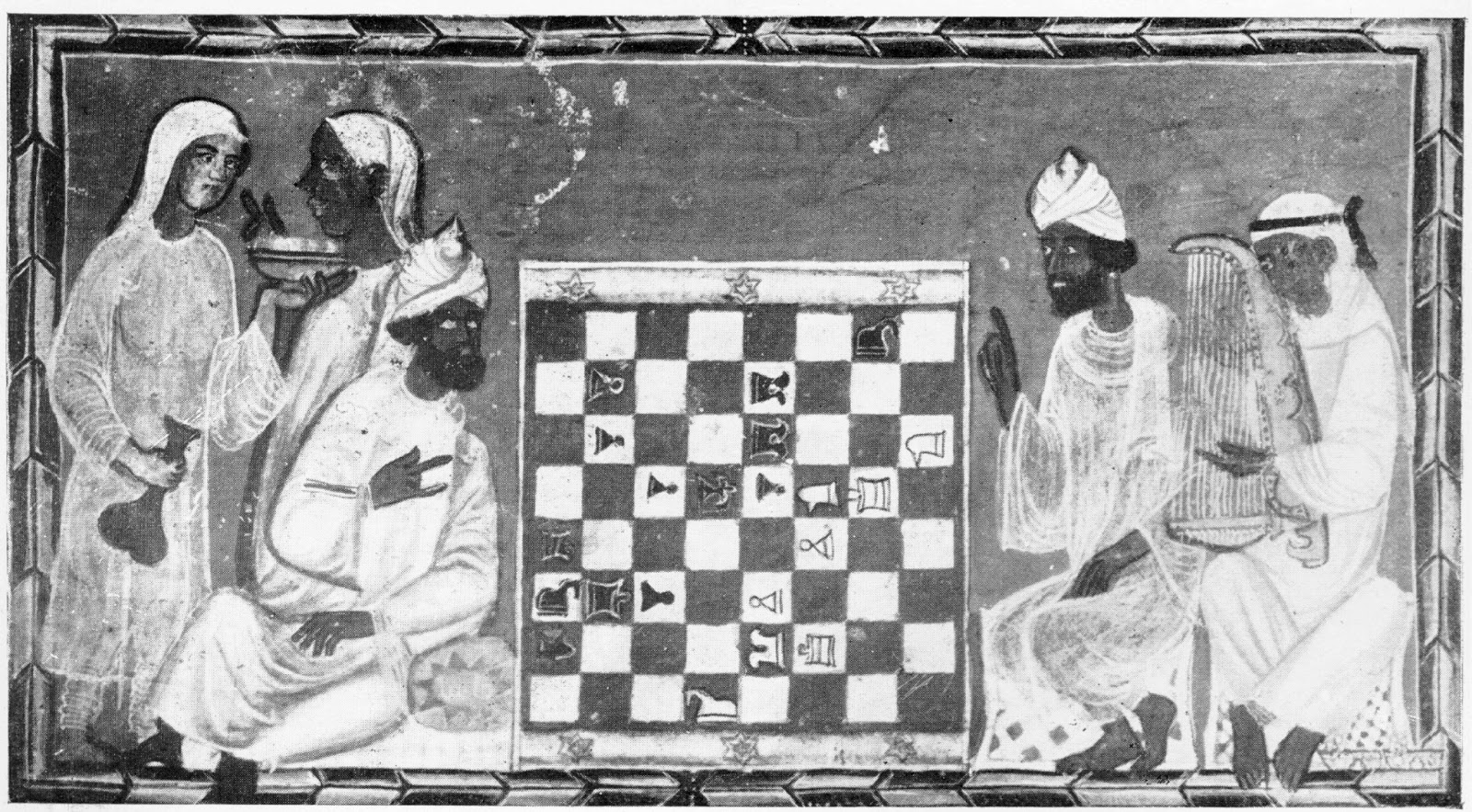 |
| A depiction of a game of chess being played by Moors in Europe. |
DL-"African Presence in the Early History of the British Isles and Scandinavia"
p 223-244
LgC-"The Mystery of the Arctic Twa" – p 245-250
RR- "Ancient and Modern Britain: A Review" – p 251-261
CIH-"Blacks in Pre-Revolutionary Russia"-p 261-276
Class 57 - Africans in the Ancient Mediterranean Isles and Mainland
Mainland Greece
Class Question – What cultural impact did Africa have on the
Mediterranean Isles including Greece?
Readings – APEE
JB-"The African Presence in the Ancient Mediterranean Isles and Mainland Greece"-
P 35-65
MB-"Black Athena-African and Levantine Roots of Greece"-p 66-82
JAW-"The Stolen Legacy: A Review- g 83-89
AGH-"Blacks in Antiquity" – p 90-95
Class 58 - Moors from Pre-History to the Moorish Dynasty in
Al-Andalusia
Class Question – Who are the Moors? Where did the Moors Come
From?
Readings – GAM
DR – "African Heritage/Ethno-History of the Moors," p 93-150
JC – "Moorish Culture-Bringers," p 248-277
Class 59 - Moors in Medieval Europe
Class Question –What impact did the Moors have in Europe?
Readings –GAM
IVS – "The Moor in Africa: Origins and Definitions," p 1-8
IVS – "The Moor in Europe," p 9-26
JEB/RR – "The Moors in Antiquity," p 27-84
JGJ – "Empire of the Moors," p 85-92
Class 60 - Moorish Contributions to European Culture/Civilization
Class Question – "What cultural/national contributions did Moors
Bring to Europe?
Readings – GAM
WC – "The Moor-Light of Europe's Dark Age," p 151-181
ES – "The Moors and Portugal's Global Expansion," p 331-359
Class 61 - Moors in Language Arts-Othello and the Three Musketeers
Class Question – What classical role did Moors play in the arts of Europe/Russia?
Readings
Shakespeare's Othello or any of Alexandre Dumas' classics

RJ – APEE - "African Presence in Shakespearean Drama," p 276-287
World's Great Men of Color, JA Rogers– Alexandre Dumas I, II and III/Chevalier St.
Georges, Joachim Murat/Ira Aldridge
Class 62 - Education in Moorish Al-Andalusia
Class Question – What educational standards did the Moors of North Africa
Institute in Europe?
Readings – GAM
JVPB-"Moorish Spain:Academic Source and Foundation for The Rise and Success of
Western Europeans Universities In The Middle Ages," p 182-247.
Class 63 - Moorish Science
Class Question – What scientific methods did the Moors Contribute to Europe's
"Renaissance"?
Readings – GAM
BL/SZ - "Cairo: Science Academy of the Middle Ages," p 382-395
IVS – "The Egyptian Precursor to Greek and Arab Science," p 396-406
Class 64 - African Faith Systems in Medieval Europe
Class Question – How did African Faith Systems impact Christian And Islamic
Philosophy of Eurasia?
 |
| Pushkin. The father of Russian Literature was of African Decsent. |
ES -"African Popes," p 96-107
MC – "Africans in the Birth and Expansion of Islam," p 360-381
Class 65 - African Women in Moorish Europe
Class Question – What role did African Women play in Europe?
Readings – APEE
ES – "African Women in Europe," p 203-222
DR – "Black Madonnas of Europe: Diffusion of the African Isis," p 108-133
Class 66 - Music of the Moors
Class Question- What is the Moorish Musical Legacy in Europe?
Readings – GAM
YA-Music of the Moors in Spain, p 278-330
World's Great Men of Color, JA Rogers, Beethoven/George Bridgetower
Class 67 – The Crusades – From the 11th Century Until the 14th Century
Class Questions 1)What Happened During the Crusades of the Medieval Era?
***See Kaba Hiawatha Kamene's DVD Catalog Collection on "The Crusades"***
Africans in Early Americas
Class 68 - Africa's Discovery of America
Class Question – What Cultural Impact Did Africa Have On America?
Readings
 |
| A depiction of African and Native Americans trading BEFORE Columbus. |
Course Description
Africans in America will include exploration of concepts in ancient African and American civilizations. Presentations of research on original American settlements and subsequent migration of African people to the Western Hemisphere dating back to the 19th dynasty of ancient Egypt (1300 BCE) and West African visits from the Malian Empire (1300 ACE)
Book List
-Jairazbhoy, R., A., Ancient Egyptians in Middle and South America
, Ancient Egyptians and Chinese in America
, Ramses III, Father of Ancient America
-Joseph, Frank, The Lost Treasure of King Juba
-Ben-Jochannan, Yosef, A., A., Abu Simbel – Gizeh, (Alkebu-Lan Books: NY), 1985.
Bradley, Michael, The Black Discovery of America, (Personal Library: Toronto), 1981
-Carruthers, Jacob, and Karenga, Maulana, Kemet and the African Worldview, (University of Sankore Press: LA), 1986.
-DeLubicz, Schwaller, R., A., The Temple In Man, (Inner Traditions: NY), 1949.
Diop, Cheikh, Anta The African Origin of Civilization: Myth or Reality, , Lawrence Hill and Company: USA, 1974.
-Emmerich, Andre, Art Before Columbus, (Simon and Schuster: NY), 1963.
Ka Re Monges, Miriam Ma'at, Kush: The Jewel of Nubia, African World Press: NJ, 1997.
-Kush, Khamit, Indus, What They Never Taught You In History Class, (Luxor Publications: NY), 1983.
-Jackson, John, G., Introduction to African Civilizations, (Citadel Press: NJ), 1970.
-Van Sertima, Ivan, They Came Before Columbus, (Random House: NY), 1976.
Ch. 6 - "The Black Kings of The 25th Dynasty," p 123-141.
-Van Sertima, Ivan, Egypt, Child of Africa, "The Sixth Napatan Dynasty of Kush,"
Peggy A. Brooks-Bertram, p 149-190.
-Van Sertima, Ivan, African Presence in Early America (Revised),
-Van Sertima, Ivan, Nile Valley Civilization, (Transaction Books: NJ), 1985.
-Van Sertima, Ivan, Black Women In Antiquity, (Transaction Books: NJ), 1985.
-Williams, Chancellor, The Destruction of Black Civilization, (Third World Press: Chicago), 1976.
Von Wuthenau, Alexander, Unexpected Faces in Ancient America, (Crown Publishing: NY), 1975.
-Jairazbhoy, R., A., Ancient Egyptians in Middle and South America
, Ancient Egyptians and Chinese in America
, Ramses III, Father of Ancient America
-Joseph, Frank, The Lost Treasure of King Juba: The Evidence of Africans in America Before Columbus, (Bear & Company: Rochester, Vermont), 2003.
Unearthing Ancient America, (New Page Books: NJ), 2009.
Magazines
 |
| A massive Olmec head found in Mexico PREDATING Columbus. |
2)National Geographic, "Great Stone Faces of the Mexican Jungle," Vol. 78, September 1940, p 309-334.
Class 69 - Introduction/Overview/Primary Sources
Class Question – What Role Did Africans Play In The Development of the American
Hemisphere?
Readings
They Came Before Columbus, Van Sertima – Intro-xiii-xv
Author's Note – xvi-xviii
African Presence – Intro – p 5-27
Dawn Voyager – Intro – v-x, Forward-xi-xvii
Class 70 - The Original Americans
Readings
African Presence – Ch. 10 –"Men Out Of Asia," Reassessment of the Gladwin Theory,"
P 215-230
Ch. 11 – "The First Americans," Legrand Clegg, p 231-240.
Class 71 - Geography of Africa and America
Class Question – What Geographical Factors Played a Role In The Peopling Of The
American Hemisphere?
Readings
African Presence – Ch. 5 – "African Sea Kings in America, Evidence from Early Maps,"
Joan Covey, p 118-135.
Dawn Voyager, "Matter of Boats,"p 112-119,
"Black Ships of the Bronze Age," p 120-133.
Class 72 - History of the 25th Dynasty of Ancient Kemet (Egypt)
Class Question – What is the History of the 25th Dynasty of Kemet (Egypt)?
Readings
They Came Before Columbus, IVS, Ch. 6 - "The Black Kings of The 25th Dynasty,"
P 123-141.
Egypt, Child of Africa, IVS, "The Sixth Napatan Dynasty of Kush,"
Peggy A. Brooks-Bertram, p 149-190.
Class 73 - African Presence in Ancient America,Part 1-The Olmec
Nation
Class Question – What evidence exists that the 25th Dynasty Came to America?
Reading
They Came Before Columbus, IVS, Ch. 7 – Black Africa/Egypt, p 100-122.
Ch. 9 – African Egyptian Presence in Ancient
America, p 142-179
Class 74 - African Presence in Ancient America, Part 2
Physical Evidence
Class Question – What is the Physical Evidence of the Presence of Africans in
America?
Readings
Unexpected Faces in Pre-Columbian America, Alexander Von Wuthenau, p 82-101.
The African Presence in Ancient America, "Evidence from Physical Anthropology,"
Keith Jordan, p 102-117.
Class 75 - The Moors of North/North West Africa
Class Question – What is the History of Africa From 710-1492 ACE?
Readings
Golden Age of the Moor, JGJ – "Empire of the Moors," p 85-92
Class 76 - African Presence in Medieval America, ACE, Part 1
Class Question – What Role Did West Africa Play in the American Hemisphere?
Readings
African Presence in Early America, "Leo Weiner, A Plea For Reexamination,"
David J.M.Muffet, p 155-163.
" A 1920 Review from the Journal
Of Negro History," Leo Weiner, p 164-168
"Mandingo Voyages across the Atlantic," Harold
Lawrence, (Kofi Wangara), 169-214.
-Joseph, Frank, The Lost Treasure of King Juba: The Evidence of Africans in America Before Columbus, (Bear & Company: Rochester, Vermont), 2003.
Unearthing Ancient America, (New Page Books: NJ), 2009.
Class 77 - African Presence in Medieval America, AD, Part 2
Class Question – How, Why and When Did West Africans Come to the America?
Readings
They Came Before Columbus, Ivan Van Sertima,
Ch. 1 – The Secret Route from Guinea, p 1-18,
Ch. 2 – the Visible Witnesses, p 19-36,
Ch. 3 – The Mariner Prince of Mali, p 38-49,
Ch. 4 – Africans Across the Sea, p 50-70.
Class 78 - African Presence in Medieval America, AD, Part 3
Class Question – What is the Physical Evidence of West Africans in America?
Readings
 |
| African Braids on an Olmec head in Mexico. |
Ch. 5 – Among The Quetzalcoatl, p 71-89,
Ch. 6 – Mandingo Traders in Medieval Mexico, p 90-107,
Dawn Voyager, Michael Bradley,
Ch. 1 – Primitive Myths of a Savage People, p 1-18,
Ch. 2 – The Niger and the Nile, p 19-38,
Ch. 3 – The Puzzle of Diffusion, p 39-48.
Class 79 - African Presence in Early America, Selected Topic #1
Africans and Asians in Early America,
Class Question – What is the Connection Among Africans, Asians and Indigenous
Americans?
Readings
African Presence in Early America, ed., Ivan Van Sertima
– "Trait-Influences in Meso-America: The African-Asian
Connection," Wayne B. Chandler, p 241-308.
-Jairazbhoy, R., A., Ancient Egyptians in Middle and South America
, Ancient Egyptians and Chinese in America
, Ramses III, Father of Ancient America
Class 80 - African Presence in Early America, Selected Topic #2
The Botany Connection
Class Question – What Botanical Evidence exists that Connects Africa with
America?
Readings
They Came Before Columbus, Ivan Van Sertima, "Plants and Transplants," p 180-208. Dawn Voyager, "Evidence of Botany," p 134-139.
Class 81 - African Presence in Early America, Selected Topic #3
The Pyramids of Africa and America
Class Question – What are the Similarities and Differences Between the Pyramids of
Africa and America?
Readings
Blacks in Science: Ancient and Modern, Journal of African Civilizations, ed., Ivan Van Sertima, "The Pyramids: Ancient Showcase of Ancient Science and Technology,"
p 136-154.
African Presence in Early America, ed. Ivan Van Sertima, Pyramids American and African: A Comparison," Beatrice Lumpkin, p 136-154.
Native Roots, Jack Weatherford, Ch. 2 - "Pyramids Along The Mississippi,"
Class 82 - African Presence in Early America, Selected Topic #4
Cultural Parallels
Class Question – What Are Some of the Cultural Similarities and Differences
Between Africa and America?
Readings
They Came Before Columbus, Ivan Van Sertima,
Ch. 11 – Smoking, Tobacco and Pipes in Africa and America, p 209-231.
Ch. 12 – The Mystery of Mu-lan-pi, p 232-260.
Postscripts on Other Finds, p 261-272.
Dawn Voyager, Michael Bradley,
Ch. 9 – Possible Cultural Parallels, p 140-155,
Ch. 10 – White Gods and Lost Cities, p 156-175,
Ch. 11 – The Shared Adventure, p 176-183.
Class 83 -Southern Africa
Class Question – What Are The Cultural Contributions Made By
Africans In Southern Africa?
Readings
When We Ruled – RW
Ch. 17 – "Southern Africa" – P 513-540
Star of Deep Beginnings – Charles Finch
Ch. 7, 8, Afterword and Special Section – P 235-281
Class 84 -Central Africa
Class Question - What Are The Cultural Contributions Made By Africans In
Central Africa?
Readings
When We Ruled - RW
Ch. 14 – "The Central Sahara
Class 85 - Kongolese Cosmology – Part 1
Class Question – How Does The Kongolese Cosmology Reflect the Earliest
Thinking of The Human Family?
Readings
African Cosmology, Dr. Fu-Kiau,
About Dr. Fu-Kiau, P 158-159
Introduction, Ch. 1 – P 9-44 Insert Ch. 4 (127-150) at the top of P 29 of Ch. 1
Class 86 – Kongolese Cosmology – Part 2
Class Question – What Does The "V" Represent In Kongolese Cosmology?
Readings
African Cosmology, Dr. Fu-Kiau
Ch. 3 – P 55
Ch. 2 – P 45-54
Class 87 – How did We Get Here? and Where Do We Go From Here?
Class Question – What Is The Past Road That Created The Present Road That Will
Lead Us To The Future Road?
Readings
When We Ruled - RW
Ch. 2 – "Survey of the Documents" – P 46-72
Ch. 18 – "The Fall of Africa and the Resistance" – P 541-577
Ch. 22 – "Afterword: Where From Here? – P 645-671
"Forty (40) Seasons"
The Per Ankh Academy
An Idea Who's Time Has Come
The following list of classes outline the first (1st) Ten Cycles of the
Per Ankh Academy's Curriculum Plan.
Cycle 1 – BEFORE THE BEGINNING BEGAN
Season 1 – 1.1
Theme - "A Kemetic Theory On The Origin Of The Cosmic Universe"
Focus Question(s) – What did the ancient Kemites (Egyptians) envision existing before the Cosmic?
Universe began? What began the Cosmic Universe at that first moment of existence?
What kept (keeps) this Cosmic Universe becoming?
Season 2 – 1.2
Theme – "The Dogon People Of Mali, North West Africa"
Focus Question(s) – What educational system did the Dogon people of Mali develop that would allow them to create an astronomical system around the Sirius star system?
Season 3 – 1.3
Theme – "The Impact Of The Moors Of North Africa On World History"
Focus Question(s) – What role did the Moors of North Africa play in the development of modern?
Civilization?
Season 4 – 1.4
Theme – "The Special Relationship Among the Sun, Plants, animals and Humans"
Focus Question – What happens to plants, animals and humans when exposed to sunlight?
Forty Seasons, cont'd, P 2
Cycle 2 – COSMIC BEGINNINGS
Season 5 – 2.5
Theme – "A Kemetic Theory On The Origin Of The Cosmic Universe"
Focus Question(s) – After the Process of Becoming began, how did galactic, stellar and planetary systems continue becoming?
Season 6 – 2.6
Theme – "The Scientific Wisdom Contained Within The Aten Text"
Focus Question(s) – What role did the sun play in the lives of 18th Dynasty (1570-1320 BCE) Kemites…particularly during the reign of Pharaoh Akhenaten (1379-1364 BCE)
Season 7 – 2.7
Theme – "Earth Science As It Applies To The Shabaka Text"
Focus Question(s) – How does the philosophy contained within the ancient Shabaka text pertain to current geological theorems?
Season 8 – 2.8
Theme – "Biological Khem-Mystery (Chemistry) And Organic History On Geb (Earth)"
Focus Question(s) – What impact does carbon have on the development of Organic Life and how is it described in the Shabaka Text (Ausarian Drama)?
Cycle 3 – ATUMIC CONSCIOUSNESS
Season 9 – 3.9
Theme – "Ma'at: The Feathered Wombedman…Balance in the Cosmic Universe"
Focus Question(s) – How was Justice, Balance, Truth and Righteousness portrayed and practiced in Ancient Kemet (Egypt)?
Season 10 – 3.10
Theme – "The Bejeweled Brain and the Sacred Science written on King Tutankhamen's Sarcophagus
Focus Question(s) – What three (3) major parts of the brain were identified by ancient Kemites (Egyptians) to be responsible for mental and spiritual ascension?
Season 11 – 3.11
Theme – "Psychological and Functional Consciousness"
Focus Question(s) – What are the mental boundaries of Created Consciousness?
Forty Seasons, cont'd, P 3
Cycle 4 – STAR BEGINNINGS
Season 12 – 3.12
Theme – "The Stages of Intellectual Growth and the Grades of Consciousness"
Focus Question(s) – Where can today's theories pertaining to Intellectual Consciousness be found among the Kemites (Egyptians) of Kemet (Egypt) and Dogon of Mali, Northwest Africa?
Season 13 – 4.13
Theme – "The Dogon People of Mali, Northwest Africa…A Socially Scientific View"
Focus Question(s) – Who are the Dogon? What is their social structure? Where did they come from? How do they function? What role does agriculture and astronomy play in their daily lives?
Season 14 – 4.14
Theme – "The Dogon People of Mali, Northwest Africa…A Scientifically Scientific View"
Focus Question(s) – What astronomical wisdom did the Dogon people possess that advanced the theories originally generated in ancient Kemet?
Season 15 – 4.15
Theme – "Ra Light…Ra Bright – The Scientific Wisdom developed through African philosophy"
Focus Question(s) – What are stars? How did/do stars form? Do stars die? How did these stars create planets and why did life come to be on the earth?
Season 16 – 4.16
Theme – "An African-Centered Theory Utilizing an Ancient Kenyan/Ethiopian Cemetery named, Namoratunga that Offers Possible Reasons Why the Pyramids Would Later be Built"
Focus Question(s) – What was/is the importance of the Serpent In The Sky, and funeral ceremonies among the Konso people of Central East Africa?
Forty Seasons, cont'd, P 4
Cycle 5 – DARK MATTERS
Season 17 – 5.17
Theme - "Dark Matters In The Cosmos"
Focus Question(s) – What role does " KMWR" (KMWR) (Melanin) play in the Cosmic Universe?
Season 18 – 5.18
Theme – "Black Holes (Black Entrance Points) In The Cosmic Womb"
Focus Question(s) – Where do Black Holes Come From and Lead To, in the Cosmic Universe?
Season 19 – 5.19
Theme – "Carbon: Its Transmutation into Melanin ant its Physical and Mental Properties"
Focus Question(s) – What are the Physical and Mental Properties of Carbon? How does Carbon become Melanin? What impact DOES KMWR ( KMWR) (Melanin) on Living Systems within Human Beings? What are the Ventricular System, Cerebral Spinal Fluid and the Dew of Life? What is the Vault of Initiation? Where is this Vault located?
Season 20 – 5.20
Theme – "Carbon: Its Transmutation into Melanin and its Mental and Spiritual Properties"
Focus Question(s) – What happens to the Eternal Human Spirit when its Mental Thoughts transmute the Physical Body?
Cycle 6 – THE SACRED SCIENCES
Season 21 – 6.21
Theme – " Grand Unified Theorem- The Unification of the Universe as formulated in the Shabaka Stone"
Focus Question(s) – How are today's theories and theorems related to the Shabaka Stone?
Season 22 – 6.22
Theme – "The Spiritual Sciences"
Focus Question(s) – What subjects, topics and disciplines comprise the Spiritual Sciences (Communication Arts)
Forty Seasons, cont'd. P 5
Season 23 – 6.23
Theme – "Africa's Philosophical Foundation in World Religions"
Focus Question(s) – What impact did Africa's Philosophy on Spirit, Soul, Mind and Body have on the development of the World's Major Religions?
Season 24 – 6.24
Theme – "Ritual and Ceremony as the Outward Performance of what is happening Inwardly…Experience Demonstrating Inspirience"
Focus Question(s) – What happens to the Eternal Human Spirit when it's Mental Thoughts Transmute the Physical Body and Vibrate the Soul?
Cycle 7 – HUMAN BEGINNINGS
Season 25 – 7.25
Theme – "The Life History of the Human Family in Africa"
Focus Question(s) – How did the Human Family come into being for the first time (Khepera Sep Tepy) and continue this Process of Becoming?
Season 26 – 7.26
Theme – "The Life History of the Hapi (Nile) Valley"
Focus Question(s) – After Birth and During Growth, How, When and Where did Humanity's 1st Families travel along and populate the Hapi Valley?
Season 27 – 7.27
Theme – "The Life History of Eurasia, Part 1"
Focus Question(s) – What role did Africa play in peopling Eastern Eurasia?
Season 28 – 7.28
Theme – "The Life History of Eurasia, Part 2"
Focus Question(s) – What role did Africa play in peopling Western Eurasia?
Forty Seasons, cont'd, P 6
Cycle 8 – ANCIENT CIVILIZATION
Season 29 – 8.28

Theme – "Pre-Dynastic Kemet (Egypt) and Northeastern Alkebulan – Wonderful Ethiopians and Their Early Cushite Empires up until the time of Qustal, Nubia (Sudan)"
Focus Question(s) – How did Northeastern Africa develop ancient civilization(s) prior to the 1st Dynasty of ancient Kemet (Egypt)?
Season 30 – 8.30
Theme – "The Old Kingdom-Astronomical/Agricultural Technology and the Birth of Mirs (Pyramids)"
Focus Question(s) – What Astronomical and Agricultural needs arose during the Old Kingdom that would bring about the Age of the Mirs (Pyramids) in Kemet?
Season 31 – 8.31
Theme – "The Nubian Origin of the Middle and New Kingdoms of Kemet (Egypt)"
Focus Question – What Inner African influences and events ushered in the Middle and New Kingdoms?
Season 32 – 8.32
Theme – "The Nubian Origins of the Napatan Kingdom"
Focus Question(s) – What World Events occurred that brought the Napatan (25th) Dynasty into existence and what influence did this Nubian (Sudanese) Family have on World History
Cycle 9 – GEOGRAPHY-ANCIENT WORLD
Season 33 – 9.33
Theme – "Compass Rose, Grid Lines and Coordinates as they relate to the Ancient World"
Focus Question(s) – How, When, Why and Where did African Explorers travel during recorded ancient times?
Season 34 – 9.34
Theme – "World Wind Systems and Ocean Currents"
Focus Question(s) – How did knowledge of Compass Rose and Grid Lines and Coordinates in conjunction with Wind Systems and Ocean Currents assist early African explorers in traveling around the world during the past 6,000 years?
Forty Seasons, cont'd, P 7
Season 35 – 9.35
Theme – "Boat Building, Trade and Commerce in Africa"
Focus Question(s) – What would lead African people to travel to various parts of the world and trade/share their creations with the world community? What role did nature play in this fellowship?
Season 36 – 9.36
Theme – " Sacred Space-Sacred Ground…As Above-So Below"
Focus Question(s) – Revisiting Namoratunga…How did Geography and Astronomy help ancient Africans traverse the heavens and the earth?
Cycle 10 – ANCIENT AMERICA
Season 37 – 10.37
Theme – "The Original Peoples of the American Continent"
Focus Question(s) – Who were the first waves of people who inhabited the American Continent?
Season 38 – 10.38
Theme – "The Importance of the Mississippi River and the Development of Ancient American Civilization"
Focus Question(s) – What role did the Mississippi River play in the creation of Indigenous American civilizations?
Season 39 – 10.39
Theme – "The Olmec Civilization of Ancient America"
Focus Question(s) – Who were the people of the Olmec Nation of Middle America and what are they responsible for creating?
Season 40 – 10-40
Theme – "The Technology (Mirs/Pyramids, Temples and Tombs) of Ancient America"
Focus Question(s) – What technological advancements impacted the peoples of ancient America?
Kaba Hiawatha Kamene (Aka-Booker T. Coleman, Jr.)
Teacher, Consultant,
Professional and Curriculum Developer
120-Elgar Place, Apt 33D
Bronx, N.Y. 10475
Ph. # (646.457.0558)
E-mail-Kamene 777@aol.com
Facebook...Kaba Kamene
Curriculum Catalog
Prices listed are for individual purchases.
To purchase wholesale, 20 copies of ONE Title is required. Wholesale Price is $7.50
A Kemetic Theory On The Origin Of The Cosmic Universe
The Memphite Text Rewritten On The Shabaka Stone
1) Introduction - $15.00
a) Cosmic Calendar
b) Primate of the EsSenses
c) Shabaka Stone – Introduction
2) Ptah's Role in the Coming Into Being For the First Time -$15.00
3) The EsSenses of Pre-Existing Order and Arrangement -$15.00
4) A Conversation Between Dr. Gabriel Oyibo and Kaba Hiawatha Kamene
(aka-Booker T. Coleman, Jr.) – The Grand Unified Theory and the Shabaka
Stone - $15.00
5) A Four Part Series Presented at the Black Gold Sacred Kultural Healing Center,
Harlem, N.Y. - $40.00
a) Shabaka Stone – Geographical and Historical Overview
b) The Primate of the EsSenses
c) The EsSenses of Pre-Existing Order and Arrangement
d) EsSenses of Order and Arrangement
Catalog, cont'd, p 2
6) Live in London - A Tour of the British Museum
The Rosetta Stone and the Shabaka Stone - $15.00
7) A Kemetic Theory on the Origin of the Cosmic Universe –
Live in Houston, Texas - $15.00
The Dogon Nation of Mali – Geography/History/Science/Astronomy
1) Live in London – The Dogon of Mali and Similarities With the Shabaka Stone –
$15.00
2) The Dogon People of Northwest Africa – Geography and History - $15.00
3) The Philosophy of the Dogon People of Mali - $15.00
4) A Two Part Series Presented at Nubian Heritage - $20.00
a) The Dogon of Mali
-Geography
-History
b) The Dogon of Mali
-Overview
-Higher Order Thinking Skills
Moors (Africans) in Europe
1) Two (2) Workshops on One (1) DVD - $15.00
a) The Moors in Medieval Europe – Geography and History
b) Moorish Music
2) A Three (3) Part Series on The Crusades - $30.00
a) An Overview - Nov 2000
b) Geography and History – Jan 2001
c) World Impact – March 2001
3) A Three (3) Part Series on Sex and Race written by Joel Augustus (JA) Rogers
$30.00
a) Sex and Race – Geography and History of the Moors in Europe – August 2001
b) Sex and Race – Moorish Philosophy – September 2001
c) Sex and Race – Prominent Africans in Europe – May 2001
Catalog, cont'd, p 3
Spirituality
1) Spirituality – Sacred Science - $15.00
2) A Three (3) Part Series - $30.00
a) An Overview
b) The 42 Laws of Ma'at
c) Spiritual Philosophy
3) A Three (3) Part Series -$30.00
a) The Seven-Fold (Septenuary) Soul – Part 1
b) -The Seven-Fold Soul – Part 2
-Ipet at Waset (Grand Lodge of Luxor) – Part 1
c) Ipet at Waset – Part 2
Black Holes – Cosmic and Earthly Wombs
1) Hidden Wisdom of the Black Hole – Ancient Science and Mathematics Deep Within
The African Wombedman's Womb - $15.00
2) 4 DVD Set – Black Holes and African Wombs - $40.00
Catalog, cont'd, p 4
Melanin
1) 2 DVD Set – TV Interview – "Melanin Chronicles" - $20.00
a) The Physical and Mental Aspects of Melanin
b) The Mental and Spiritual Aspects of Melanin
2) How to Teach Melanin in the Classroom – Live at the Family Life Center
$15.00
What is Melanin Series?
3) Melanin – Introduction and Overview - $15.00
4) Melanin – The Sun, 7-Dehydrocholestrol and Vitamin D - $15.00
5) Melanin – Cosmic and Solar Melanin - $15.00
6) Melanin – Crossover Workshop – Sun to Plant Photosynthesis - $15.00
7) Melanin – Crossover Workshop – Plant Photosynthesis to Skin Photosynthesis
$15.00
8) Melanin – Essential Notions of Black Skin - $15.00
9) Melanin – The Melanin Molecule – Carbon, Tyrosinase, Melanosome and
Melanocyte - $15.00
10) Melanin – Skin, the Brain and the Central Nervous System - $15.00
11) Melanin – The Brain and Spirituality - $15.00
12) Melanin – A 2 Disc - 4 Part Series on Neuromelanin - $40.00
13) Melanin – The Sensory and Endocrine System - $15.00
14) Melanin – A Question of Color – Ethnic Notions - $15.00
15) Melanin – Rap Up ...Live…Listening and Speaking to African Echoes
$15.00
16) Melanin – 2 DVD Set – Live in Toronto, Canada - $20.00
Spirituality is Unseen Science…Science is Seen Spirituality
The Aten Text – Solar Science
1) The Aten Text – Introduction – Live at City College of New York - $15.00
2) 2 DVD Set - Aten Text and Photovoltaics - $20.00
3) 4 DVD Set – Sacred Science of the Sun Tape 1-4 - $40.00
Catalog, cont'd P 5
Kush – Northern Kenya, Somalia, Djibouti, Eritrea, Ethiopia, Sudan and Egypt
1) Kush and Kemet - $15.00
2) Ethiopia – Droppin' the Science - $15.00
3) Ancient Africans Explore the World - $15.00
4) Qustal – Nubian Home of the 1st Dynasty of Ancient Kemet (Egypt) - $15.00
5) Teaching the Pyramids to High School Students - $15.00
6) The 18th and 25th Dynasties of Ancient Kemet (Egypt) - $15.00
7) King Tutankhamen's Tomb, Consciousness and Cosmic Wisdom - $15.00
Education
1) Professor William Leo Hansberry – Early Pioneer in the African Studies Program
Live at African Echoes - $15.00
2) Professor William Leo Hansberry – Life at Howard University in the 1923-1959
Live at City College of New York - $15.00
3) Education at the Crossroads – Live at the University of Minnesota - $15.00
4) A Moorish Curriculum – Listening and Speaking to Afrikan Echoes - $15.00
5) Professional Development – A Curriculum of Correction – Live at City College
Of New York - $15.00
6) Cosmic Astronomy – Live at the Chocolate Factory - $15.00
7) Tribute to a Master Teacher – Professor John Henrik Clarke – "Teaching In A Circle"
$15.00
8) African Centered Education – Live in the House of Consciousness - $15.00
9) Educating our Youth Enraptured in the Red, Black and Green - $15.00
10) Melanin Chronicles – TV Interview – Education and Science - $15.00
11) Melanin Chronicles – TV Interview – Educating Our African Youth - $15.00
12) Origin of the Human Family in Africa - $15.00
13) The Geography of Human Origins and Migrations - $15.00
14) The Movement of Africans into EurAsia - $15.00
15) Diploma Plus High School – Live in Indianapolis - $15.00
16) Education For Empowerment – Live in Columbus, Ohio - $40.00
Two (2) Part Series - (2 DVDs per part)
Catalog, cont'd, P 6
Body and House Oil - An Aroma To Live WithIn
"Hapi In Kush/Gold In Brown" – Body/House Oil
$5.00 per Bottle
Ordering Information
Please include 15% for Shipping. Asante Sana (Thank You)
Please send Postal Money Orders in the United States
Please send Money Transfer Orders outside of the United States
Please Make Money Orders/Money Transfers out to
Kaba Hiawatha Kamene
120 Elgar Place, Apt 33D
Bronx, NY 10475
For Workshop Engagements – As of January 1, 2013
-New York City - $1,000.00 Honorarium per day
-Outside New York City within New York State - Transportation (Lodging, if more than 1 day)
plus $1,000.00 Honorarium per day
-Outside New York State – Air Fare + Transportation Expenses –
By Air - $150.00
By car - $200.00 Travel Expenses,
Lodging
plus $1,000.00 Honorarium per day
-Outside the United States – Air Transportation + $200.00 Travel Expenses, Lodging plus $1,000.00 Honorarium per day


