Monday, July 11, 2011

Rethinking Malcolm: What was Marable thinking?
by Abdul Alkalimat
 

July 8, 2011-sfbayview.com
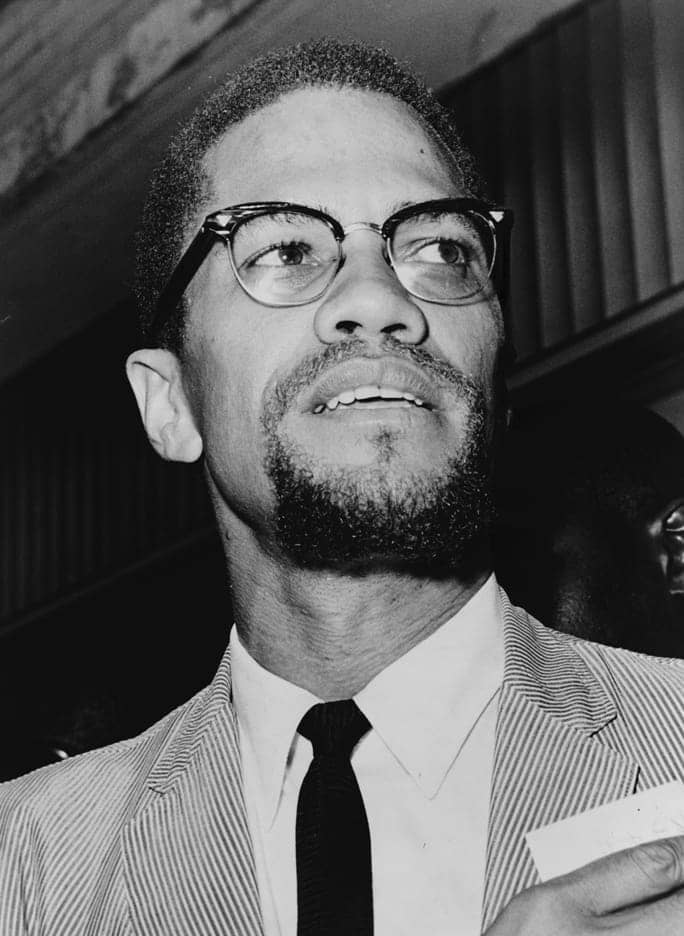

Malcolm X at Queens Court 1964 - Photo: Herman Hiller
The new book by Manning Marable, “Malcolm X: A Life of Reinvention,” will help us to get a deeper understanding of Malcolm X and the times we’re living in now. This will not be a direct result of what Marable has done, but rather of what needs to happen now because of what he has done.1 We can advance our thinking through deep and thorough criticism of this book. We are facing a challenge to our perspective, philosophy and politics for Black liberation. We respect Manning Marable and ourselves by taking him seriously and raising our critique to the highest level. Many will oppose and even resent this review, but I write for the brothers and sisters who will dare to struggle to take the hardcore stance we need for victory.

First came the book, days after Marable’s death, then an avalanche of praise and polemic vaulting Marable into the esteemed ranks of ruling class darling public intellectuals. I collected and sent, to the H-Afro-Am list, nearly 100 reviews and commentaries on this Marable book. They range from “magnificent,” “magisterial” and “a magnum opus of a life’s work based on 20 years of research,” to “sloppy,” “unprofessional” and “speculative based on logical fallacy.” Why such extremely opposite views of this book?

Of course we have been here before with books trying to redefine major historical figures under the pretext of making them more human. This is usually done with innuendo, hearsay and gossip supported by state surveillance reports, all amounting to nothing that can be supported with responsibly sourced data or withstand academic peer review.

The main trend uniting these books is their focus on redirecting the force of revolutionary nationalism towards social democracy reform of a kind that finds its home in the capitalist Democratic Party or towards the figure’s personal or sexual identity, being as influential as political identity. Such work has been written about, among others, Nat Turner (Styron 1976), Paul Robeson (Duberman 1989), Martin Luther King (Garrow 1987, Dyson 2000) and Malcolm X (Perry 1991, Lee 1992). As a generational deviation, this trend is exposed in the 2008 book, “Betrayal,” by Houston Baker. Marable’s book somewhat differs from this trend but nevertheless fits the genre.

It is necessary to critique this book for at least three reasons. First: Marable speaks from within the movement with the legitimacy of being a Black studies professor at an ivy-league school. This reverses the “street cred” marshaled by Spike Lee for his 1992 film, “Malcolm X.” Many have learned from Marable and, given his recent death, are not open to deep and revealing criticism. But this does not serve our movement. Silence never trumps critique. As on Malcolm, so on Marable on Malcolm.

Second: The rulers are making the Marable argument their own, as are the reigning Black public intellectuals, namely Henry Louis Gates, Mike Dyson, Cornel West, Peniel Joseph, Nell Painter etc. It is unprecedented for a book on a leading revolutionary nationalist to be positively reviewed in the main English language capitalist media, i.e., the New York Times, Washington Post, Wall Street Journal, Guardian (UK), Financial Times (UK) and so on. Reviews are in all the major European languages as well. They hyped the book into the New York Times hardback non-fiction bestseller list for five weeks: April 24 at number three on the list, May 1 at six, May 8 at 13, May 15 at 16 and May 22 at 34.

But third and most important of all is the fact that the issues arising from the book are fundamental and may influence both what and how we think. This is my main concern. Elijah Muhammad wrote several books on “How to Eat to Live.” Now we need to focus on how to think to live! And by live, I mean to affirm our radical Black tradition, to critique and resist all forms of oppression and exploitation and to chart a path of social justice toward social transformation.

We need to consider perspective, philosophy and politics in critiquing “Malcolm X: A Life of Reinvention.” Our concern is to probe past the specific inaccuracies, innuendos and judgmental conclusions to get at the basics of how to think to live.

Perspective 

First, the question of perspective: Whose eyes do we use to see? Whom do we intend to hear us? One of the great paradigm shifts of Black studies is to reclaim and reorient the relationship between Black intellectuals and their community. We began to speak to and with each other without necessarily seeking the approval of white authority. We sought peer review from each other and the brothers and sisters off campus. We wanted to understand each other, map our agreements and disagreements, find the intertextuality of our traditions – meaning Black liberation theology, womanism, nationalism, pan-Africanism and socialism – and base our understandings on the dogmas and debates within these traditions.

Marable, at page 492 of “Malcolm X: A Life of Reinvention,” says this of his collaboration with his Viking editor: “Kevin and I communicated almost daily, discussing various versions of chapters, in the effort to build a narrative to reach the broadest possible audience.”

This explains why he regards the Organization of African American Unity (OAAU) as “controversial,” page 2, and not merely what it was: An attempt to bring the united front strategy of the Organization of African Unity to the Black liberation movement. Who considered it controversial? He refers to alleged “anti-semitic slurs,” page 246, without putting this in the context of a necessary struggle against Zionism and the relative power of Blacks and Jews in New York City.

He regards the surveillance of the state as legitimate rather than as flawed in its spreading of disinformation to discredit and disorient. No serious Black liberation perspective would allow this.

On the one hand, Marable contributes interesting summations of Harlem, page 51-64, and Islam, page 79-86, but he is noteworthy for not engaging any of the major writers who have done serious research which has resulted in viewpoints different from his own. A good example of this is Bill Sales’ work on the OAAU, listed in the bibliography but not engaged in the text.

Nor does Marable engage the primary references used by Sales, notably the main state surveillance of the OAAU. And the same goes for James Cone and his definitive comparison of Malcolm X and Martin Luther King. Both Sales and Cone were members of the Malcolm X Work Group, a collective of intellectual activists working collaboratively on research about Malcolm X and holding important symposia in 1987, 1988 and 1989.
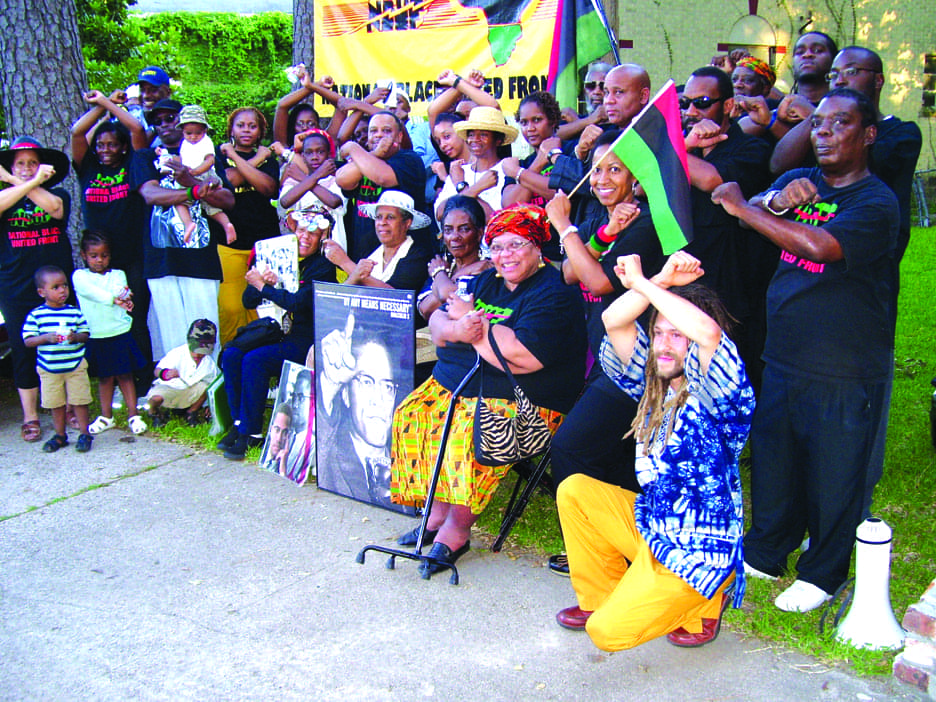
Malcolm X Day, Houston.
Perhaps the most cold-blooded negation is his statement that Malcolm has to be resurrected for Black people where, most certainly, he should have said white people. Black people have never forgotten Malcolm X and certainly the state and white intellectuals haven’t either. He was more of an icon in the Black radical tradition than even Martin Luther King Jr. The primary reference for this can be found in the website BrotherMalcolm.net, where there are lists of schools, parks, cultural events, academic lectures and many other things named after Malcolm in communities all over the world. Included are the proceedings of the historic international conference on Malcolm X, “Radical Tradition and Legacy of Struggle,” 1990.  

Perhaps the most egregious omission in this regard is the failure to mention Preston Wilcox. Not only had Preston been a professor at Columbia University, but he was the founder of the Malcolm X Lovers Network. As a community-based archivist, for decades he sent out mailings of the news clippings and ephemera he collected at the community level, flyers of events, petitions, documentation of naming ceremonies, debates, lectures, conferences etc. He was a long time resident of Harlem and left his papers to the Schomberg Center. To ignore Preston Wilcox is to show no respect for the Black community or its community-based intellectuals who have always kept the memory of Malcolm alive.

The perspective of Marable’s book is not from the Black studies approach of respecting our own tradition. Instead, it gives credence to such as the Bruce Perry book on Malcolm, 1991, which was written as a police agent’s attack, filled with lies and innuendo. What was Marable thinking? Or not thinking?

Perhaps the most cold-blooded negation is his statement that Malcolm has to be resurrected for Black people where, most certainly, he should have said white people. Black people have never forgotten Malcolm X

Philosophy 

Now let us take up issues of philosophy. Here, I want to focus on two questions: What is real and how does reality change? In other words, this is an investigation as to whether Marable uses a dialectical materialist philosophy in this book. How was Marable thinking?

First, what is dialectical materialism? Materialism is a philosophical position that affirms the existence of the material world outside of and independent of our consciousness and hence we must be in the world and engage it in order to come to any understanding of it. This means that when you want to speak about the world, you have to provide material evidence so that others can evaluate whether and how your words correspond with material reality.

Dialectics is about the nature of reality, that everything is in motion and that this motion reflects the conflicting tensions between contradictions. Most things have many contradictions, but in general there is always a principle contradiction that dominates the identity of that reality. External contradictions are the conditions for change but internal contradictions are the basis for change.

So to understand something, we have to include both the external and the internal contradictions as part of our analysis. This is a philosophical approach that is essential for understanding the complexity of the world, human society and of course important historical figures.

In sum, we can say that philosophy is not – and should not be portrayed as – a mystery but something that all of us can master. This is clearly a different approach to philosophy than the archaic approaches usually associated to philosophy as an academic discipline. For our purposes here, there are two fundamental philosophical questions:

1. How do we know something? This gets at our grasp of material reality. We all think we know some things, so how do we know what we think we know?
2. And so what? How does our understanding capture the nature of reality such that we understand the motion of how things change and how change comes about?
In this regard, Marable sets a high standard for this book:
“My primary purpose in this book is to go beyond the legend: to recount what actually occurred in Malcolm’s life. I also present the facts that Malcolm himself could not know, such as the extent of illegal FBI and New York Police Department surveillance, acts of disruption against him, the truth about those among his supporters who betrayed him politically and personally and the identification of those responsible for Malcolm’s assassination,” page 12.
First, when you apply the revolutionary mandate, “no investigation, no right to speak,” the book comes up short for a lack of evidence. Why not provide the source and let the reader be the judge? Here are some examples of statements with no evidence presented in the 63 pages of footnotes:

1. Page 12 – “55-year-old audio tapes” are cited as having been reviewed by Marable but no additional information is given such as the number of tapes, dates etc. Good scholarship requires documentation of evidence so it can be checked by others.

2. Page 22 – “Amy Jacques Garvey … may have been involved in Eason’s assassination,” a statement based on the conjecture in a secondary source.

3. Page 36 – “He may have also believed that his mother’s love affair [was] a betrayal of his father.” Here, Marable is practicing psychoanalysis without any data to back this conclusion.

4. Page 123 – He states of the Nation of Islam (NOI) membership: “Until 1961, it would expand more than tenfold, to 75,000 members.” Again, no source, so why should we consider this as fact?

5. Page 137 – “James Warden … son of a labor organizer who may once have been a member of the Communist Party.” He interviewed Warden on three occasions, so why no indication of the source of this? Exactly what was said? James Warden, now Abdullah Abdur Razzaq, stated during the Malcolm X Museum forum on the book, held at the Schomburg Center on May 19, 2011, that he was totally misquoted in the book and that he has the transcripts of his interview to prove it. Wassup?
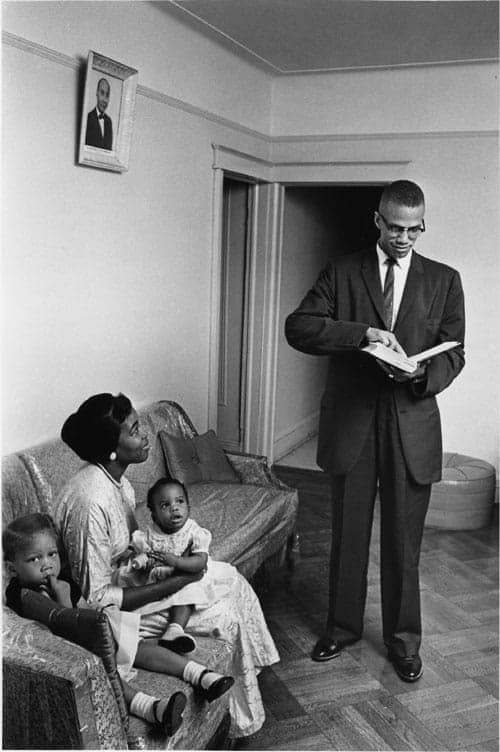
Malcolm with wife, Betty, and two daughters.

6. Page 147 – Referring to his wife, Betty: “Malcolm rarely, if ever, displayed affection toward her.” But then on page 180, Marable writes: “Malcolm conveyed his love for her.” Which is it? And without evidence, how can we believe the amateurish psychoanalysis he presents?  

7. Pages 174-175 – “A fire broke out in Louis’ home … most NOI members believed [Ella] Collins was responsible.” Again, no evidence.

8. Page 247 – Elijah Muhammed “interpreted the [autobiography] as evidence of Malcolm’s vanity but [decided], at least temporarily, to cater to this.” Here, Marable’s father-son Freudian analysis on Elijah Muhammad and Malcolm X remains speculative without even a footnote that exposes the intellectual framework for such an idea. This idea is at least more responsibly argued by Wolfenstein, 1981.

9. Page 256 – Regarding Malcolm’s analysis of the 1963 March on Washington, Marable writes that his “version of events was a gross distortion of the facts – yet it contained enough truth to capture an audience of unhappy black militants.” Note the lower case b. Does Marable think his assessment is so self-evident that it needs no support? Who is he writing to?

10. Page 266 – Regarding the notion that Malcolm was romantically involved with a woman whom Elijah Muhammad got pregnant: “No one else, not even James 67X, has made such a claim.” So why make such a big deal out of this sexual controversy in at least five different places in the book?

11. Page 268 – “Nearly every individual he trusted would betray that trust.” Again, such a global statement without proof can only sow the seeds of distrust in the movement and go against those living who were close to Malcolm.

12. Page 284 – “There is evidence that Malcolm may have met with the leaders of the Communist Party’s Harlem branch.” Now, while this is perfectly possible, why no documentation of the evidence? And what about Bill Epton?

13. Page 294 – “It is likely that no more than 200 members in good standing quit the sect: less than 5 percent of all mosque congregants.” Why use the pejorative word “sect” for the NOI? And again, what is the source of these numbers?

14. Page 423 – “Sharon 6X may have joined [Malcolm] in his hotel room.” Another damning statement with no evidence whatsoever.

15. Page 469 – “The organization’s archival heritage … were [sic] largely destroyed and a new memory, branded by orthodoxy, was imposed.” What is the source for this? There are several organizations who claim to have the archives, so why does Marable think that they are gone? And who imposed what new memory? While many may believe this, a serious work of scholarship would provide some kind of proof.
So the basic trend of these 15 points tells us that this is a poor job of empirical scholarship. Moreover, only about 20 percent of the 63 pages of footnotes come from primary sources. The rest of the footnotes come from published work based on others peoples’ research. Marable hardly ever engages the serious scholarship of others and fails to give any credit to his first project director who guided the day-to-day research effort, Cheryl Greene, who was not even mentioned in the acknowledgments.

Marable states in the acknowledgments: “Elizabeth Mazucci was largely responsible for building the Malcolm X chronology.” In fact, the first chronology on his Columbia University website was lifted entirely from our BrotherMalcolm.net site without any attribution. I had to protest to Marable and when I got no response from him, I wrote to the Columbia administration. The page was taken down, but no one gave me the courtesy of a response. Marable then reposted the chronology with a new format and a couple of new dates added, but still with no acknowledgement of sources. 

Marable and I were among the five founders of the Black Radical Congress but this was hardly the move of a comrade, a brother or an honest scholar.

The overarching philosophical error in this book is suggested by the title: “Malcolm X: A Life of Reinvention.” There are two incorrect aspects to this fundamental, idealist error. First, Marable discounts Malcolm’s own autobiography, writing: “In many ways, the book is more Haley’s than its author’s: because Malcolm died in February 1965, he had no opportunity to revise major elements of what would become known as his political testament,” page 9.

I was at the 1992 Knoxville, Tenn., auction of the papers from the Haley estate and reviewed the documents such as the final copy edited by Malcolm and the missing chapters. After but a quick scan, I don’t believe there is any basis for this authorial challenge, which seems like just another attack on Malcolm X. The autobiography was not of a life invented by Alex Haley. The documents in question were purchased by Detroit attorney Greg Reed and we await their release for a closer examination. Reed has also obtained a trove of documents recovered from the papers of a former member of the NOI in Detroit that will increase the archives we have.

Second, Marable suggests that Malcolm opportunistically invented and re-invented himself as a form of self-promotion, “to package himself to maximum effect,” page 10. He thinks the process was based on intentional agency by Malcolm X himself. Does consciousness determine being, or does being determine consciousness? Marable takes the first approach while I suggest a materialist perspective that follows this observation by Karl Marx: “It is not the consciousness of men that determines their being, but, on the contrary, their social being that determines their consciousness.” We must look to the concrete circumstances of Malcolm’s life and how the interplay of external and internal forces played out in his dialectical transformations.

There is no evidence that Malcolm deliberately reinvented himself. Rather, as with anyone who matures, the stages of Malcolm’s life can be understood as resulting from the dialectic of his consciousness and his concrete experiences. His ideas about himself and the world were negated by his experience, compelling him forward, even against his will at times.
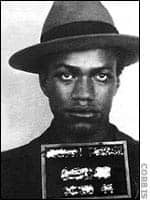
Malcolm Little, 18.
He was a youth who believed in and wanted to be part of society, but the negation of dominant society by his father and his mother and then the negations of Malcolm by his teachers and his foster home experience all made him reject mainstream aspirations and pulled him into life on the street and becoming an outlaw. As an outlaw, the state negated him and put him in the joint, where he continued to be a satanic character. In opposition to this negation, his family and fellow prisoners then provided support and a path into a new form of consciousness and being. He cleaned up and began to recapture consciousness, to follow the path of his father and family.

As Malcolm Little, he remained in small Midwestern towns such as Omaha, Milwaukee and East Lansing. As Detroit Red, he was in large East Coast cities like Boston, New York and Washington D.C. What remained a constant was his eagerness to learn and achieve, first as an affirmation of society, then when negated as a negative force in society.

Once Malcolm X joined the NOI, led by his family members, he combined the lessons of both earlier stages of his life and built its membership up by going among the gangsters, the negated and the most oppressed, raising them into the lifestyle that his parents taught him and that Elijah Muhammad reaffirmed – all of them moral, disciplined and proud people.

At least three more forces changed Malcolm X. First, he was appointed by the NOI to become national minister and travel the county at the same time that the national freedom movement was reaching its peak in terms of consciousness and mobilization. He read and engaged with activists. While he changed many, he was also changed.

Second, the police attacked and killed members of the NOI, especially in Los Angeles, and Malcolm was ready for action that far exceeded what the NOI was prepared to do.
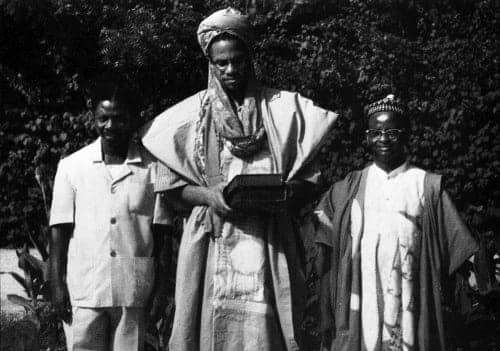
Malcolm X in Africa,1964.

Third, the world situation was ablaze with armed struggle for national liberation from Vietnam to Africa, Cuba and Latin America. He followed these movements very closely. His three great Detroit speeches from 1963, 1964 and 1965 made this very clear. His final break with the NOI was conditioned by these external factors and two more factors internal to the NOI. One was Elijah Muhammad, violating his own moral teachings regarding adultery. The other was Malcolm’s direct violation of the central leadership’s order of silence on the Kennedy assassination.

Elijah Muhammad negated himself; Malcolm, having internalized the external political forces acting on him, negated the order of silence. Malcolm’s new status, free from the confines of the NOI, was reinforced by his continued movement into Sunni Islam via his Hajj and his continued movement into world revolution by extensive trips abroad in Europe and Africa.

My argument is that Malcolm’s life was not an intended self-invention process through his agency, but a global process that summed up the journey so many were to make from being members of the oppressed to embracing Black self-determination and becoming revolutionaries. This is the dialectical materialism of social change in the late 20th century and on that basis people held, and continue to hold, Malcolm in the highest regard and they lived, and continue to live, the life he epitomized.

Politics

Now we come to politics and the strategy and tactics advocated by Malcolm X. Strategy is the long term view of how to seize power and transform society, making clear what forces in society can be counted on and what forces one will have to fight. Strategy also focuses on the goals of a struggle. Tactics are the methods used in the day-to-day struggle in which a lot of flexibility and innovation is needed in the tit-for-tat encounters with the enemy and in mobilizing the masses of people. Tactics are subordinate to strategy and can’t be equated or else one will confuse the zigzag of the struggle with the goal and basic plan for mobilization, organization and victory.

On a global level, Marable gives us a clue of how he invents his own Malcolm X. He states: “The United Nations World Conference Against Racism, held in Durban, South Africa in 2001, was in many ways a fulfillment of Malcolm’s international vision,” page 485. This is ridiculous. Malcolm X would have condemned the Durban meeting just as he did the 1963 March on Washington. Apparently the writer of the epilogue of Marable’s book forgot what the writer of Chapter 4 had written: “Black American leaders, Malcolm now urged, must ‘hold a Bandung Conference in Harlem,’” page 120.

Malcolm’s life was not an intended self-invention process through his agency, but a global process that summed up the journey so many were to make from being members of the oppressed to embracing Black self-determination and becoming revolutionaries.

Durban was a conference in which the imperialists were trying to assert their hegemony over anti-racism and decolonization. Bandung was a third-world gathering to plan unity and resistance in opposition to the imperialists. Compare Wikipedia’s descriptions of each meeting:
Malcolm X never believed an honest discussion could be held with imperialists. He would have predicted what actually happened in Durban: The U.S. imperialists blocked any open debate in order to defend their client state, Israel.

On Malcolm X’s political thinking, Marable writes: “Despite his radical rhetoric, as ‘The Ballot or the Bullet’ makes clear, the mature Malcolm believed that African Americans could use the electoral system and voting rights to achieve meaningful change,” page 484. Here Marable refuses to embrace the dialectical thinking of Malcolm X. First, Malcolm’s thinking was grounded in the radical Black tradition. See what Frederick Douglass wrote 100 years earlier in an article titled “The Ballot and the Bullet,” 1859:

“If speech alone could have abolished slavery, the work would have been done long ago. What we want is an anti-slavery government in harmony with our anti-slavery speech, one which will give effect to our words and translate them into acts. For this, the ballot is needed, and if this will not be heard and heeded, then the bullet. We have had cant enough and are sick of it. When anti-slavery laws are wanted, anti-slavery men should vote for them; and when a slave is to be snatched from the hand of a kidnapper, physical force is needed, and he who gives it proves himself a more useful anti-slavery man than he who refuses to give it, and contents himself by talking of a ‘sword of the spirit,’” reprinted in Douglass 1950, page 457-458.

The ballot or bullet theme in Black radicalism is in fact a fundamental tenet of American politics. It was part of the ideological rationale for the American anti-colonial war of liberation from England. It was stated in the 1776 Declaration of Independence, 235 years ago. Read the full text if you want to understand the tradition on which Malcolm X stands – a radical American tradition.
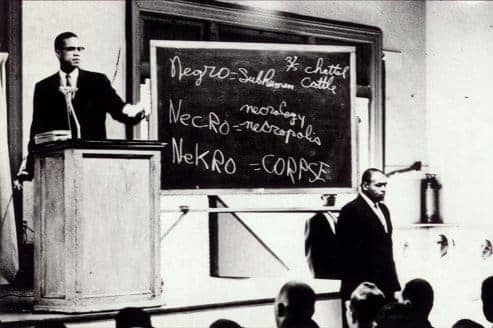
Malcolm delivers Ballot or Bullet speech in Detroit, Michigan, on April 12, 1964.
Malcolm’s “Ballot or the Bullet” speech was part of his spring 1964 offensive. It is important to be clear on the historical context in which he was giving political leadership. Forces that preceded and surrounded him undoubtedly impacted his thinking:  

1. The increasingly militant struggles in the South, especially those led by Medgar Evers after the brutal murder of Emmett Till in 1955.

2. Robert Williams and his Monroe, North Carolina, armed self-defense strategy as summed up in his book “Negroes with Guns,” 1962.

3. The armed group Deacons for Defense and Justice formed in Louisiana in 1964.

4. The Revolutionary Action Movement, a group led by Max Stanford, who went on to influence the development of the Black Panther Party. This was the only other organization that Malcolm X joined.
President John F. Kennedy was assassinated in November 1963. Vice President and then President L.B. Johnson consolidated his own leadership by staying the course and supporting major civil rights legislation, so the Civil Rights Act of 1964 was signed into law on July 2, 1964.

During the summer of 1964, SNCC led the civil rights organizations that had formed into a coalition called the Council of Federated Organizations (COFO) in 1962 for a major offensive in Mississippi. This was the Mississippi Summer Project. Hundreds of activists poured into the state and confronted the heart of racist state power. The House passed the bill in February 1965, but a Senate filibuster held it up. The Senate filibuster ended on June 19.

Three movement activists – Goodman, Chaney and Schwerner – were martyred by assassination in Philadelphia, Miss., on June 21. Out of the Mississippi Summer Project came a political party, the Mississippi Freedom Democratic Party, MFDP. It was the MFDP that brought Fannie Lou Hamer to Harlem in 1964, where she appeared on a platform with Malcolm X.

From the local precinct level to a delegation going to the national convention, the MFDP fought the racist party organization that excluded Black people. The main civil rights leaders tried to get the MFDP to accept being seated at the convention without voice or vote. The MFDP, with the SNCC, rejected this as a sellout. In the meantime, the bullets kept flying:
  • 1963 – June: assassination of Medgar Evers.
  • 1964 – July: rebellion in Rochester, N.Y. August: rebellion in Philadelphia, Pa.
  • 1965 – February: assassination of Malcolm X. August: rebellion in Watts, Los Angeles.
  • 1966 – June: “Black Power” slogan emerges in militant march in Mississippi. July: rebellions in Cleveland, Ohio and Omaha, Neb. [September: rebellion in Hunters Point, San Francisco. – ed.] October: Black Panther Party is organized in Oakland, Calif.
  • 1967 – June: rebellion in Detroit, Mich. July: rebellions in Newark and Plainfield, N.J. October: assassination of Che Guevara.
  • 1968 – April: assassinations of Black Panther Bobby Hutton and Martin Luther King Jr. and rebellions in Chicago, Ill., and more than 100 other cities. June: League of Revolutionary Black Workers is organized in Detroit.
  • 1969 – December: assassination of Black Panther Fred Hampton.
In 1965-66, the struggle was developing. The defeat of the Watts rebellion led to the ideological advance of the “Black Power” slogan and the new revolutionary organization called the Black Panther Party, followed two years later by workers throwing up a new revolutionary force on the factory floor called the League of Revolutionary Black Workers. The U.S. armed forces put down major urban rebellions and assassination of Black radical leaders continued.

The 1964 presidential campaign brought forward the ultra-right in the form of Barry Goldwater. By 1966, “Black Power” emerged as a key ideological slogan. Electoral victories led to the first major Black mayors of Cleveland, Ohio, and Gary, Ind.

By 1968, things got even more extreme when Alabama Gov. George Wallace, the nation’s leading segregationist politician, ran for president and won the Indiana primary. Richard Nixon was elected president in 1968 and 1972, but was run out of office in disgrace in 1974. A struggle for power was taking place.

Malcolm X laid the basis for understanding these events: the Senate filibuster and racist state power, the murders and the unity between the Klan and the government and the emergence of Black Power in both electoral and more militant forms as well. This was indeed the ballot and the bullet, 20th century edition.

The analysis that Malcolm laid out in his spring 1964 speeches amounts to a theory of the U.S. racist, capitalist state that is based on finding a strategy to fight against it. First, the power of the U.S. ruling class, as based on Southern fascism versus a Black united front; then, armed self-defense for Black liberation as self-determination versus that racist state power.

Marable advances an argument that separates Malcolm from his legacy, a legacy that was in fact us – the Black liberation movement. But no activist in that movement who was in motion at the time will believe his argument. It flies in the face of our experience.

Malcolm X laid the basis for understanding these events: the Senate filibuster and racist state power, the murders and the unity between the Klan and the government and the emergence of Black Power in both electoral and more militant forms as well. This was indeed the ballot and the bullet, 20th century edition.

Why this book, at this time? 
We have reviewed Manning Marable’s book on Malcolm X as far as perspective, philosophy and politics. But we still have an outstanding question – why this book, at this time? President George W. Bush was a right-wing standard bearer. We took to the streets to fight his policies. The resistance to the imperialist war on Iraq and then Afghanistan produced a major antiwar movement with heightened consciousness that developed faster and with a sharper focus than the movement against the Vietnam War.
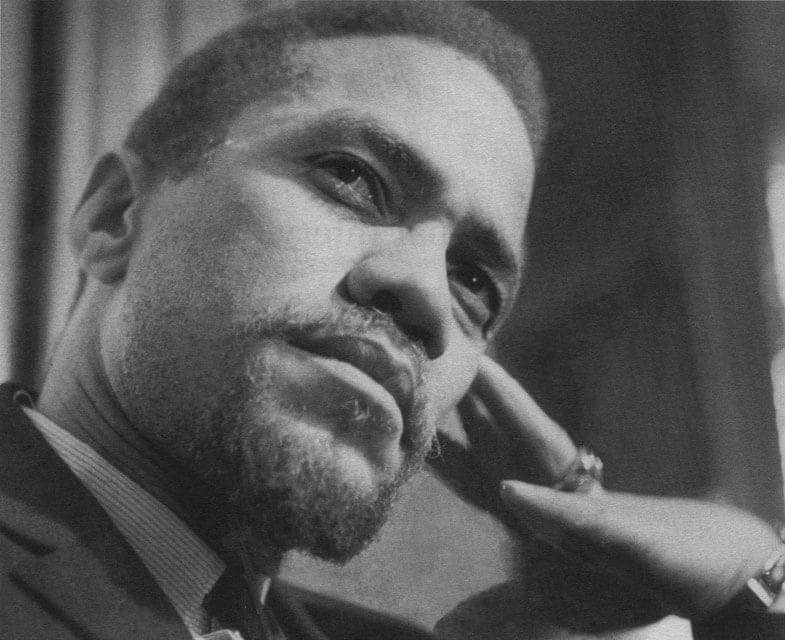
But now we have the Obama moment. Barack Obama is a Black face on U.S. imperialism. While he has escalated Bush’s war and extended it into Libya, we have no antiwar movement challenging Obama’s legitimacy. The ruling class is using a Black man to advance the cause of neoliberalism. They are concerned more about banks “too big to fail” than unemployment and the suffering of the masses of people.

Maybe I should say Obama is our man doing their work. We voted for him but he lacks the guts to fight for us against the rulers and generals who govern. He seeks to compromise with right-wing Republicans and Democrats captured by the fascist Tea Party that holds 10 percent of the seats in Congress.

Rather than give us the Malcolm X of the Detroit speeches, the Malcolm X we love and respect, Marable tries to cut him down to size with unsubstantiated arguments under the guise of humanizing Malcolm X. In summary, Marable gives us a perspective that is outside of the Black studies tradition in his attempt to sell books to a wide American book-buying public.

Marable gives us a philosophy that is mechanical and not dialectical, idealist and not materialist. And he attempts to turn Malcolm X into a social reformer rather than the revolutionary that he actually was. In short, Marable fabricates a Malcolm X who would not take militant and revolutionary action against the global war, poverty or degradations of today. That’s why we have to speak up: to respect our legacy and affirm our future.

Rather than give us the Malcolm X of the Detroit speeches, the Malcolm X we love and respect, Marable tries to cut him down to size with unsubstantiated arguments under the guise of humanizing Malcolm X.

Bibliography 

Baker, Houston. “Betrayal: How Black Intellectuals Have Abandoned the Ideals of the Civil Rights Era.” New York: Columbia University Press, 2008.
Clarke, John Henrik, ed. “William Styron’s Nat Turner: Ten Black Writers Respond.” Boston: Beacon Press, 1968.
Cone, James. H. “Martin & Malcolm & America: A Dream or a Nightmare.” Maryknoll, N.Y.: Orbis Books, 1991.
Douglass, Frederick. “The Life and Writings of Frederick Douglas, Volume 2.” Philip S. Foner, ed. New York, International Publisher, 1950.
Duberman, Martin Bauml. “Paul Robeson.” New York: Alfred A. Knopf, 1988.
Dyson, Michael Eric. “I May Not Get There With You: The True Martin Luther King, Jr.” New York: Free Press, 2000.
Engels, Frederick. Translated by Emile Burns. “Anti-Duhring.” Moscow: Progress Publishers, 1947. Available at http://www.marxists.org/archive/marx/works/1877/anti-duhring/.
Garrow, David J. “Bearing the Cross: Martin Luther King Jr., and the Southern Christian Leadership Conference.” New York: William Morrow & Company, 1986.
Lee, Spike. “Malcolm X” [movie], 1992.
Marable, Manning. “Malcolm X: A Life of Reinvention.” New York: Viking, 2011.
Muhammad, Elijah. “How to Eat to Live, Volume 1.” Chicago, Muhammad Mosque of Islam No. 2, 1967. Available at http://www.seventhfam.com/temple/books/eattolive_one/eat1index.htm.
Muhammad, Elijah. “How to Eat to Live, Volume 2.” Chicago, Muhammad Mosque of Islam No. 2, 1972. Available at http://www.seventhfam.com/temple/books/eattolive_two/eat2index.htm. 
Perry, Bruce. “Malcolm: The Life of a Man Who Changed Black America.” Barrytown, NY. Station Hill Press, 1991.
Sales, William W. “From Civil Rights to Black Liberation: Malcolm X and the Organization of Afro-American Unity.” Boston: South End Press, 1994.
Stanford, Maxwell C. “Revolutionary Action Movement (RAM): A Case Study of an Urban Revolutionary Movement in Western Capitalist Society.” Master’s thesis. Atlanta University, 1986. Available at http://www.ulib.csuohio.edu/research/portals/blackpower/stanford.pdf.
Styron, William. “The Confessions of Nat Turner: A Novel.” New York: Random House, 1967.
Williams, Robert F. “Negroes with Guns.” New York, Marzani & Munsell, 1962.
Wolfenstein, E. Victor. “The Victims of Democracy: Malcolm X and the Black Revolution.” Berkeley: University of California Press, 1981.


Abdul Alkalimat, Ph.D., is a professor of African American studies at the University of Illinois, the author of “The African American Experience In Cyberspace,” the creator and editor of BrotherMalcolm.net and the compiler of Selected Work on Malcolm X by Abdul Alkalimat. In 1996, he and Bill Fletcher Jr., Manning Marable, Leith Mullings and Barbara Ransby founded the Black Radical Congress. He can be reached at mcworter@illinois.edu.
============================

Monday, June 27, 2011

DARK GIRLS: 
A Black Documentary The Needs Our Support
Below are clips from the upcoming documentary exploring the deep-seated biases and attitudes about skin color---particularly dark skinned women, outside of and within the Black American culture.

This film will be released in Fall/Winter 2011. Please "Like" the Dark Girls page on Facebook,so you will be kept updated with news there. Please support the Sisters and Brothers who have made this important documentary by helping raise money at indiegogo.com/​Dark-Girls-Movie

Directed by Bill Duke and D. Channsin Berry
Produced by Bill Duke for Duke Media
and D. Channsin Berry for Urban Winter Entertainment
Co-Produced by Bradinn French
Line Produced by Cheryl L. Bedford
Edited by Bradinn French 
----------------------------
Dark Girls: Preview from Bradinn French on Vimeo.

Sunday, June 26, 2011

FREE HEALTHCARE AT ALL MAJOR US AIRPORTS!

Thursday, June 16, 2011

More Evidence of Deep Racial Selfahte Among Our Youth

Instead of living in a "postracial" society, we are living in a HYPERRACIAL society that guarantees Black economic, social, cultural and spiritual oppression for the sake of profit maximization and white supremacy.  The successful day-to-day functioning of this hyperracial reality makes sure that the vast majority of the world's people (people of color) also fall in line behind the white capitalist Pied Piper.

We need to find creative ways to break thru the Racist Matrix that traps our youth to help them see that they are not free and ugly, but oppressed and Beautifully Black Geniuses in dire need of Revolution.

Wednesday, June 15, 2011

Racism + "Science"  =  Hole in the Head
An Essential Video Documentary of PreNazi US "Scientific Experiments" In Mississippi
-----------------
Hole In the Head: A Life Revealed

Vertus Hardiman hid a shocking secret under a wig & beanie for over 80 years. He was experimented on at age of 5 by a county hospital in Indiana during 1927. Vertus was one of ten children, all experimented on with radiation that day.

FOR MORE INFORMATTION ON MOVIE AND PRINT RELEASES, PLEASE VISIT THE WEBSITE AND SIGN UP. http://www.smithleonardproductions.com

Tuesday, June 14, 2011

Rescuing the Real Uncle Tom
By DAVID S. REYNOLDS

June 13, 2011

NOTE: Racism- over the years has so distorted what Harriet Beecher Stowe was trying to portray in the central character of her novel, that we now have a term that denotes a groveling sellout of Blackfolk: Uncle Tom. Just like the word "Black" evolved into meaning everything evil/less than/inhuman/impure... so has "Uncle Tom." But, Blackfolk redefined the word "Black" back in the socially, culturally and politically conscious days of the 60's and 70's when we asserted: BLACK POWER! & BLACK IS BEAUTIFUL! Now, we must begin to reverse the proslavery connotation of an anti-slavery character called "Uncle Tom." For Uncle Tom was NOT an Uncle Tom! This little essay helps us along the way.-- SEA

THE novelist Harriet Beecher Stowe, born 200 years ago today, was an unlikely fomenter of wars. Diminutive and dreamy-eyed, she was a harried housewife with six children, who suffered from various obscure illnesses worsened by her persistent hypochondria.

And yet, driven by a passionate hatred of slavery, she found time to write "Uncle Tom's Cabin," which became the most influential novel in American history and a catalyst for radical change both at home and abroad.

Today, of course, the book has a decidedly different reputation, thanks to the popular image of its titular character, Uncle Tom — whose name has become a byword for a spineless sellout, a black man who betrays his race.

And we tend to think of the novel itself as an old-fashioned, rather lachrymose affair that features the deaths of an obsequious enslaved black man and his blond, angelic child-friend, Little Eva.

But this view is egregiously inaccurate: the original Uncle Tom was physically strong and morally courageous, an inspiration for blacks and other oppressed people worldwide. In other words, Uncle Tom was anything but an "Uncle Tom."

Indeed, that's why in the mid-19th century Southerners savagely attacked "Uncle Tom's Cabin" as a dangerously subversive book, while Northern reformers — especially blacks — often praised it. The ex-slave Frederick Douglass affirmed that no one had done more for the progress of African-Americans than Stowe.

The book was enormously popular in the North during the 1850s and helped solidify support behind the antislavery movement. As the black intellectual W. E. B. Du Bois later wrote, "Thus to a frail overburdened Yankee woman with a steadfast moral purpose we Americans, both black and white, owe our gratitude for the freedom and the union that exist today in these United States."

The book stoked fires overseas, too. In Russia it influenced the 1861 emancipation of the serfs and later inspired Vladimir Lenin, who recalled it as his favorite book in childhood. It was the first American novel to be translated and published in China, and it fueled antislavery causes in Cuba and Brazil.

At the heart of the book's progressive appeal was the character of Uncle Tom himself: a muscular, dignified man in his 40s who is notable precisely because he does not betray his race; one reason he passes up a chance to escape from his plantation is that he doesn't want to put his fellow slaves in danger. And he is finally killed because he refuses to tell his master where two runaway slaves are hiding.

As for Little Eva, she bravely accepts her coming death and says she would gladly give her life if that would lead to the emancipation of America's enslaved blacks. Together Tom and Eva form an interracial bond that offers lessons about tolerance and decency.

Unfortunately, these themes were lost in many of the stage versions of "Uncle Tom's Cabin" that inevitably sprung from its immense popularity. Indeed, Stowe's novel yielded the most popular and one of the longest-running plays in American history.

The first dramatization of the novel appeared in 1852, the year it was published, and countless others followed. By the 1890s, there were hundreds of acting troupes — so-called Tommers — that fanned out across North America, putting on "Uncle Tom's Cabin" in every town, hamlet and city. Some troupes even toured internationally, performing as far away as Australia and India.

The play, seen by more people than read the book, remained popular up to the 1950s and still appears occasionally, including a staging last fall at the Metropolitan Playhouse in New York.

But as the story moved from the book to the stage, Stowe's revolutionary themes were drowned in sentimentality and spectacle. Eva's death was frequently a syrupy scene in which the actress was hauled heavenward by rope or piano wire against a backdrop of angels and billowing clouds.

Uncle Tom, meanwhile, was often presented as a stooped, obedient old fool, the model image of a submissive black man preferred by post-Reconstruction, pre-civil rights America.

It was this Uncle Tom, weakened both physically and spiritually, who became a synonym for a racial sellout by the mid-20th century. Black musicians, sports figures, even establishment civil rights leaders were all tarred with the "Uncle Tom" label, often by younger, more radical activists, as a way of demeaning them in the eyes of the African-American community.

But it doesn't have to be that way; Uncle Tom should once again be a positive symbol for African-American progress.

After all, many people who over the years were derided as Uncle Toms — Jackie Robinson, Louis Armstrong and Willie Mays, to name a few — are now seen as brave racial pioneers.

Indeed, during the civil rights era it was those who most closely resembled Uncle Tom — Stowe's Tom, not the sheepish one of popular myth — who proved most effective in promoting progress.

Rosa Parks didn't mind the Uncle Tom label, since she believed that great change could result from nonviolent moral protest. The Rev. Dr. Martin Luther King Jr., though often called an Uncle Tom, also stuck to principled nonviolence.

Their form of protest was just as active as Tom's, and just as strong. Both Stowe and Tom deserve our reconsideration — and our respect.

David S. Reynolds, a professor of American studies and English at the Graduate Center of the City University of New York, is the author of "Mightier Than the Sword: 'Uncle Tom's Cabin' and the Battle for America."

Sunday, June 12, 2011

HOW THE INTERNET IS REVOLUTIONIZING EDUCATION

How the Internet is Revolutionizing Education
Via: OnlineEducation.net

Thursday, June 09, 2011

Open Letter from the Citywide Coalition for Educational Excellence NOW!

BLOOMBERG'S CHANCELLOR CHOICES ONLY LEAD TO MORE MIS-EDUCATION


White Supremacy & Capitalism Rules Bloomberg's Privatization of Public Education

Brecht Forum Lecture Series
The Continuous Study of Race and Class in America
Part of the Course “Hubert Harrison, Theodore W. Allen, and the Continuing Centrality of the Struggle against White Supremacy”
Lecturer: Jeffrey B. Perry, biographer, historian
“White Supremacy and Bloomberg Autocracy on the NYC Public Schools”
Panelists include: Jitu Weusi, Mark Torres, Ernestine Augustus, Sam Anderson, Sean Ahern, Muriel Tillinghast, Chair

To SEE Video, GO TO: 
http://www.politube.org/show/3231

Monday, June 06, 2011

Sometimes Political Cartoons Can Say it Better than a Thousand Words

=======================
========================

===============================


Apartheid Still Lingers Strong in South African Education System


Less than half of Black South African youth graduate from hi school.... Just like the reality for Black students in the US- because US-style Apartheid still lingers strong also.

Wednesday, May 25, 2011

Michelle Alexander Speaks Powerfully On the New Jim Crow


May 21, 2011 was supposed to be the end of the world, well, it was the end of the world as many of us knew it when they heard Michelle Alexander dissect the criminal "injustice" system in America and its progeny---The New Jim Crow and mass incarceration in the age of Colorblindness.

The Campaign to End the New Jim Crow

Support work to end mass incarceration and the emergence of the New Jim Crow! Become part of a movement, and refuse to be silent and inactive!

www.newjimcrow.org
www.allthingsharlem.com/new-jim-crow

 PART II


PART III


PART IV

Sunday, May 22, 2011

The Malcolm X Museum Presents a Discussion of Manning Marable's Malcolm X Biography 
May 19, 2011
Schomburg Center for Research In Black Culture- Harlem, NY
This event was cosponsored by the Museum of Moving Image... and was part of a two day series of movies and discussions concerning Malcolm X and his times.

This particular Thursday night event saw a standing room only crowd eager to listen to and be engaged in lively discussion about a controversial biography.

For 3 hour Video, GO TO: http://politube.org/show/3222

Sunday, May 15, 2011

Malcolm X On Canadian TV in January 1965

Here is a rare view of Brother Malcolm X being interviewed in the last days of his life. He went on CBC's Front Page Challenge on Jan. 5, 1965. It was a very popular infotainment type TV show that- as you can see -was not designed around soundbites and "gotcha" moments that so dominate today's TV news & views shows.

PART II

Thursday, April 28, 2011

Boy, Show Me Your Papers! Obama's Birth Certificate Madness
Below Sister Goldie Taylor, contributing editor for TheGrio.com, tells the story of the arrest of her great, great grandfather, Major Blackard, to explain the racist history of demanding identification from African-Americans and its connection to present-day "birtherism."


Thursday, March 31, 2011

Yes, Virginia, the US Civil War was about Slavery & Racism & Capitalism
Fort Sumter: The Civil War Begins

Nearly a century of discord between North and South finally exploded in April 1861 with the bombardment of Fort Sumter
* By Fergus M. Bordewich
* Smithsonian magazine, April 2011

An enslaved family in 1861 Virginia

"The heart and soul of the secession argument was slavery and race," says historian Emory Thomas.

On the afternoon of April 11, 1861, a small open boat flying a white flag pushed off from the tip of the narrow peninsula surrounding the city of Charleston. The vessel carried three envoys representing the Confederate States government, established in Montgomery, Alabama, two months before. Slaves rowed the passengers the nearly three and a half miles across the harbor to the looming hulk of Fort Sumter, where Lt. Jefferson C. Davis of the U.S. Army—no relation to the newly installed president of the Confederacy—met the arriving delegation. Davis led the envoys to the fort's commander, Maj. Robert Anderson, who had been holed up there since just after Christmas with a tiny garrison of 87 officers and enlisted men—the last precarious symbol of federal power in passionately secessionist South Carolina.

The Confederates demanded immediate evacuation of the fort. However, they promised safe transport out of Charleston for Anderson and his men, who would be permitted to carry their weapons and personal property and to salute the Stars and Stripes, which, the Confederates acknowledged, "You have upheld so long...under the most trying circumstances." Anderson thanked them for such "fair, manly, and courteous terms." Yet he stated, "It is a demand with which I regret that my sense of honor, and of my obligation to my Government, prevent my compliance." Anderson added grimly that he would be starved out in a few days—if the Confederate cannonthat ringed the harbor didn't batter him to pieces first. As the envoys departed and the sound of their oars faded away across the gunmetal-gray water, Anderson knew that civil war was probably only hours away.
One hundred and fifty years later, that war's profound implications still reverberate within American hearts, heads and politics, from the lingering consequences of slavery for African-Americans to renewed debates over states' rights and calls for the "nullification" of federal laws. Many in the South have viewed secession a matter of honor and the desire to protect a cherished way of life.

But the war was unarguably about the survival of the United States as a nation. Many believed that if secession succeeded, it would enable other sections of the country to break from the Union for any reason. "The Civil War proved that a republic could survive," says historian Allen Guelzo of Gettysburg College. "Europe's despots had long asserted that republics were automatically fated either to succumb to external attack or to disintegrate from within. The Revolution had proved that we could defend ourselves against outside attack. Then we proved, in the creation of the Constitution, that we could write rules for ourselves. Now the third test had come: whether a republic could defend itself against internal collapse."

Generations of historians have argued over the cause of the war. "Everyone knew at the time that the war was ultimately about slavery," says Orville Vernon Burton, a native South Carolinian and author of The Age of Lincoln. "After the war, some began saying that it was really about states' rights, or a clash of two different cultures, or about the tariff, or about the industrializing North versus the agrarian South. All these interpretations came together to portray the Civil War as a collision of two noble civilizations from which black slaves had been airbrushed out." African-American historians from W.E.B. Du Bois to John Hope Franklin begged to differ with the revisionist view, but they were overwhelmed by white historians, both Southern and Northern, who, during the long era of Jim Crow, largely ignored the importance of slavery in shaping the politics of secession.

Fifty years ago, the question of slavery was so loaded, says Harold Holzer, author of Lincoln President-Elect and other works on the 16th president, that the issue virtually paralyzed the federal commission charged with organizing events commemorating the war's centennial in 1961, from which African-Americans were virtually excluded. (Arrangements for the sesquicentennial have been left to individual states.) At the time, some Southern members reacted with hostility to any emphasis on slavery, for fear that it would embolden the then-burgeoning civil rights movement. Only later were African-American views of the war and its origins finally heard, and scholarly opinion began to shift. Says Holzer, "Only in recent years have we returned to the obvious—that it was about slavery."

As Emory Thomas, author of The Confederate Nation 1861-1865 and a retired professor of history at the University of Georgia, puts it, "The heart and soul of the secession argument was slavery and race. Most white Southerners favored racial subordination, and they wanted to protect the status quo. They were concerned that the Lincoln administration would restrict slavery, and they were right."

Of course, in the spring of 1861, no one could foresee either the four-year-long war's numbing human cost, or its outcome. Many Southerners assumed that secession could be accomplished peacefully, while many Northerners thought that a little saber rattling would be sufficient to bring the rebels to their senses. Both sides, of course, were fatally wrong. "The war would produce a new nation, very different in 1865 from what it had been in 1860," says Thomas. The war was a conflict of epic dimensions that cost 620,000 American lives, and brought about a racial and economic revolution, fundamentally altering the South's cotton economy and transforming four million slaves from chattel into soldiers, citizens and eventually national leaders.
The road to secession had begun with the nation's founding, at the Constitutional Convention of 1787, which attempted to square the libertarian ideals of the American Revolution with the fact that human beings were held in bondage. Over time, the Southern states would grow increasingly determined to protect their slave-based economies. The founding fathers agreed to accommodate slavery by granting slave states additional representation in Congress, based on a formula that counted three-fifths of their enslaved population. Optimists believed that slavery, a practice that was becoming increasingly costly, would disappear naturally, and with it electoral distortion. Instead, the invention of the cotton gin in 1793 spurred production of the crop and with it, slavery. There were nearly 900,000 enslaved Americans in 1800. By 1860, there were four million—and the number of slave states increased accordingly, fueling a sense of impending national crisis over the South's "peculiar institution."

A crisis had occurred in 1819, when Southerners had threatened secession to protect slavery. The Missouri Compromise the next year, however, calmed the waters. Under its provisions, Missouri would be admitted to the Union as a slave state, while Maine would be admitted as a free state. And, it was agreed, future territories north of a boundary line within land acquired by the Louisiana Purchase of 1803 would be free of slavery. The South was guaranteed parity in the U.S. Senate—even as population growth in the free states had eroded the South's advantages in the House of Representatives. In 1850, when the admission of gold-rich California finally tipped the balance of free states in the Senate in the North's favor, Congress, as a concession to the South, passed the Fugitive Slave Law, which required citizens of Northern states to collaborate with slave hunters in capturing fugitive slaves. But it had already become clear to many Southern leaders that secession in defense of slavery was only a matter of time.

Sectional strife accelerated through the 1850s. In the North, the Fugitive Slave Law radicalized even apathetic Yankees. "Northerners didn't want anything to do with slavery," says historian Bernard Powers of the College of Charleston. "The law shocked them when they realized that they could be compelled to arrest fugitive slaves in their own states, that they were being dragged kicking and screaming into entanglement with slavery." In 1854, the Kansas-Nebraska Act further jolted Northerners by opening to slavery western territories that they had expected would remain forever free.

By late the next year, the Kansas Territory erupted into guerrilla warfare between pro-slavery and antislavery forces; the violence would leave more than 50 dead. The Supreme Court's Dred Scott decision of 1857 further inflamed Northerners by declaring, in effect, that free-state laws barring slavery from their own soil were essentially superseded. The decision threatened to make slavery a national institution. John Brown's raid on Harper's Ferry, in October 1859, seemed to vindicate slave owners' long-standing fear that abolitionists intended to invade the South and liberate their slaves by force. In 1858, Abraham Lincoln, declaring his candidacy for the Senate, succinctly characterized the dilemma: "I believe this government cannot endure permanently half slave and half free."

For the South, the last straw was Lincoln's election to the presidency in 1860, with only 39.8 percent of the vote. In a four-way contest against Northern Democrat Stephen A. Douglas, Constitutional Unionist John Bell and the South's favorite son, Kentucky Democrat John Breckenridge, Lincoln received not a single electoral vote south of the Mason-Dixon line. In her diary, Charleston socialite Mary Boykin Chesnut recounted the reaction she had overheard on a train when news of Lincoln's election was announced. One passenger, she recalled, had exclaimed: "Now that...radical Republicans have the power I suppose they will [John] Brown us all."Although Lincoln hated slavery, he was far from an abolitionist; he believed freed blacks should be sent to Africa or Central America, and declared explicitly that he would not tamper with slavery where it already existed. (He did make clear that he would oppose the expansion of slavery into new territories.)

However, the so-called Fire-eaters, the most radical Southern nationalists who dominated Southern politics, were no longer interested in compromise. "South Carolina will secede from the Union as surely as that night succeeds the day, and nothing can now prevent or delay it but a revolution at the North," South Carolinian William Trenholm wrote to a friend. "The...Republican party, inflamed by fanaticism and blinded by arrogance, have leapt into the pit which a just Providence prepared for them." In Charleston, cannon were fired, martial music was played, flags were waved in every street. Men young and old flocked to join militia companies. Even children delivered "resistance speeches" to their playmates and strutted the lanes with homemade banners.

In December 1860, a little more than a month after Lincoln's election, South Carolina's secession convention, held in Charleston, called on the South to join "a great Slaveholding Confederacy, stretching its arms over a territory larger than any power in Europe possesses." While most Southerners did not own slaves, slave owners wielded power far beyond their numbers: more than 90 percent of the secessionist conventioneers were slaveholders. In breaking up the Union, the South Carolinians claimed, they were but following the founding fathers, who had established the United States as a "union of slaveholding States." They added that a government dominated by the North must sooner or later lead to emancipation, no matter what the North claimed. Delegates flooded into the streets, shouting, "We are afloat!" as church bells rang, bonfires roared and fireworks shot through the sky.

By 1861, Charleston had witnessed economic decline for decades. Renowned for its residents' genteel manners and its gracious architecture, the city was rather like a "distressed elderly gentlewoman....a little gone down in the world, yet remembering still its former dignity," as one visitor put it. It was a cosmopolitan city, with significant minorities of French, Jews, Irish, Germans—and some 17,000 blacks (82 percent of them slaves), who made up 43 percent of the total population. Charleston had been a center of the slave trade since colonial times, and some 40 slave traders operated within a two-square-block area. Even as white Charlestonians boasted publicly of their slaves' loyalty, they lived in fear of an uprising that would slaughter them in their beds. "People talk before [slaves] as if they were chairs and tables," Mary Chesnut wrote in her diary. "They make no sign. Are they stolidly stupid? or wiser than we are; silent and strong, biding their time?"

According to historian Douglas R. Egerton, author of Year of Meteors: Stephen Douglas, Abraham Lincoln, and the Election that Brought on the Civil War, "To win over the yeoman farmers—who would wind up doing nearly all the fighting—the Fire-eaters relentlessly played on race, warning them that, unless they supported secession, within ten years or less their children would be the slaves of Negroes."

Despite its decline, Charleston remained the Confederacy's most important port on the Southeast coast. The spectacular harbor was defended by three federal forts: Sumter; tiny Castle Pinckney, one mile off the city's Battery; and heavily armed Fort Moultrie, on Sullivan's Island, where Major Anderson's command was based but where its guns pointed out to sea, making it defenseless from land.

On December 27, a week after South Carolina's declaration of secession, Charlestonians awoke to discover that Anderson and his men had slipped away from Fort Moultrie to the more defensible Fort Sumter. For secessionists, Anderson's move "was like casting a spark into a magazine," wrote one Charlestonian, T. W. Moore, to a friend. Although a military setback for Confederates, who had expected to muscle the federal troops out of Moultrie, Anderson's move enabled the Fire-eaters to blame Washington for "defying" South Carolina's peaceable efforts to secede.

Fort Sumter had been planned in the 1820s as a bastion of coastal defense, with its five sides, an interior large enough to house 650 defenders and 135 guns command ing the shipping channels to Charleston Harbor. Con struction, however, had never been completed. Only 15 cannon had been mounted; the interior of the fort was a construction site, with guns, carriages, stone and other materials stacked about. Its five-foot-thick brick walls had been designed to withstand any cannonballs that might be hurled—by the navies of the 1820s, according to Rick Hatcher, the National Park Service historian at the fort. Although no one knew it at the time, Fort Sumter was already obsolete. Even conventional guns pointed at the fort could lob cannonballs that would destroy brick and mortar with repeated pounding.

Anderson's men hailed from Ireland, Germany, England, Denmark and Sweden. His force included native-born Americans as well. The garrison was secure against infantry attack but almost totally isolated from the outside world. Conditions were bleak. Food, mattresses and blankets were in short supply. From their thick-walled casements, the gunners could see Charleston's steeples and the ring of islands where gangs of slaves and soldiers were already erecting bastions to protect the Southern artillery.

Militiamen itching for a fight flooded into Charleston from the surrounding countryside. There would soon be more than 3,000 of them facing Fort Sumter, commanded by the preening and punctilious Pierre Gustave Toutant Beauregard, who had resigned his position as West Point's superintendent to offer his services to the Confederacy.

"To prove it was a country, the South had to prove that it had sovereignty over its territory," says historian Allen Guelzo. "Otherwise no one, especially the Europeans, would take them seriously. Sumter was like a huge flag in the middle of Charleston Harbor that declared, in effect, 'You don't have the sovereignty that you claim.' "

With communications from his superiors reaching him only sporadically, Anderson was entrusted with heavy responsibilities. Although Kentucky born and bred, his loyalty to the Union was unshakeable. In the months to come, his second-in-command, Capt. Abner Doubleday—a New York abolitionist, and the man who was long credited, incorrectly, with inventing baseball—would express frustration at Anderson's "inaction." "I have no doubt he thought he was rendering a real service to the country," Doubleday later wrote. "He knew the first shot fired by us would light the flames of a civil war that would convulse the world, and tried to put off the evil day as long as possible. Yet a better analysis of the situation might have taught him that the contest had already commenced and could no longer be avoided." But Anderson was a good choice for the role that befell him. "He was both a seasoned soldier and a diplomat," says Hatcher. "He would do just about anything he could to avoid war. He showed tremendous restraint."

Anderson's distant commander in chief was the lame-duck president, Democrat James Buchanan, who passively maintained that while he believed secession to be illegal, there was nothing he could do about it. A Northerner with Southern sympathies, Buchanan had spent his long career accommodating the South, even to the point of allowing South Carolina to seize all the other federal properties in the state. For months, as the crisis deepened, Buchanan had vacillated. Finally, in January, he dispatched a paddle wheel steamer, Star of the West, carrying a cargo of provisions and 200 reinforcements for the Sumter garrison. But when Confederate batteries fired on her at the entrance to Charleston Harbor, the ship's skipper turned the ship around and fled north, leaving Anderson's men to their fate. This ignominious expedition represented Buchanan's only attempt to assert federal power in the waters off Charleston.

Some were convinced the Union was finished. The British vice-consul in Charleston, H. Pinckney Walker, saw the government's failure to resupply Fort Sumter as proof of its impotence. He predicted the North would splinter into two or three more republics, putting an end to the United States forever. The Confederacy, he wrote, formed what he called "a very nice little plantation" that could look forward to "a career of prosperity such as the world has not before known." Popular sentiment in Charleston was reflected in the ardently secessionist Charleston Mercury, which scoffed that federal power was "a wretched humbug—a scarecrow—a dirty bundle of red rags and old clothes" and Yankee soldiers just "poor hirelings" who would never fight. The paper dismissed Lincoln as a "vain, ignorant, low fellow."

While Buchanan dithered, six more states seceded: Mississippi, Florida, Alabama, Georgia, Louisiana and Texas. On February 4, the Confederate States of America declared its independence in Montgomery, Alabama, and named Mexican War hero, former Secretary of War and senator from Mississippi Jefferson Davis, its president. "The radicals felt they were making a revolution, like Tom Paine and Samuel Adams," says Emory Thomas. Although Davis had long argued for the right of secession, when it finally came he was one of few Confederate leaders who recognized that it would probably mean a long and bloody war. Southern senators and congressmen resigned and headed south.

Secessionists occupied federal forts, arsenals and customhouses from Charleston to Galveston, while in Texas, David Twiggs, commander of federal forces there, surrendered his troops to the state militia and joined the Confederate Army. Soon the only significant Southern posts that remained in federal hands were Fort Sumter and Florida's Fort Pickens, at the entrance to Pensacola Harbor. "The tide of secession was overpowering," says Thomas. "It was like the moment after Pearl Harbor—people were ready to go to war." Buchanan now wanted nothing more than to dump the whole mess in Lincoln's lap and retire to the quietude of his estate in Pennsylvania. But Lincoln would not take office until March 4. (Not until 1933 was Inauguration Day moved up to January 20.)

The new president who slipped quietly into Washington on February 23, forced to keep a low profile because of credible death threats, was convinced that war could still be avoided. "Lincoln had been a compromiser his whole life," says Orville Vernon Burton. "He was naturally flexible: as a lawyer, he had always invited people to settle out of court. He was willing to live with slavery where it already was. But when it came to the honor of the United States, there was a point beyond which he wouldn't go."

Once in office, Lincoln entered into a high-stakes strategic gamble that was all but invisible to the isolated garrison at Fort Sumter. It was in the Confederacy's interest to provoke a confrontation that made Lincoln appear the aggressor. Lincoln and his advisers believed, however, that secessionist sentiment, red-hot in the Deep South, was only lukewarm in the Upper South states of Virginia, North Carolina, Tennessee and Arkansas, and weaker yet in the four slaveholding border states of Delaware, Maryland, Kentucky and Missouri. Conservatives, including Secretary of State William H. Seward, urged the president to appease the Deep South and evacuate the fort, in hopes of keeping the remaining slave states in the Union. But Lincoln knew that if he did so, he would lose the confidence of both the Republican Party and most of the North.

"He had such faith in the idea of Union that he hoped that [moderates] in the Upper South would never let their states secede," says Harold Holzer. "He was also one of the great brinksmen of all time." Although Lincoln was committed to retaking federal forts occupied by the rebels and to defending those still in government hands, he indicated to a delegation from Richmond that if they kept Virginia in the Union, he would consider relinquishing Sumter to South Carolina. At the same time, he reasoned that the longer the standoff over Fort Sumter continued, the weaker the secessionists—and the stronger the federal government—would look.

Lincoln initially "believed that if he didn't allow the South to provoke him, war could be avoided," says Burton. "He also thought they wouldn't really fire on Fort Sumter." Because negotiating directly with Jefferson Davis would have implied recognition of the Confederacy, Lincoln communicated only with South Carolina's secessionist—but nonetheless duly elected—governor, Francis Pickens. Lincoln made clear that he intended to dispatch vessels carrying supplies and reinforcements to Fort Sumter: if the rebels fired on them, he warned, he was prepared to land troops to enforce the federal government's authority.

Rumors flew in every direction: a federal army was set to invade Texas...the British and French would intervene...Northern businessmen would come out en masse against war. In Charleston, the mood fluctuated between overwrought excitement and dread. By the end of March, after three cold, damp months camped on the sand dunes and snake-infested islands around Charleston Harbor, Fort Sumter's attackers were growing feverishly impatient. "It requires all the wisdom of their superiors to keep them cool," wrote Caroline Gilman, a transplanted Northerner who had embraced the secessionist cause.

For a month after his inauguration, Lincoln weighed the political cost of relieving Fort Sumter. On April 4, he came to a decision. He ordered a small flotilla of vessels, led by Navy Capt. Gustavus Vasa Fox, to sail from New York, carrying supplies and 200 reinforcements to the fort. He refrained from sending a full-scale fleet of warships. Lincoln may have concluded that war was inevitable, and it would serve the federal government's interest to cause the rebels to fire the first shot.

The South Carolinians had made clear that any attempt to reinforce Sumter would mean war. "Now the issue of battle is to be forced upon us," declared the Charleston Mercury. "We will meet the invader, and the God of Battles must decide the issue between the hostile hirelings of Abolition hate and Northern tyranny."

"How can one settle down to anything? One's heart is in one's mouth all the time," Mary Chesnut wrote in her diary. "The air is red-hot with rumors." To break the tension on occasion, Chesnut crept to her room and wept. Her friend Charlotte Wigfall warned, "The slave-owners must expect a servile insurrection."

In the early hours of April 12, approximately nine hours after the Confederates had first asked Anderson to evacuate Fort Sumter, the envoys were again rowed out to the garrison. They made an offer: if Anderson would state when he and his men intended to quit the fort, the Confederates would hold their fire. Anderson called a council of his officers: How long could they hold out? Five days at most, he was told, which meant three days with virtually no food. Although the men had managed to mount about 45 cannon, in addition to the original 15, not all of those could be trained on Confederate positions. Even so, every man at the table voted to reject immediate surrender to the Confederates.

Anderson sent back a message to the Confederate authorities, informing them that he would evacuate the fort, but not until noon on the 15th, adding, "I will not in the meantime open my fire upon your forces unless compelled to do so by some hostile act against this fort or the flag of my Government."

But the Confederacy would tolerate no further delay. The envoys immediately handed Anderson a statement: "Sir: By authority of Brigadier-General Beauregard, commanding the provisional forces of the Confederate States, we have the honor to notify you that he will open the fire of his batteries on Fort Sumter in one hour from this time."

Anderson roused his men, informing them an attack was imminent. At 4:30 a.m., the heavy thud of a mortar broke the stillness. A single shell from Fort Johnson on James Island rose high into the still-starry sky, curved downward and burst directly over Fort Sumter. Confederate batteries on Morris Island opened up, then others from Sullivan's Island, until Sumter was surrounded by a ring of fire. As geysers of brick and mortar spumed up where balls hit the ramparts, shouts of triumph rang from the rebel emplacements. In Charleston, families by the thousands rushed to rooftops, balconies and down to the waterfront to witness what the Charleston Mercury would describe as a "Splendid Pyrotechnic Exhibition."

To conserve powder cartridges, the garrison endured the bombardment without reply for two and a half hours. At 7 a.m., Anderson directed Doubleday to return fire from about 20 guns, roughly one half as many as the Confederates. The Union volley sent vast flocks of water birds rocketing skyward from the surrounding marsh.

At about 10 a.m., Capt. Truman Seymour replaced Doubleday's exhausted crew with a fresh detachment.

"Doubleday, what in the world is the matter here, and what is all this uproar about?" Seymour inquired dryly.

"There is a trifling difference of opinion between us and our neighbors opposite, and we are trying to settle it," the New Yorker replied.

"Very well," said Seymour, with mock graciousness. "Do you wish me to take a hand?"

"Yes," Doubleday responded. "I would like to have you go in."

At Fort Moultrie, now occupied by the Confederates, federal shots hit bales of cotton that rebel gunners were using as bulwarks. At each detonation, the rebels gleefully shouted, "Cotton is falling!" And when a shot exploded the kitchen, blowing loaves of bread into the air, they cried, "Breadstuffs are rising!"

Humor was less on display in the aristocratic homes of Charleston, where the roar of artillery began to rattle even the most devout secessionists. "Some of the anxious hearts lie on their beds and moan in solitary misery," trying to reassure themselves that God was really on the Confederate side, recorded Chesnut.

At the height of the bombardment, Fox's relief flotilla at last hove into sight from the north. To the federals' dismay, however, Fox's ships continued to wait off the coast, beyond range of rebel guns: their captains hadn't bargained on finding themselves in the middle of an artillery duel. The sight of reinforcements so tantalizingly close was maddening to those on Sumter. But even Doubleday admitted that had the ships tried to enter the harbor, "this course would probably have resulted in the sinking of every vessel."

The bombardment slackened during the rainy night but kept on at 15-minute intervals, and began again in earnest at 4 a.m. on the 13th. Roaring flames, dense masses of swirling smoke, exploding shells and the sound of falling masonry "made the fort a pandemonium," recalled Doubleday. Wind drove smoke into the already claustrophobic casements, where Anderson's gunners nearly suffocated. "Some lay down close to the ground, with handkerchiefs over their mouths, and others posted themselves near the embrasures, where the smoke was somewhat lessened by the draught of air," recalled Doubleday. "Everyone suffered severely."

At 1:30 p.m., the fort's flagstaff was shot away, although the flag itself was soon reattached to a short spar and raised on the parapet, much to the disappointment of rebel marksmen. As fires crept toward the powder magazine, soldiers raced to remove hundreds of barrels of powder that threatened to blow the garrison into the cloudless sky. As the supply of cartridges steadily shrank, Sumter's guns fell silent one by one.

Soon after the flagpole fell, Louis Wigfall, husband of Charlotte Wigfall and a former U.S. senator from Texas now serving under Beauregard, had himself rowed to the fort under a white flag to call again for Anderson's surrender. The grandstanding Wigfall had no formal authority to negotiate, but he offered Anderson the same terms that Beauregard had offered a few days earlier: Anderson would be allowed to evacuate his command with dignity, arms in hand, and be given unimpeded transport to the North and permission to salute the Stars and Stripes.

"Instead of noon on the 15th, I will go now," Anderson quietly replied. He had made his stand. He had virtually no powder cartridges left. His brave, hopelessly outgunned band of men had defended the national honor with their lives without respite for 34 hours. The outcome was not in question.

"Then the fort is to be ours?" Wig-fall eagerly inquired.

Anderson ordered a white flag to be raised. Firing from rebel batteries ceased.

The agreement nearly collapsed when three Confederate officers showed up to request a surrender. Anderson was so furious at having capitulated to the freelancing Wigfall that he was about to run up the flag yet again. However, he was persuaded to wait until confirmation of the terms of surrender, which arrived soon afterward from Beauregard.

When news of the surrender at last reached the besieging rebels, they vaulted onto the sand hills and cheered wildly; a horseman galloped at full speed along the beach at Morris Island, waving his cap and exulting at the tidings.

Fort Sumter lay in ruins. Flames smoldered amid the shot-pocked battlements, dismounted cannon and charred gun carriages. Astoundingly, despite an estimated 3,000 cannon shots fired at the fort, not a single soldier had been killed on either side. Only a handful of the fort's defenders had even been injured by fragments of concrete and mortar.

Beauregard had agreed to permit the defenders to salute the U.S. flag before they departed. The next afternoon, Sunday, April 14, Fort Sumter's remaining artillery began a rolling cannonade of what was meant to total 100 guns. Tragically, however, one cannon fired prematurely and blew off the right arm of a gunner, Pvt. Daniel Hough, killing him almost instantly and fatally wounding another Union soldier. The two men thus became the first fatalities of the Civil War.

At 4:30 p.m., Anderson handed over control of the fort to the South Carolina militia. The exhausted, blue-clad Union soldiers stood in formation on what remained of the parade ground, with flags flying and drums beating out the tune of "Yankee Doodle." Within minutes, the flags of the Confederacy and South Carolina were snapping over the blasted ramparts. "Wonderful, miraculous, unheard of in history, a bloodless victory!" exclaimed Caroline Gilman in a letter to one of her daughters.

A steamboat lent by a local businessman carried Anderson's battle-weary band out to the federal fleet, past hordes of joyful Charlestonians gathered on steamers, sailboats bobbing rowboats and dinghies, under the eyes of rebel soldiers poised silently on the shore, their heads bared in an unexpected gesture of respect. Physically and emotionally drained, and halfway starved, Anderson and his men gazed back toward the fort where they had made grim history. In their future lay the slaughter pens of Bull Run, Shiloh, Antie-tam, Gettysburg, Chickamauga and hundreds more still unimaginable battlefields from Virginia to Missouri. The Civil War had begun.

---------------------
Fergus Bordewich's most recent book is Washington: The Making of the American Capital. Photographer Vincent Musi is based in Charleston, South Carolina.

-----------------------
Find this article at: http://www.smithsonianmag.com/history-archaeology/Fort-Sumter-The-Civil-War-Begins.html

Monday, March 21, 2011

 Michigan Governor and Republicans End Public Rule in State

Rachel Maddow: Michigan's Dystopian (Corporate Republican) Future  

MSNBC's Rachel Maddow breaks down how The State of Michigan is now up for Fascist Control: The Privatizing of Governmental Affairs


----------------------

Emergency Manager law already forcing unions into new concessions

Teachers union considers authorizing strike
By Eartha Jane Melzer | 03.18.11 |
The new law that allows the governor to appoint Emergency Managers with broad powers to fire elected officials, break contracts and dissolve towns is already forcing public workers to accept new concessions.

In Flint, which received state approval for an $8 million emergency bond needed to make payroll this month and is seen as a likely target for state intervention, the firefighters union has reportedly issued a list of new concessions including increased health insurance payments and giving up holiday pay and night-shift premiums.

"I would rather give concessions that I would like than have an [emergency financial manager] or something of that magnitude come in and say this is what you are going to do," Flint Firefighters Union President Raul Garcia told the Wall Street Journal.

The law also gives officials in financially troubled towns the ability to cancel contracts, but Flint Mayor Dayne Walling has said that double digit concessions by union workers could prevent that from happening.

In Pontiac, which along with Benton Harbor, Ecorse and the Detroit Public School system already has an emergency financial manager in place, local police voted to dissolve their union last week.

Michigan Fraternal Order of Police spokesman John Buczek said that Pontiac's emergency financial manager Michael Stampfler had reduced the city's police force from over 100 to just 41 and was prepared to lay off more as the new law giving him power to break contracts gained final approval.

The former Pontiac police officers hope to be hired on by the Oakland County Sheriffs Dept., which will take over police service for the town.

Buczek questioned whether Stampfler's plan for police service would provide adequate coverage for the city of 66,000 and he said that his group is in complete opposition to the new law that gives appointees total control over local governments.

"It would appear once they abolish collective bargaining agreements they can just get rid of police and firefighters as they like," he said. "The people who still pay taxes in those communities have no say."

With about 40 school districts in deficit across the state the Emergency Manager bill is "a mixed blessing," said David Martell, executive of Michigan School Business Officials.

Though the law may allow schools to stay afloat by cutting labor costs, problems remain.

Schools are required by law to provide free and appropriate education, he said, "but we are not funding districts at a level that is consistent with how their costs are growing."

The state teachers union, the Michigan Education Association, whose members now face possible cuts because of the new law, has asked its local units to vote by April 15 on whether the union should "initiate crisis activities up to and including job action."

In a letter to union members MEA President Iris Salters wrote:

"The legislation being considered on a daily basis at the Capitol (emergency managers, step freezes, mandatory privatization, mandatory health insurance payments, budget cuts, etc.) are outright attacks on our students, our members, our communities and our future. And we must take action accordingly."

Salters said that a vote for more intense union action would demonstrate that MEA is not willing to stand silent while Michigan's public schools and middle class are under attack.

And although backers of the bill insist that use of the extraordinary powers in the bill would be rare, Benton Harbor emergency financial manager Joe Davis, who has clashed with city council members over cost cutting measures, would not rule out disbanding city council when asked last week.

As many as nine local governments and school districts may require state review under Michigan's new Emergency Manager law, Treasurer Andy Dillon said as Gov. Rick Snyder signed the bill into law on Wednesday.

Dillon declined to name the local units that may test out the new law.

Treasury Dept. spokesman Terry Stanton said that no financial reviews have been scheduled and that reviews become public when a review team is appointed.


Sunday, March 13, 2011

"What is amazing to me is that not a single critically thinking educator I know of has responded publicly by supporting Glen Ford's assertion that President Obama's education plan of charter schools, high stakes testing, wholesale teacher removal, anti-union, privatization, and I would add anti-African-centered instruction, is disastrous for Black people. In 2008 I tried to sound the alarm when failed Chicago Education CEO Arne Duncan was named Education Secretary. Billionaires and hedge fund managers own public education."

Donald H. Smith, Ph.D.

Obama Celebrates "Common Ground" with GOP on Education
A Black Agenda Radio commentary by Glen Ford
03/08/2011

------------------------
This new post comes from Brother Glen Ford of BlackCommentator.com where he takes Obama to task for having put Prez Bush's privatizing of public education on steroids.

It is clear that the UFT and the NEA as well as many prominent "progressive" Black educators, politicians and clergy have sold their Black souls to the Devil of Capitalism and are remaining silent or supporting Obama's privatizing schemes in order to receive monies (or hopes of monies) and/or proximity with America's first "Black" president.

The more we remain silent and not fighting back, the more we allow the Privateers to completely take over public education and make it their new money trough in the pig sty of capitalism... while directing our youth into prison cells, deadend jobs and levels of racial selfhatred unseen in our 500 year history of being in the West.-- SEA

------------------------

President Obama's "admiration fest" with Republicans is in high gear, especially in the education arena. The administration's mass charterization policies "represent an even bigger danger to public education" than George Bush's private school vouchers. "The charter school racket is the perfect Trojan Horse for corporate domination of the classroom, at public expense."
"The president proudly proclaimed that he has no 'ideological' differences with the Bushes over education."

If there is any arena outside of waging aggressive war where the Obama administration shows itself to be in near-perfect continuity with its Republican predecessor, it is in education. President Obama last week staged a mutual admiration fest [8] with George Bush's brother, Jeb, at Miami's Central High School, where Obama celebrated the "common ground" he shares with Republicans on educational policy. The president proudly proclaimed that he has no "ideological" differences with the Bushes over education. That is an understatement. In fact, Obama has taken George Bush's No Child Left Behind program as a starting point to launch his own so-called "Race to the Top," an all-out assault on teachers unions and the very nature of public schooling in the United States that advances the corporatization of American classrooms in ways that Republicans never could.

Obama is counting on Republican support for reauthorization of No Child Left Behind, as well he should, since George Bush's program opened the door to Obama's efforts to break teachers unions and create a national system of charter schools. The differences between George Bush's educational policies and Barack Obama's are in emphasis, not intent. In a practical sense, Obama's policies represent an even bigger danger to public education.

"Because he is a Democrat, the leadership of the two national teachers unions pretend Obama is a friend."

In the slick, sly way of the corporate Democrat, Obama avoids the worst rhetorical excesses of his Republican partners in the anti-public education project. You won't hear Obama's Education Secretary, Arne Duncan, calling the nation's largest teachers union a "terrorist organization [9]," as Bush education chief Rod Paige did back in February of 2004. Instead, Arne Duncan travels around with arch-reactionary Newt Gingrich and Obama's Black pit-bull Al Sharpton on a Three Stooges tour [10] promoting their common agenda for non-union charter schools run by private companies. Obama fires teachers en mass, in numbers beyond George Bush's wildest dreams, while making hypocritical noises of support for the profession. And because he is a Democrat, the leadership of the two national teachers unions pretend Obama is a friend, or at least the lesser of two evils, when in reality he is the greater threat.

Under George Bush, the Republicans were ideologically wedded to providing public money for private school vouchers. Charter schools were their second choice for weakening public education. But corporate Democrats like Obama saw that charterization was a much more politically acceptable way to privatize many more schools in a much shorter period of time, while maintaining the veneer of public education. Most importantly, charter schools are the best vehicles for handing control of education over to private corporations while the public continues to pay all the costs. Hedge funds and all kinds of speculators and hustlers have discovered that charter schools are a no-risk, potentially high-profit proposition – that is, no risk to themselves.
The charter school racket is the perfect Trojan Horse for corporate domination of the classroom, at public expense, opening up a new, wholly subsidized educational "market" valued at hundreds of billions of dollars a year, in which the public pays and the private parties profit. And that's why Obama is a greater danger to public education than the Bush brothers ever were.

For Black Agenda Radio, I'm Glen Ford. On the web, go to www.BlackAgendaReport.com [11].

BAR executive editor Glen Ford can be contacted at Glen.Ford@BlackAgendaReport.com [12].
http://traffic.libsyn.com/blackagendareport/20110309_gf_ObamaCharters.mp3


-------------------------
Source URL: http://blackagendareport.com/content/obama-celebrates-%E2%80%9Ccommon-ground%E2%80%9D-gop-education

Links:
[1] http://blackagendareport.com/category/education-public-education/charter-schools
[2] http://blackagendareport.com/category/education-public-education/public-education
[3] http://blackagendareport.com/category/education-public-education/school-privatization
[4] http://blackagendareport.com/category/other/ba-radio-commentary
[5] http://blackagendareport.com/category/us-politics/democrats
[6] http://blackagendareport.com/category/us-politics/obamarama
[7] http://blackagendareport.com/sites/www.blackagendareport.com/files/obama_at_miami_hs.jpg
[8] http://www.nytimes.com/2011/03/05/us/politics/05obama.html?pagewanted=print
[9] http://www.commondreams.org/headlines04/0223-08.htm
[10] http://blackagendareport.com/content/send-clowns-3-stooges-gingrich-sharpton-duncan-hit-road-corporate-ìschool-reformî
[11] http://www.BlackAgendaReport.com/
[12] mailto:Glen.Ford@BlackAgendaReport.com
[13] http://www.addtoany.com/share_save?linkurl=http%3A%2F%2Fblackagendareport.com%2Fcontent%2Fobama-celebrates-%25E2%2580%259Ccommon-ground%25E2%2580%259D-gop-education&linkname=Obama%20Celebrates%20%E2%80%9CCommon%20Ground%E2%80%9D%20with%20GOP%20on%20Education

Tuesday, March 08, 2011

Blair Underwood Plays an Obama-like Prez Supporting US Fascist Underbelly

This filmclip is from NBC's "THE EVENT"- a SciFi action series where there are extraterrestrials that look just like us (except they age much much slower) who being held prisoners for the past 66 years in an Alaskan MAXI MAXI type prison embedded in a mountain. Back in the 1940s, they crash landed up there and originally came in peace. But, a faction is now prepared to invade and exterminate Earth's humanity for the sake of their own survival.

They are the "AlQeda" that needs to be imprisoned at all cost.... The series is more complex than this- as are a lot of these trying-to-be-real fantasies made for TV (think of Lost and 24).

But given the fact the Obama has taken up the Bush mantra that Guantanamo holds the world's worst terrorists that must be held without trial for the sake of "National Security," last nite's Event episode could not be more timely!