Friday, January 25, 2013

Internalized Racism IS PanAfrican!

One of the worst parts of Capitalist globalization in the 21st Century is that it carries deep white supremacist culture everywhere there are Human Beings. It is relentless and sophisticated to such an extent that, for example, Beyonce becomes a cultural ambassador for white supremacy and its consumer products of weaves, wigs, dyes and creams. For many, this article from Brazil is an eye opener into how deep racial inferiority has infected African People worldwide in the 21st Century. Yes, very damaging and negative things can be PanAfrican. Our struggle is to find organizing/educational/mobilizing ways to destroy those negative PanAfrican ideas and practices... wherever we BlackFolk are on Planet Earth!-- SEA

Black Women of Brazil is a photographic and informational blog featuring bios and interviews of a diverse array of Brazilian Women of African descent, as well as news and current events about Afro-Brazilians.
For contact, please e-mail us at: gatasnegrasbrasileiras@gmail.com. Follow us at https://twitter.com/BWofBrazil

Negras brasileiras!!! Se você gostaria de apresentar-se em nosso blog, envie suas fotos, cidade de nascimento e qualquer informação que você gostaria de divulgar pra nosso endereço de e-mail.

Sunday, January 20, 2013

Inspired by Beyoncé, actress Roberta Rodrigues straightens her hair and goes blonde; says guys are crazy about her new look

Afro Brazilian women
Actress Roberta Rodrigues who first became famous in her role as Berenice in the 2002 hit film Cidade de Deus (City of God) has decided to go against the grain in the Afro-Brazilian women's hair revolution. She straightened out her curly locks and added some blonde weave. As we have shown in a number of previous articles, the issue of hair and the infamous "good hair/bad hair" debate is huge amongst black Brazilian women, subjecting them to harassment on the job, disrespectful song lyrics and influencing low self-acceptance amongst children. But the open discussion is also leading many black women to embrace their natural hair in numbers that could be considered revolutionary in a country where straight hair is the standard of beauty. Due to these politics of hair, it seems that Roberta is getting some backlash over her new look.

Below are photos of her current look as well as over the years. With her new look, the Brazilian press was quick to slap the Beyonce label on her (as they've done with countless other black women in Brazil) calling her "A Beyoncé do Alemão" (The Beyoncé of Alemão, in reference to Complexo do Alemão, a group of 13 favelas (slums) in the north zone of Rio de Janeiro). Well, in reality, it was Roberta herself who said that the look was actually inspired by the American singer. Again the Beyonce thing. So what does this say about the world's top black entertainer if she's inspiring other black women to go blond, straight and weave? It's funny, around 40 years ago, black American women inspired a very successful black Brazilian actress to accept her natural hair. More on that later in this post...For now, here's the story on Roberta.

Roberta Rodrigues on her long, straight hair: "They're saying I abandoned my roots."

Despite some criticism, the actress is enjoying her new look: “I often say that there is a Roberta before and another after this hair.”

Roberta suffered criticism for straightening her hair

Straightening her hair for the first time, actress Roberta Rodrigues, who plays Maria Vanúbia on the novela Salve Jorge, is thrilled with the radical change in her visual, but confesses that she is hearing criticism about her new look. “There are people saying that I abandoned my roots. The origin has to do with one’s character and not the hair. I'm an actress, I have to change for the characters,” the actress said.

Despite some criticism, Roberta is finding everything wonderful. “I'm really enjoying it. It’s completely different from anything I've ever done. I often say that there is a Roberta before and another after this hair. I think people really notice blondes more. The hair really calls attention, it's very funny.”

Roberta doesn’t hide the fact that she loves kinky/curly hair, but says that it is easier to take care of it straight. “Having straight hair is much easier. I wake up, take a bath, run my hand through my hair and I'm ready. Kiny/curly hair requires more care. You have to wash it, put cream in it, dry it with a towel and then use a hair diffuser,” she says.

To achieve this long-haired look, the actress enlisted the help of a weave that requires some caution: “I have to moisturize it a lot and use a special brush. All of the blonde parts are weave. I didn’t dye my hair because it would break everything and I could end up going bald!”

Rodrigues says that the concept of beauty in Complexo do Alemão is inspired by Beyonce. “They like blonde, straight hair. It (Alemão) has Beyonce as reference and they create amazing looks,” she said. “I felt very different, I'm more successful. The guys go crazy, it's funny. I think that it's a fetish for men. I put two things together: black and blonde. Now I use red lipstick because it matches. I’m loving myself blond and straight (hair).”

In an interview from July, the actress revealed that she thought of herself as ugly as a child and was the only black girl in a school she went to. But with the support of her father she overcame this bout of low self-esteem. The radical change of hair styles is an about face for Roberta as in that same interview she said that using a diffuser was great for her natural hair saying, "I love it! It leaves my hair super beautiful." It seems that attention from the opposite sex and local beauty standards have a way of changing one's tune. 

On her latest character, Maria Vanúbia, Rodrigues says that she is abused and loves to appear and show off her body. “She always shows her body and speaks full of gesture. She's enough all by her self”, she says, noting that the approach of writer Gloria Perez to the favela (shantytown) is real. “We see in the text care, affection. They're scenes that don’t continue in the stereotype of the slum.”

Roberta as the "The Beyonce of the Alemão Complex"
So let's consider a few things here. Number one, just curious, what does it say when the world's top black female entertainer is inspiring women of African descent to go blond, straight and weave? The politics of black hair has also been debated in speaking of the First Lady of the United States, Michelle Obama. Is this simply how it is or is it part of the sacrifice that women of African descent must make in order to reach the highest pinnacles of success? I won't get into that here because it's already been thoroughly debated. But I will say it's intriguing to say the least. The most visible persons of African descent in the world are African-Americans, but even they must deny (or would it be sacrifice?) a part of themselves that signals African ancestry in order to achieve mainstream acceptance. Consider this interesting and ironic story. 
Zezé Motta (left) is one of Brazil's most successful black actresses of the past four decades. In the 2005 book Muito Prazer by Rodrigo Murat (Fundação Padre Anchieta), Motta recounts travelling to the United States in 1969 with a theater group of director Augusto Boal. At the time she was accustomed to wearing a straight, Chanel wig. When she arrived in Harlem, she met a group of African-American militants who were shocked at the sight of her wearing this wig. It was at a time when Black Power and "Black is Beautiful" were the slogans of the day. Besides wearing the wig, Motta was also accustomed to using a hot comb to straighten her hair. It was after this encounter with black Americans who were fully committed in accepting and promoting the black aesthetic that Motta began to assume herself as a black woman. As Motta put it: "I went out in the streets of Harlem and I noticed that black Americans walked with their heads held high. I didn't have this subservient posture that I felt in Brazil and in myself. This trip had this importance (because) it made me see my country from the outside."

Thus, 43 years ago, African-Americans helped an Afro-Brazilian woman find her identity and pride in her African-oriented features. 43 years later, another African-American, Beyonce, is influencing some Afro-Brazilians to return to the era of the suppression of the African aesthetic. Is this the path to success? Should this even be considered true success when socially oppressed groups accept the aesthetics imposed upon them by the very system that they once fought against? Or is this, as Rodrigues and many other women will argue, simply a question of hair maintenance? Another deep question. Think about that one.

On another topic, Rodrigues says that scenes from the Salve Jorge novela don't continue with the stereotype of Brazil's primarily Afro-Brazilian favelas. In a long post from a few weeks ago about the highly anticipated Globo TV series, Subúrbia (which featured a 90% black cast), that ended up descending into well-known stereotypical depictions of Afro-Brazilians, one of the characters we discussed was Jéssica as portrayed by actress, Ana Pérola. Here is what we wrote in that post:

"Speaking of her character, Ana Pérola herself describes the Jéssica character as “vulgar”, “full of attitude”, a woman who “uses sensuality well” and a total “periguete”. In Brazilian slang, a “periguete” is defined as a “woman that goes to the dances to enjoy herself, dance, drink and get with various guys at the same time; she is vulgar in how she dresses, how she speaks, walks and acts." The type of woman known in African-American communities as a "hoochie". The character is also a throwback to the old Brazilian stereotype of the "crazy black woman", the "nega maluca." 


Rodrigues describes her character, Maria Vanúbia, as someone who "always shows her body and speaks full of gesture." In most of the reviews of the series, Maria is described as a "periguete" (see news clipping above). I don't know about you, but this sounds like a stereotype to me. And considering how black Brazilian women are portrayed in Brazil's most popular novelas, is another "periguete" (sexually promiscuous person) really a good look?

What's your take on Roberta's new look? Should women of African descent feel obligated to wear their hair in its natural state while other women have the freedom to experiment with various styles? How much does the standard of beauty of the opposite sex influence a woman's look? For black girls who continue to feel a certain self-rejection of their natural features, are people like singer Beyonce and actress Roberta Rodrigues sending a negative message about self-acceptance or are they good representatives of individual freedom of expression? Feel free to leave a comment. Below are a few more photos of Roberta, both from the current TV series and over the years. 

Roberta as the "periguete" Maria Vanúbia


In July interview with singer/actress Preta Gil

Thursday, January 24, 2013

Better Beware HipHop Video

Progressive HipHop from Circa95

Circa95 Folks Say:
Thank You to everyone that came thru to Pregones for our performance last week. We had artists like Chief 69, Luss, YC The Cynic and Rebel Diaz join us on stage. We even performed a new track that Rebel Diaz and Circa '95 recorded together. We also unveiled our latest music video. It was a wonderful evening.
LINE vs COLOR
A series of paintings by mixed media artist and hip-hop champion
REPH

JAN 9 - FEB 28, 2013

Line vs Color combines the simplicity of the line with expressive use of color to create order within chaos. The work strives to embody life's contradictions and humanity's relationship to those contradictions. It is also visually influenced by the indigenous Taino pictographs found throughout the Caribbean, traditional Japanese crest designs, New York City Graffiti art, revolutionary print making of the 1960's & 1970's, and the classic American children's book Harold and the Purple Crayon.
When painting Reph doesn’t usually like to plan many things in advance, he just lets it happen. His artistic process is as much about the act of painting as it is about the act of living while waiting for the right moment to arrive, with some works being created in a few hours and others over a series of months or years


For more info on REPH and his projects please visit:

Reph Opening
ABOUT REPH STAR
Born in the early 80's, on the island of Manhattan, REPH has been creating creative chaos wherever, whenever, and in whatever medium he chooses. From music production to painting, nothing is out of bounds and anything can happen when he is involved. His skills in the visual arts and music were developed through graff'n and cyphering on the block daily. That coupled with a passion for technology, history and social change is what led him to what he is doing today. He envisions this work as a reflection of the human experience through the eyes of the hip-hop generations. These days he can be found in the studio working with CIRCA95 and The Rhyme Factory.
Smart People Lie

EuroCentric Education Gets a Common Core Boost

Common Core Assessments: More Tests, But Not Much Better


NOTE: FOR A PRINT FORMATED PDF COPY OF THIS FACT SHEET CLICK HERE.

Under No Child Left Behind, states set standards and developed assessments. NCLB’s failure to spur achievement or close achievement gaps led to unproven claims that national or “common” standards were the missing piece of the education puzzle. With millions in federal Race to the Top money and NCLB “waivers” as incentives, all but a few states have adopted the Common Core standards. Two multi-state consortia—the Smarter Balanced Assessment Consortium (SBAC) and the Partnership for Assessment of Readiness for College and Careers (PARCC)—won federal grants to develop tests to measure the new standards. These tests will be in full use in the 2014-15 school year. Since most states have joined a consortium, it is important to understand what the new exams will mean for our schoolchildren.

More grades will be tested, with more testing per grade. NCLB triggered an unprecedented testing explosion (Guisbond, et al., 2012). The Common Core will compound the problem. SBAC (2012) and PARCC (2012) will continue mandatory annual English/language arts (ELA) and math testing in grades 3-8. In high school, SBAC includes mandatory reading and math testing in 11th grade, while PARCC’s plan is for three years of testing in ELA and math. PARCC also requires high schoolers to take a speaking and listening test. For kindergarten through second grade, PARCC adds voluntary “formative” tests. Both consortia call for two required exams annually, and both encourage states to use consortium interim tests two to three times each year. Preschool testing will come from the U.S. Department of Education’s early childhood version of Race to the Top (U.S. DOE, 2012). As with NCLB, federal mandates create a market for interim tests to prep students for high-stakes exams.

Lured by federal funds, states agreed to buy “pigs in a poke.” The new tests do not yet exist except for a few carefully selected sample items, so it is not possible to judge their quality. Nevertheless, states are committing large sums of taxpayer money for the equivalent of “vaporware”—much hype, little substance. New drugs must be carefully tested before release lest they do more harm than good. Yet, these new measures are being pushed through with at most one year of trials. There’s no guarantee that they will function as advertised and many reasons to believe they will not.

The new exams are a mixed bag, only marginally better than current tests. The new tests will only assess a narrow slice of what students need to know and be able to do.  Mostly administered by computer, the proposed tests will remain largely multiple-choice. Some questions will require written responses, as many states already require, and there will be one performance task. The performance tasks may be well designed, and these items may better assess critical thinking, but many will be “beatable” through coaching. Most prototype items, however, look like current standardized tests (PARCC, 2012; SBAC, 2012). For example, some math questions are simple computation tasks buried in complex “word problems.” Measurement experts fear it will be extremely difficult to write thousands of higher quality items before 2014-15. Samples also suggest the exams may be more difficult than current state tests. But harder is not always better. It is also not clear what the “passing” scores will be or who will set them.

High-stakes misuses of test scores remain unchanged, extending the damaging effects of NCLB. Under Race to the Top and NCLB waiver rules, states must use exam results to evaluate both schools and teachers. As a result, the Common Core tests will still control, distort and corrupt the curriculum. Researchers and testing experts have shown the negative consequences of using student exam results to evaluate teachers (Baker, et al., 2009; FairTest, 2011). Under NCLB, control over teaching and learning largely passed from local districts to the federal government. Under the new tests, parents, communities and even states will lose even more power. In addition, many states and districts are likely to misuse the new tests as a high school graduation or grade promotion requirement. The negative consequences land most heavily on low-income students, those of color or with a disability, and English language learners (FairTest, 2012).

Companies with poor track records will design, administer and score Common Core exams. The same old firms, including Pearson, Educational Testing Service and CTB/McGraw-Hill, will produce the tests. These corporations have long histories of mistakes and incompetence. The multi-national conglomerate Pearson, for example, has been responsible for poor-quality items, scoring errors, computer system crashes and missed deadlines. Despite these failures, Pearson is sharing $23 million in contracts to design the first 18,000 items in the PARCC’s test bank (Gewertz, 2012).
You know, I'm really hatin' this Common Core Testin' stuff! I thought school was about learning- not filling in silly little squares all day!

Poor districts will have to cut instructional staff and other basic services to divert money to testing. The move to new standards and tests sets the stage for a huge transfer of resources from cash-strapped schools to testing companies (Samtani, 2012). Federal grants will cover initial test production, but funding for continued development and administration, including scoring, is uncertain. In addition, many schools lack the necessary computer infrastructure (Herbert, 2012). States and districts will have to invest in expensive new equipment, wiring and broadband. Costs will greatly exceed benefits. This money would be better spent on educational essentials such as teachers and books.

Enormous amounts of time will be wasted.  Too few computers are available in many schools. To accommodate all students, testing will have to go on for weeks. This will cause even more disruption as classes are put on hold to allow test-taking. Computer labs will be unavailable for teaching and learning. Test prep will remain a huge time-waster, likely eating up even more learning time than it now does.

America’s children, teachers, parents, communities and the nation deserve better. High-quality assessment can improve teaching and learning and provide useful information about schools. Examples of better assessments include well-designed formative assessments (FairTest, 2006), performance assessments that are part of the curriculum (New York Performance Standards Consortium), and portfolios or Learning Records (FairTest, 2007) of actual student work. Schools can be evaluated using multiple sources of evidence that includes limited, low-stakes testing, school quality reviews, and samples of ongoing student work (Neill, 2010).

References
Baker, E., et al. 2009. "Problems with the Use of Student Test Scores to Evaluate Teachers," Economic Policy Institute Briefing Paper, http://epi.3cdn.net/b9667271ee6c154195_t9m6iij8k.pdf
FairTest, 2006. “The Value of Formative Assessment.” http://www.fairtest.org/value-formative-assessment
FairTest, 2007. “The Learning Record.” http://www.fairtest.org/learning-record
FairTest. 2011. “Flawed Massachusetts Teacher Evaluation Proposal Risks Further Damage to Teaching and Learning.” http://www.fairtest.org/flawed-ma-teacher-evaluation-proposal-report-home
FairTest, 2012. “How Standardized Testing Damages Education.” http://www.fairtest.org/how-standardized-testing-damages-education-pdf
Gewertz, C. 2012. “Questions Dog Design of Tests,” Education Week. http://www.edweek.org/ew/articles/2012/07/31/37act.h31.html
Guisbond, L., Neill, M., and Schaeffer, R. 2012. NCLB’s Lost Decade for Educational Progress: What Can We Learn from this Policy Failure? (Boston: FairTest), http://www.fairtest.org/NCLB-lost-decade-report-home.
Herbert, M. July/August 2012. “Common Core Testing Online Without Constant Connectivity?” District Administration. http://www.districtadministration.com/article/common-core-testing-online...
Neill, M. June 18, 2010. “A Better Way to Assess Students and Evaluate Schools,” Education Week. http://www.fairtest.org/better-way-assess-students-and-evaluate-schools
New York Performance Standards Consortium. http://performanceassessment.org
Partnership for Assessment of Readiness for College and Careers. Item and Task Prototypes. 2012. http://www.parcconline.org/samples/item-task-prototypes#6.
Samtani, H. 2012. “Common Core Standards Boon to E-Learning Industry,” Schoolbook. The New York Times. http://www.schoolbook.org/2012/08/03/common-core-standards-boon-to-e-lea...
Smarter Balanced Assessment Consortium. A Summary of Core Components. 2012. http://www.smarterbalanced.org/resources-events/publications-resources/p....
U.S. Department of Education. 2012. Race to the Top -- Early Learning Challenge. http://www2.ed.gov/programs/racetothetop-earlylearningchallenge/index.html.

Monday, January 21, 2013

---------

Black Educational Excellence:  Cameron Clarke Receives Perfect SAT Score

cameron-clarke
With all the media coverage criticizing black men, it’s always great to hear of those making extraordinary accomplishments in their lives. One such achiever is Cameron Clarke, 18, of Fort Washington.

The senior at Germantown Academy in Fort Washington, PA, received a perfect score on his SAT (2400). He is one of 360 students who received a perfect score this year out of 1.66 million test-takers, according to SAT officials.

The National Merit Scholarship semifinalist told Philly.com this accomplishment is a result of hard work:

“I put in a lot of work. I took a prep class with some of my friends, and I did a lot of practice tests from a book. But that only prepares you so much. The difference between getting, like, a 2400 and a couple of points lower is just focus.”

Both focus and persistence can be credited for Clarke’s perfect score. He scored a 2190 the first time he took the SAT. Clarke then took the test a second time, believing he could score even higher. And that he did.

His next goal? Attending his dream college: Princeton. The academic superstar, who writes for his school paper, participates in a math club, tutors other students, and is a senator in his school’s student government, has a great shot.
------------------------

Senior With Perfect SAT Score: 'I Try to Give Back'

 
Philadelphia teen Cameron Clarke, who achieved a perfect SAT score (Fox News)

Cameron Clarke, an African-American high school senior from Philadelphia, is being celebrated for getting a perfect score on the SAT exam, reports Fox News. His academic achievement is enormous, but we're equally impressed by what he said to local news station Fox 29 about his priorities, his real passion and the beyond-his-years value he places on the support of his community.
On when he found out:
"I woke up and checked my score on my cell phone and I didn't believe it at first, so I kept refreshing the page and after five to 10 times refreshing I woke my parents up. 'Mom, dad I got a perfect score!'"
On the worst moment during the exam:
"I realized with 5 minutes to spare that I made a mistake and I need to erase 35 bubbles and go back and write them in the right sections. So that was kind of the low point of the day for me." 
On why he doesn't spend all his time studying:
"Music is what takes up most of my time," Cameron says. He is the [principal] cellist of the Philadelphia Youth Orchestra, and involved at school as the editor on the school newspaper, a writing advisor in the school's writing center, senator in the student government, is involved in the math club, and in multiple honor societies, Fox 29 reports.
Oh his college plans:
"My first choice is probably Princeton University, I applied early action."
On his time in high school: 

"I try to stay busy here as much as I can just because the community has given so much to me, and I try to give back in whatever ways I can."

Monday, January 07, 2013

DJANGO UNCHAINED CRITIQUED

Still Chained: Django, Tarantino and the Exploitation of Black History

by Ewuare X. Osayande- osayande.org
Django-Unchained-Leo
I am not a fan of Quentin Tarantino or his movies. I find his treatment of race, gender and class issues trivial and demeaning, lacking any depth whatsoever.

He is a member of a generation of white men who were weaned on a version of Blackness that was served from the shelves of corporate America in the mid-70s. Let him tell it, it was in the theaters watching films like “Shaft” and “Superfly” that he discovered his desire to become a filmmaker.

Blaxploitation films were Hollywood’s answer to the Black Power and Black Arts movements of the late Sixties. In these films we witness the real aspirations of working class Black people at that time as evidenced by organizations such as The Black Panther Party for Self-Defense turned inside out, gutted of all political relevance. These films became the canvas for white men to project their guilt-ridden fantasies of racial retribution. They turned our self-defined expression into a fashion statement, a corporate-sponsored slogan propped up on the billboards that scoured the skylines of ghettos across the country. Tarantino’s fascination with Black culture is not based on actual experience or concern with Black people’s organized struggle for justice, self-determination and liberation. It is based on his coming-of-age white boy experience with commercialized Blackness as filtered through the lens of Hollywood’s B-rated white directors, producers and executives.

So when I walked into the theaters to watch “Django Unchained,” I wasn’t expecting much. What I was expecting was what I have come to expect from a Tarantino film – gratitutous violence intermingled with homoerotic overtones, the overt exploitation of women and a sadistic use of the n-word. The thing is that in doing a film that proposes to treat the issue of slavery in the United States, such images and usages would be required given the obscene and brutal reality that slavery was. So, again, I was expecting Tarantino to have a field day. The problem with Tarantino’s film lies not in that he made use of such images; the problem is in how he used them.

Tarantino’s film was not as violent as I thought it would be or could have been. In fact, he was restrained. Slavery in the United States was violence unmitigated and without restraint.  To define it otherwise, is to tell the most blatant of lies. Tarantino’s treatment of violence of slavery was timid in comparison to the daily reality faced by enslaved Africans. That said, the film failed to faithfully depict the Black men and women that lived under slavery. In “Django Unchained,” Black women are cast as mindless vixens and willing sexual liaisons to white men. Having a white master named “Big Daddy” (with all of its 70’s pimp nostalgia in tact) being called upon affectionately by enslaved women is a disservice to the memories of women like Harriet Jacobs, who resisted the sexual advances of her slave master for seven years by hiding away in the crawl space above a porch.

Although Tarantino does manage to portray Kerry Washington’s Broomhilda as having agency (she runs away twice in the film), she never manages to escape the typical patriarchal frame being cast as a mere object for the hero’s affection. Rather than escaping slavery on her own merit, she is made to be rescued by her prince on horseback … and Harriet Tubman rolls over in her grave.

In Tarantino’s homoerotic white patriarchal fantasy we witness what is rare in American cinema – a blockbuster film that portrays the Black man as “the hero that rescues the girl and kills everyone that dares to stand in his way.” The problem with this is that the depiction of Django is a parody of history. From the moment Django and Schultz step out of the saloon facing an entire town of angry white men with their guns aimed at their faces, I knew that what would come after this would render the rest of the film mere fantasy. And from that scene to the last, every interaction Django has with a white man is unrealistic and unfaithful to the history the story is set in.

No, this film is not history. Neither is it historical. Tarantino does what white men do. Rewrite history. The facts are irrelevant. For white filmmakers, truth is in the mind of the beholder. When it comes to the Black experience, they can do what they have done to Black people throughout American history – whatever they please.

For me, the greater crime in this regard goes to Spielberg and his film “Lincoln.” Spielberg promotes this film as being true to history, yet leaves out a critical player in that history. For him to make a film about Abraham Lincoln and the signing of the Emancipation Proclamation and not include Frederick Douglass is be akin to someone making a film about Lyndon Johnson and the signing of the Voting Rights Act and leave out Dr. King. Incredible, right? Yet, that is exactly what Spielberg did.

I did find Tarantino’s treatment of white people interesting in this movie. He does a decent job of treating the dynamics of whiteness as played out in the plantation system – and in the process makes a statement on whiteness as it is played out today. He showcases white men who are enforcers of the plantation system. These white men do not own plantations, themselves. They merely work to enforce the plantation system. But that is not meant to diminish the power they wield over the lives of the enslaved.

Even mired in ignorance and illiteracy, they still command a clear authority above the very Africans who are more intelligent than they are – as evidenced by the character of Django. This dynamic is played out very well in the scene where one of Candie’s “Mandigoes” is captured after attempting escape. In it, we see a dialogue between Candie and one of his white overseers whose garbled words are not intelligible, whatsoever.

That scene was a telling indictment on the wage of whiteness that was paid out to buy the systemic complicity of impoverished whites who had more in common with enslaved Africans than the men and women who exploited them both. But that one scene and scenes like it were undermined by the comedic atmosphere that surrounded them throughout the film, enabling most viewers to just laugh it off and miss the message.

“Django Unchained” is a knock-off of Sergio Corbucci’s 1966 spaghetti western. According to Austin Fisher’s Radical Frontiers in the Spaghetti Western: Politics, Violence and Popular Italian Cinema, Sergio Corbucci’s films were revolutionary efforts to dramatize the brutality of the Italian state at a time when the working class were literally in the streets protesting policies they considered neo-fascist. Many of the directors of these films found inspiration from the writings of Che Guevera, Mao Tse-Tung, Leon Trotsky and Frantz Fanon! Imagine what kind of film Tarantino could have made had he injected “Django Unchained” with the philosophy of a Fanon. But that would have been too much work for Tarantino. He can’t seem to get past his juvenile obsession with gun-fire, bloodshed and gore to investigate the political messages that lie behind the bullets.

One of the most disturbing moments in the film was when Candie snorts “Why don’t they [the enslaved Africans] just rise up?” The rhetorical remark plays into the American white supremacist myth that Black people passively accepted slavery. No white slave owner conscious of the history of just his lifetime would make such an unchallenged statement in the late 1850′s.

He would surely know the story of Nat Turner. He would certainly have been told of the conspiracies of Denmark Vesey and Gabriel Prosser. And that is just the short-list. In placing such ahistoric commentary in the film, Tarantino does more than lie on the history of slavery, he trashes the legacies of true Black heroes.

In keeping with his desire to mash up Blaxploitation and Spaghetti Westerns, he messed over the memory of a people still chained by the legacy of slavery. In an interview on NPR he was asked what he thought about his film premiering soon after the Sandy Hook mass shooting. A more appropriate question in light of the film’s subject matter would be to consider how his film glorifies the gun violence that has too many young Black men  believing they can shoot their way out of the conflicts they encounter on the street. His film aggrandizes a violence that is not history but present day reality. A reality that has the Black community left grappling with the crippling effects of a startling statistic: there are as many Black people in the criminal justice system today as there were Black people enslaved in the late 1850′s.

Fact is, shooting one’s self out of slavery was a much riskier venture than the film proposes. The system knew and knows how to handle that. Black men and women had to be and were smarter than that. They came together and organized collectively. They had to outfox the fox. I am referring to men like Robert Smalls who stole a ship right under the noses of the Confederate army and liberated himself and a band of his fellows and their families. He would go on to become one of the first Black elected officials from the South to serve in the U.S. Congress.

Tarantino could have tried to make a film about any number of great Black men and women who beat slavery on their own terms. Thing is, making such a film would require having a real relationship with Black struggle. Tarantino is confused. He believes that dabbling in stereotypes is the equivalent to treating the Black experience. He doesn’t have a real relationship with Black people, our history, our culture, our reality. And he doesn’t want one. To paraphrase Frederick Douglass he wants Blackness without the struggle.

With “Django Unchained,” Tarantino is saying to Black people, “I know Hollywood won’t let y’all make a movie like this, so let me do it for you.” He is one of those whites who believe they can use their privilege for the benefit of the oppressed. But in the process, what real benefits are gained?

As the Black intelligentsia and artistic elite bemoan and debate the merits of this film, there is a greater concern here that is being missed – our  lack of control and influence in Hollywood. Yes, it is true – a Black person could not have gotten this film made in Hollywood. Even truer, a Black person cannot get any film green-lighted in Hollywood that attempts to tell the story of slavery in the Americas as it actually happened. Just ask famed actor Danny Glover who has been working for years to get a film made on the Haitian Revolution. In 2008 Glover, appearing at a press conference in Paris, stated that Hollywood financiers dismissed the film stating that it lacked white heroes. The racism of the industry remains as virulent as when the first Hollywood film “A Birth of a Nation” appeared in theaters across the country. The NAACP picketed that film in 1915.

This year, “Django Unchained” is up for four NAACP awards. Is this a sign of progress or of something else? Such valorization of Hollywood and films that Hollywood produces casts a long shadow over the incredible films that are being produced by independent Black filmmakers.

We lack a viable organization that would check Hollywood’s racism as well as highlight the considerable and valuable work being done by Black filmmakers not chained to the deep pockets of the likes of 20th Century Fox, Warner Bros. or Columbia. Sad fact is that Black actors in Hollywood, those that could bankroll such an organization or such an effort, are still chained to the executive offices of these corporations. Thus, we are left with great Black actors confined to roles that leave us engaged in a debate that does little to empower us, either economically or culturally.

Tarantino has stated that there are many great films that have yet to be made on the subject of slavery. I agree. “Django Unchained” is not one of them. Until we are able to pay our ten or twelve dollars to see Glover’s story of Toussaint L’Ouverture and the Haitian Revolution brought to the silver screen or any other film on slavery that has the gall to tell it like it was without apology and that captures the victorious spirit of our people’s struggle, I encourage you to search out Haile Gerima’s “Sankofa.” You will not be disappointed.

Ewuare X. Osayande (www.osayande.org) is a poet, essayist and political activist. He is founder and director of POWER: People Organized Working to Eradicate Racism. Follow his work on Facebook: Ewuare Xola Osayande and Twitter: @EwuareXOsayande. His latest book is entitled Whose America?

Sunday, December 09, 2012

Fiscal Cliff? Fiscal Curb? Fiscal Pimple in the Road?
Whatever It Is, the 99% Is In Deeper Economic Trouble!

Sunday, December 02, 2012

A Viewer’s Guide to Steven Spielberg’s‘Lincoln & the American Civil War’  

(FinalCall.com) - Steven Spielberg’s Lincoln opened last week, and many have flocked to see this Hollywood version of one of the nation’s most tumultuous times—the American Civil War. The film purports to recount the last months of the life of Abraham Lincoln as he lobbied to achieve the passage of the 13th Amendment to the Constitution, which is said to have ended legal slavery in America—at least on paper.
 
Spielberg is the master of American propaganda, and there is no one since the notorious director D.W. Griffith who has more successfully exported to the world a utopian vision of America as a Caucasian paradise. And while his White characters—from Jaws to ET to Amistad—show a range of virtues, his Black characters have been limited to cardboard portrayals of simplistic and racially clichéd stereotypes.

This is the inescapable context with which one must approach Spielberg’s Lincoln, a film that is no more accurate in its depiction of a critical period in history than George Bush was about the so-called weapons-of-mass-destruction lie that brought a world of nations to endless war.
First, let us take a couple of paragraphs to dispose of some well-entrenched historical myths.

No war in the 6,600-year history of the White man has ever been fought for the benefit of Blacks—never has happened and never will. If the North fought to “free the slaves,” then why did the war start with the slaveholding South attacking the Union at Fort Sumter? Should it not have been the reverse?
This mural shows Frederick Douglass asking President Abraham Lincoln to allow black soldiers to serve in the Union army during the Civil War. Gideon Welles, the Secretary of the Navy, and Salmon P. Chase, Secretary of the Treasury, are the two men standing in the back. The image surely depicts a fictional event: although Lincoln and Douglass met three times at the White House, those meetings took place after Congress approved the use of blacks as soldiers in the Union armed forces. This was missing from Spielberg's Lincoln.

The Civil War was fought between two sets of White people to see which one would benefit most from the multitude of products America derived from Black slave labor. Southerners realized that the engines of the American economy—cotton and slaves—were in their territory. They resented that the big banks in the North were making most of the profits from their plantations. They decided to end that one-sided relationship and SEPARATE from America. Abraham Lincoln knew that America would collapse without Southern slavery and reluctantly fought the war to maintain the UNION of North and South—and, most important, to keep the slavery wealth flowing from South to North.

No one fought to free Black people, and, indeed, before a single shot was fired both sides agreed to the Crittenden Resolution, which made it clear that the war would not target what they called “established institutions,” namely, Black slavery.

Here are a few more points:

• While still engaged in the war, Union General Benjamin F. Butler placed his troops at the disposal of the governor of Maryland to repress a rumored slave insurrection.
• In 1861, when General John C. Fremont freed all slaves in the state of Missouri, Lincoln fired him. When General David Hunter freed the slaves in three states, Lincoln cancelled and reversed the order.
• Union military camps were closed to runaway slaves, and some poor Black souls were actually captured by Union soldiers and returned to their rebel owners!
• Most abolitionists were White workers who HATED Blacks but wanted an end to slavery so that they—Whites—would not have to compete with Black workers.
• Lincoln had no intention of establishing “integration” and in 1862 sent 450 “freed” slaves to an island off the coast of Haiti in an ill-fated colonization scheme. The navy had to be sent to retrieve the beleaguered Blacks.
• Lincoln publicly voiced support for the Fugitive Slave Law, which made every American citizen—North and South—responsible for catching runaway slaves.
***
Contrary to popular belief, Lincoln’s famous Emancipation Proclamation did not “free” a single Black person from chattel slavery—not one. When it looked like the Union was losing the war, Lincoln “freed” slaves in the South so that they could fight against their masters. In that same document he made sure that slavery was not disturbed where it existed in the North!
These are hardly the acts of a Saviour or of a Salvation Army. But they are truths that dirty the image of Lincoln, whom Spielberg is posing as America’s very own Christ figure—the man who died for the racial sins of a nation.

Spielberg is intent on hiding these important facts, portraying his subject as the avuncular oracle of racial kindness. But Spielberg is not so charitable with the Black characters that appear throughout his wartime fairytale. It opens with a combat scene, but the first death we see is a Black man stabbed in the chest with a bayonet—Spielberg preserves an honored Hollywood tradition that Blacks must be the first to die.

President Lincoln is then shown in the midst of a Union camp earnestly listening to the battlefield accounts of two Black soldiers. Spielberg puts them with the Second Kansas Colored Regiment, an actual Black military unit, though their encounter with the President is totally fictional. What is troubling is that one of the soldiers describes a combat event in which, he says, his colored unit “killed them all”—every last one of them. This is a description of a war atrocity—not a battle in which the enemy was beaten badly—and it is Spielberg’s way of making the Black race responsible for the extreme brutality of America’s deadliest war (750,000 dead). The Jenkins Ferry battle was indeed brutal and bloody, but if an order were given to “kill them all” it would have had to come from the White leader of the “colored” unit.

Spielberg’s other Black soldier presses the President for equality in an unrealistically brash dialogue that would have earned him time in a dungeon after many lashes. Yet Spielberg’s brazen Negro has the temerity to ask Lincoln for a job! This again is a bold falsehood that misstates the actual condition of the Black race. Blacks were not asking for jobs—because during slavery and for a time after the war they dominated all of the skilled crafts in the South and were capable builders, inventors, and independent-minded believers in their own talents and skills. The fact is, Whites feared that freeing Blacks would leave Whites totally stranded and uncared for. In many cases, the Black slave of a White family was the only breadwinner in that family! If America were to actually allow the ex-slave 40 acres, a mule, and the vote, Whites would be homeless, friendless and hopeless in a matter of days.

From there, Spielberg gives us Black caricatures direct from the set of Gone With The Wind. We see Mrs. Lincoln’s mulatto maid, Mr. Lincoln’s dutiful butler, the trusty carriage driver, the obligatory Blacks praising God for the White man’s largesse, and the Lincolns’ child oddly playing with slavery photos like they are baseball cards. Jewish writer Tony Kushner puts “nigger” in the mouths of too many whiteys, but not in the mouth of Lincoln, who actually used the word with chilling regularity.

And then there is the last scene, when Thaddeus Stevens, played by Tommy Lee Jones, grabs the original copy of the 13th Amendment and brings it home, where he is greeted by his Black housekeeper Lydia Smith, played by S. Epatha Merkerson. He presents it to her with the words “a gift for you,” whereupon the satisfied servant crawls into bed with the White man, for a night of emancipation fornication, one assumes.

Centuries of slavery meant the daily debasement and brutal rape of the Black woman (see Legitimate Rape: A Truly American History). In his nauseating reconstruction Spielberg shows us what he feels are the “benefits” of the legal end of slavery—even more of the White man’s sexual debasement of the Black woman!

In reality, Abraham Lincoln is no hero for the Black man. Ebony Magazine editor historian Lerone Bennett wrote a landmark 652-page book titled Forced Into Glory that really ends all debate in the matter. But Hollywood would have to hold its nose in reading the true history of Lincoln’s racial words and deeds. And then there’s the forgotten fate of the Native American, whose Holocaust was accelerated by Lincoln’s murderous expansionist policies, which unleashed violent White settlement on Indian lands in the West.

In analyzing the insufferable idolization of this supreme White supremacist, one is reminded of the words of Elijah Muhammad: “Abraham Lincoln was not instrumental in trying to free you….The truth will make you free.”

Tuesday, November 27, 2012

For Black America-  
We Are “Still A Nation at Risk”
The National Black Education Agenda Responds to COMMON CORE STATE STANDARDS

ALSO...
DECLARATION OF ACADEMIC AND CULTURAL EXCELLENCE FOR ALL BLACK CHILDREN, FAMILIES AND COMMUNITIES
SIGN the Petition here:

Monday, November 26, 2012

Kelvin Doe, Self-Taught Engineering Whiz From Sierra Leone, Wows MIT Experts

November 24, 2012
By
November 19, 2012


NOTE: SEE VIDEO BELOW

At the age of 13, a boy living in Sierra Leone created batteries and generators using materials he picked up around the house or from trash bins. Now, he’s wowing experts in the U.S.

Kelvin Doe, now 16, became the youngest person in history to be invited to the “Visiting Practitioner’s Program” at MIT, according to CNN.

Doe, a completely self-taught engineer, manages his own fully-staffed community radio station in Sierra Leone where he broadcasts news and plays music under the moniker ‘DJ Focus.’ The radion station is powered by a generator created from a deteriorating voltage stabilizer, which he found in the trash, while a simple antenna lets his neighborhood listen in.

“They call me DJ Focus because I believe if you focus, you can do an invention perfectly,” Doe said in a video produced by @radical.media for their THNKR YouTube channel.

Among those inventions is a battery that he created to light up homes in his neighborhood.

“The lights will come on once in a week, and the rest of the month, dark,” Doe told interviewers.

It took several attempts before Doe finally had a working prototype for the battery — a combination of soda, acid and metal, wrapped together by tape.

MIT discovered Doe during Innovate Salone, a national high school innovation challenge held in Sierra Leone by an international organization called Global Minimum. Doctoral student David Sengeh recognized his skills right away.
“It’s very inspirational,” Sengeh said in the video. “He created a generator because he needed it.”
Before attending Innovate Salone this year, Doe had never been more than 10 miles from home. With Sengeh’s help, in September he journeyed to New York for the 2012 World Maker Faire, where he sat on a “Meet the Young Makers” panel with four American inventors.

Doe’s fame only promises to grow from here. Soon he will be a resident practitioner with the International Development Initiative at MIT and a guest presenter at Harvard School of Engineering, where he’ll gain even more practical knowledge to help his community.

“Whatever things I’ve learned here, I will share it with my friends, colleagues and loved ones,” Doe said.

Wednesday, November 21, 2012

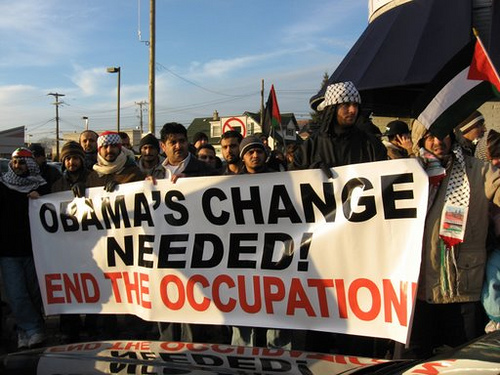
Black America in Solidarity with the Palestinian Struggle for Land, Peace & Freedom Has been Long, Consistent and Principled.

THE PRESENT:

Psalms for Palestine

by Ewuare X. Osayande


Netanyahu,
your flag may bear 
the star of David
but the Palestinian people
bear his spirit;
twirling freedom’s slingshot
hurling the bleeding stones of their defiance  
in the face
of your iron-clad Goliath.


 ---------------------
Malcolm X Grassroots Movement statement condemning the Israeli assault on Gaza and the Palestinian People

The Malcolm X Grassroots Movement condemns in the strongest terms the Israeli assault on Gaza and the US governments full political and diplomatic support for this illegal and amoral military operation.

We firmly assert the right of the Palestinian people to resist their ongoing occupation and colonization by the Israeli government and the international forces of Zionism. We also firmly support the Palestinian peoples right to self-determination and statehood, and the unequivocal and irrevocable right to return.

We recognize that this assault comes at a very critical period for the Southwest Asian and North African region. A period where political alignments and being renegotiated and political maps redrawn by a shifting body of forces, some progressive and some extremely reactionary. In this context we call on the Arab League and all of the Arab governments from Algeria to Iraq, from Saudi Arabia to Sudan, to stand united in solidarity and resistance with the Palestinian people. And to those states that supported regime change in Libya, and are supporting the ongoing regime change operation in Syria, we call on them to provide the Palestinians with the same level of political and economic support for their just cause against the illegitimate Zionist colonial project.

Finally, we call on all people of Afrikan descent within the United States to stand with us in condemning this assault and the ongoing occupation of Palestine. We ask you all to join us in demanding that President Barack Obama condemn this assault, demand that Israel cease its aggression, abide by international law, and by the numerous United Nations resolutions that condemn the occupation, the apartheid system, and the various human rights violations being committed by the Israeli state.

Free the Land!


Monday, November 19, 2012
----------------------------------


THE PAST:
 This was published in the NY Times in the Fall of 1969. It was also published in other newspapers across the US.
======================

 
The Black Panther Party and Palestine Solidarity


by Matthew Quest


"We Are Against the Government that Will Persecute the Palestinian People": Clarifying the Position of the Black Panther Party in Huey Newton’s To Die For The People

Huey Newton, with Bobby Seale, was cofounder of the Black Panther Party (BPP). According to the FBI’s Counter Intelligence Program (COINTELPRO), a campaign by the state to disrupt domestic radical political organizations, the BPP was said to be one of the major threats to American national security in the twentieth century. In their battles against white supremacy and empire, the BPP throughout its history (1966-1982), was more accurately a profound threat to the American ruling class.

The Panthers, as an autonomous Black liberation organization, embodied for many both the independent validity of the expression of revolutionary Black nationalism, and the need to forge principled multi-racial united fronts to fight injustice. Organizing armed community patrols to fight police brutality, breakfast for children, independent media, and community health programs; the Panthers for a time forged a socialist ethic of popular self-management through direct action among urban working class African American communities, and became an international inspiration toward a free society. The BPP had many linkages to insurgent national liberation movements and defiant communist regimes in Vietnam, Cuba, China, Algeria, and Mozambique, to name merely a few.[1]

Perhaps the international solidarity linkage most overlooked and relevant to contemporary battles against empire is the Panthers’ solidarity with Palestine[2]. The following is an examination of the BPP’s stance on Palestine through one historical text, Huey Newton’s communiqué “On The Middle East” (1970) in his volume of collected writings, To Die For The People (1972, 1995)[3]. It is beyond the scope of this essay to comprehensively document historical opinion of the BPP as a whole, which should not be confused with the ideas of one of its major leaders. To do so, it would be necessary to examine views of many of the thousands of members and local chapters nationwide. Rather, the following is an analysis of this one statement by Newton for insights to contemporary struggles for building Palestine solidarity with a particular concern for African American linkages, accusations of anti-Jewish bigotry, and opposing not any particular policy of Israel, but this colonial settler state as a whole.

On September 5, 1970 the BPP called a press conference in response to media allegations, and a memo spread internationally through embassies, that there was a Panther delegation in Jordan led by Stokely Carmichael (later known as Kwame Ture) promoting the interests of the Black Power movement’s solidarity with Palestine “against the Jewish people.” Stokely Carmichael was a major leader of Student Non-Violent Coordinating Committee (SNCC)[4], a multi-racial organization famous for using direct action in the Jim Crow South to register Black folks to vote. He became famous for leading the transformation of SNCC into a black nationalist organization. Huey Newton repudiated this news item about Carmichael and the Panthers as incorrect for two reasons before explaining in more general terms the BPP’s philosophy toward Palestine solidarity in a climate of numerous accusations that the Panthers were “anti-Semitic.”

First, the Panthers did not have a delegation in Jordan. They did have an authorized international chapter based in Algeria, led by Kathleen and Eldridge Cleaver, and these Panthers were in “daily contact” with the Palestine Liberation Organization.[5] Second, Newton distanced the BPP from Carmichael, who was briefly associated with them after the decline of SNCC, continuing a series of unwise destructive exchanges discussing their political differences in public. Admittedly “without evidence”, but under the pressure of COINTELPRO tactics of disruption, Newton sadly accused Carmichael of being a CIA agent, largely over strategic differences in the African American liberation struggle.[6] 

However, their political differences, as discussed by Newton, are worthy of our attention. Not because he fairly characterized all of Carmichael’s positions at that time, or in view of history Carmichael’s evolving political philosophy in comparison with his own. Rather, because Newton asserts certain principles critical to Black and by extension Palestinian liberation.[7]

Newton took issue with the BPP being reported as doing solidarity work under the banner of “Black Power,” a slogan originally closely associated with Carmichael. Carmichael in these years inconsistently advocated socialism and saw the highest stage of Black Power as Pan-Africanism. Newton was critical of ethnic capitalism as the collective economics of liberation, illustrated a similarity between Stokely Carmichael’s and Richard Nixon’s opportunistic support for “black capitalism.”[8] Further while expressing his support for African liberation struggles against imperialism, Newton could not support Pan-Africanism because too many advocates of this philosophy were African governments which in fact aligned themselves with U.S. imperialism.
"In other words, these governments are saying that if the United States will let us exist as a class to oppress our African people then we will cooperate; in other words Black oppressing Black…We know that without the support of the United States imperialism no reactionary government can exist. So we are very careful when we start supporting a government that has relationships in support of the United States."[9]

Newton was seeking to demonstrate “the Black Panther Party [was] internationalist,” and this meant not just international solidarity with all peoples oppressed by white supremacy but international resistance against all whom he understood to be the bodyguards of capital.[10] He did not think the establishment of socialism would automatically eliminate white supremacy but that “the only way to start changing the racist nature of the society is to revolutionize or transform the institutions” of society.[11]

Huey Newton in this statement “On the Middle East” had to preface it with an acknowledgement the Panthers were being attacked for being anti-Semitic, that individual members had in the past said some hurtful, inappropriate things towards Jews which could be publicly cited by enemies of his party, but the official position of the BPP was not anti-Semitic.[12] The Panthers were in the whirlwind of national media incidents where Black Power was in conflict with Jewish Americans.[13] Capitalist economic relations, marked by white racism and ethnic competition for and control over scarce resources, explains, not excuses, some pejorative epithets against Jews by some Black community activists.[14] 

However, it was also a fact that the FBI’s COINTELPRO program was using Black-Jewish tensions as a wedge to disrupt sympathy for the Panthers including manufacturing conflicts which had no material basis.[15] Emerging out of this difficult climate Newton stated the following:
"As far as the Israeli people are concerned we are not against the Jewish people. We are against that government that will persecute the Palestinian people. We have to admit that there is something wrong in the Middle East. The Palestinian people are living in hovels, they don’t have any land, they’ve been stripped and murdered; and we cannot support that for any reason."[16]

Huey Newton then explains he recognized the “shortcomings” of what was supposed to be the progressive United Arab Republic, and the inability or lack of desire of other Arab nation-states, to consistently defend Palestine.[17] 

He believed that everyday Palestinian people were in the forefront of liberating the Middle East, and that he was in solidarity as well with the few Israelis “who were working to see that the Zionist government of Israel is transformed into a secular people’s state” instead of one which privileged those of a certain religion.[18] Newton said Israel was based on “the height of chauvinism and ethnocentrism” and contrasting the Panther viewpoint with Israel’s claim as representative of every Jewish person he stated: 

“We are chiefly interested in the survival of our people, but not at the expense of other people.”[19]
After implying African Americans have a shared history of racial and colonial oppression with Jews and Palestinians and thus a tendency towards solidarity with both, Huey Newton then shares a comparative view on Jewish autonomy, as supposedly represented by the state of Israel, and the hope for Black self-determination in America. It has an immediate relevance to the struggle for Palestinian autonomy as well.

"We have a long history of being enslaved and murdered. We have wrestled with the question of nationalism and we have concluded we have a moral right to embrace nationalism. We have a moral right to choose separatism, just as the Jewish people have that moral right. But we realize that the United States will not allow us to separate and live side by side with United States imperialism. It’s obvious that we cannot become self-determined because the United States will not let countries exist 15 million miles away in freedom…so they will certainly not let us exist in a separate state in North America in freedom. So the question can be put into the future."[20]

Newton in this statement causes the reader to ask why has the US embraced the nation-state of Israel as representative of Jewish autonomy when it allows no other nationality of historically oppressed peoples to be self-determining miles away or within its own borders? Newton exclaims “our central task is the overthrow of the ruling circle, who will not permit the question of self-determination to exist in this world.”[21]
"This transformation can only take place by wiping out United States imperialism and establishing a new earth, a new society, a new world. So politically and strategically the correct action to take is not separation but world revolution in order to wipe out imperialism. Then people will be free to decide their destiny. Self-determination and national liberation can not really exist while United States imperialism is alive. That is why we don’t support nationalism as our goal." [22]

“In some instances,” Newton explained he did support revolutionary nationalism, such as some aspects of the Palestinian national liberation struggle, “as a strategy.” This is because:

"The motives are internationalist because the revolutionists are attempting to secure liberated territory in order to choke imperialism by cutting them off from the countryside. [However,] when the motive for national liberation is solely to create a capitalist state so that the ruling circle of that capitalist state can align itself with [U.S.] imperialism, then it is reactionary nationalism and cannot be supported by revolutionaries."[23]

Unfortunately, this conservative motive for national liberation, which fairly characterizes Zionism, overlords Palestinian national liberation as well to this day led by Yasir Arafat, once their defender and ally of the BPP, now a dictator.[24] This is true whether the U.S. rulers characterizes him as such or imagine still he is their best hope for a dependent pawn as head of an oppressive future Palestinian regime.

Huey Newton characterizes accurately an appropriate standard for anti-racist solidarity with Jewish, Arab, and Muslim individuals and communities as historically oppressed peoples. Do they allow their nationalism to be a pawn for imperialism? Do they oppose not merely some policies of the state of Israel but the Zionist government as a whole?

"Israel was created by Western imperialism and maintained by Western fire power. The Jewish people have a right to exist [there] as long as they exist to down the reactionary expansionist Israeli government. [The African American] situation is similar in so many ways; we say that morally perhaps, the Jewish people can make a case for separatism and a Zionist state based upon their religion for self-defense. We say morally perhaps we could accept this, but politically and strategically we know it is incorrect. In the first place it is perpetuating nationalism…if nationalism is reaction, and I think the United States proves this by using nationalism to rape the world and dominate everyone else. In other words, it went from nationalism to the natural conclusion which is empire or imperialism. So the Jewish people must be careful not to be an agent of imperialism."[25]

Huey Newton concludes this communiqué “On the Middle East” with acknowledgement of two positive developments which he saw emerging three decades ago and a sharp declarative statement. First, Newton felt there was emerging a vocal minority of Jewish people struggling against the racist tactics of the Zionist Israeli government. He expressed the Panthers’ solidarity as evidence they were not anti-Semitic. Second, Newton thought it was a great development that the Arab and Muslim nation states were showing their true colors; their “contradictory” incapacity to defend Palestinian freedom, for to do so compromised the relative privileges of their rulers with American imperialism and inspired visions of freedom among their own subjects.

Finally, Newton took a clear stand against the perpetual assault by Zionist Jews, who insist to be opposed to the state of Israel is to attack the Jewish community as a whole:
"We realize that some people who happen to be Jewish and who support Israel will use the Black Panther Party’s position that is against imperialism and against the agents of the imperialist as an attack of anti-Semitism. We think that is a backbiting racist underhanded tactic and we will treat it as such. We have respect for all people, and we have respect for the right of any people to exist. So we want the Palestinian people and the Jewish people to live in harmony together. We support the Palestinian’s just struggle for liberation one hundred percent. We will go on doing this, and we would like for all of the progressive people of the world to join our ranks in order to make a world in which all people can live." [26]

Footnotes
  1. For global dimensions of the influence of the BPP see Michael L. Clemons’ and Charles E. Jones’ “Global Solidarity: the Black Panther Party in the International Arena.” In New Political Science. 21.2 (1999) 177-204.
  2. Perhaps another international BPP solidarity alliance neglected, related to this story, beyond the scope of this article, but deserving of its own in light of Palestine solidarity is the story of the Black Panther Party of Israel, an organization of “oriental Jews” fighting discrimination against the European dominated Zionist state. See Deborah Bernstein’s “Conflict and Protest in Israeli Society: The Case of the Black Panthers of Israel.” Youth and Society. 14 (1984) 129-151.
  3. Huey P. Newton. “On The Middle East.” In To Die For the People. New York: Random House, 1972. 191-197. The new 1995 edition by the publisher Writers and Readers may be more accessible.
  4. The standard work on SNCC is Clayborne Carson’s In Struggle: SNCC and the Black Awakening of the 1960s. Cambridge: Harvard UP, 1995.
  5. These basic facts in the Newton “On the Middle East” document were briefly introduced by another Panther David Hilliard. For further information on the Panther’s Algeria chapter see Kathleen Neal Cleaver’s “Back to Africa: the Evolution of the International Section of the Black Panther Party (1969-1972)” In Charles E. Jones ed. The Black Panther Party Reconsidered. Baltimore, MD: Black Classic Press, 1998. 211-256.
  6. Newton, 191.
  7. An informative treatment of Stokely Carmichael’s politics in the context of the Black Power era can be found in Robert L. Allen’s Black Awakening in Capitalist America. Trenton, NJ: Africa World Press, 1990.
  8. An older text worth examining on the emergence of “black capitalism” as a political force which clearly illustrates how populist ethnic entrepreneurial schemes undermine the class struggle within national liberation movements is Earl Ofari Hutchinson’s The Myth of Black Capitalism. New York: Monthly Review Press, 1970.
  9. Newton, 192.
  10. Ibid, 192.
  11. Ibid, 193.
  12. Ibid, 193.
  13. These included other Black Power groups support of Palestine, such as SNCC’s and the League of Revolutionary Black Workers’, as well as the Ocean Hill-Brownsville (Brooklyn, NY) public school strike for Black community control which clashed with the predominantly Jewish teachers’ union.
  14. An interesting argument is made that one source of Black resentment towards Jews is consistent with African resentment to middle or model minorities such as Koreans, South Asians, and Arabs. See Vijay Prashad’s Everybody Was Kung-Fu Fighting: Afro-Asian Connections and the Myth of Cultural Purity.
  15. The Jewish Defense League (JDL) was invented with the help of the FBI to disrupt Black liberation struggles in NYC. See Robert I. Friedman’s The False Prophet: Rabbi Meir Kahane, From FBI Informant To Knesset Member. Brooklyn, NY: Lawrence Hill Books, 1990. 96-97.
  16. Newton, 193-194.
  17. The United Arab Republic was a nominal Pan-Arab secular federation of nation-states which was led by Gamal Nasser’s Egypt in unity with Syria and for a time Iraq. Defense of Palestine was often the populist basis for this union. Appearing a strong presence in the late 1950s and early 1960s, and decimated in the 1967 Arab-Israeli War, by 1970 the U.A.R. was proven a myth as a serious opponent of Israel.
  18. Newton, 194.
  19. Ibid, 194.
  20. Ibid, 194.
  21. Ibid, 195.
  22. Ibid, 195.
  23. Ibid, 195.
  24. A concise informative biography of Yasir Arafat is Said K. Aburish’s Arafat: From Defender to Dictator. New York: Bloomsbury, 1998.Newton, 195-196.
  25. Newton, 195-196.
  26. Ibid, 196
==========================================

The League of Revolutionary Black Workers, Arab Americans and Palestine Solidarity
Lauren Ray  

Palestine solidarity activists face intimidation. If we are talented at what we do, organizing and educating about the nature of Israel's white supremacy and colonialism, it is a real risk that we may lose our jobs or get thrown out of school. That the media, the twin managers of corporate capital and trade union bureaucracy, and even so-called defenders of intellectual freedom are liable to turn against us is an occupational hazard. John Watson, member of the League of Revolutionary Black Workers, and student editor of the South End, the campus newspaper of Wayne State University in Detroit, confronted these obstacles in 1968.The paper published an article/editorial favorable toward Palestinian guerrilla operations against Israel. The reaction far outstripped anything before thrown at the South End and set off a series of events that would lead to Watson being pushed out as editor.

Meanwhile in the auto plants of Detroit, thousands of Arab immigrants were laboring, like their African American co-workers, under difficult conditions and represented by a United Auto Workers (UAW) union that was, when not openly hostile, showed willful neglect. By 1973 the number of Arab auto workers had grown significantly. As a sign of increasing militancy, they organized against Leonard Woodcock, then president of the UAW, for accepting an award from B'nai B'rith and against Local 600 for buying Israeli bonds. As well, whereas in the past they had often crossed the picket lines, these Arab auto workers participated in the wildcat strikes called by the League of Revolutionary Black Workers.

Racial and class subordination at home, along with imperialism abroad, produced important and significant activity among Black and Arab workers in the Detroit area. Looking at such a confluence can bring historical weight to the vital strategic importance of a principled and consistent anti-racist democratic perspective which is independent and antagonistic to the permanent hypocrisy of the politicians, local officials, administrators and the union bosses.

The League of Revolutionary Black Workers

The League of Revolutionary Black Workers arose out of the growing militancy of the Black Freedom Movement during the 1960s.[1] The struggle for black autonomy, that found its form in both non-violent direct action and armed uprisings across the U.S., was being unrelentingly repressed by the forces of coercion protecting white supremacy. The so-called progressive moves by the state to expand public welfare and civil rights legislation were finally implemented to subdue rebellious masses (not forge a "Great Society" as the state pretended). Out of continued frustration, anger, and the hopeless limitations of these progressive moves, Black communities exploded from Watts to Newark to Detroit.

The Detroit rebellion of July 1967 was one of the largest Black insurrections this country has seen. It lasted about five days, and during that time African Americans responded to years of police brutality and oppression in the workplace by taking to the streets and battling all the forces of coercion that the U.S. state had to offer—the Detroit police, the National Guard and the U.S. army were called out to suppress the uprising.

Out of the ashes of the city wide rebellion, Black workers brought militant rebellion directly to their capitalist managers. In May of 1968, while the world was watching an epic uprising in France of workers and students which nearly toppled the French rulers, between three and four thousand workers participated in a wildcat strike at the Dodge Main auto plant. This strike was a protest against two main factors. First, black workers were being stifled in the factory by racist policies that kept them in the most back-breaking jobs with no chance of promotion or pay increase. At a time when intellectuals were theorizing about automation making workers obsolete, black workers at another plant were beginning to refer with ironic humor to the conditions of labor they faced as "niggermation."

Second, Black workers faced racism in the unions, particularly the United Auto Workers (UAW), which the League renamed "U Ain't White" for its policies of discrimination and exclusion towards black folks. This fact has not always been clear in the historical record because the major leader of the UAW, Walter Reuther, while doing nothing to fight racism where he had the power to do so inside his own union, has been written up more as a symbol of unity between civil rights and organized labor than for his actual substance.[2]

Several of the Black workers decided to organize the Dodge Revolutionary Union Movement (DRUM). A number of other RUMs were soon established at other factories in Detroit including the famous and huge Ford River Rouge Plant, and Chrysler's Eldon Avenue Gear and Axle plant, but also with spinoffs nationally.[3] With increasing success and popularity of RUM wildcat strikes and popular associations among black workers, an umbrella organization, named the League of Revolutionary Black Workers (LRBW), was created in 1969 to centralize the organizing efforts.

During its short lifetime, the LRBW was to become a radical beacon of light in the struggle for Black autonomy in a turbulent time of political assassinations, state repression, and growing imperialist aggression at the hands of the U.S. state. The founding leaders of the LRBW along with John Watson were Ken Cockrel, Luke Tripp, Mike Hamlin, General Baker, and Chuck Wooten. Ernest Allen and James Forman would play prominent roles subsequently. They would be inspired by such precursors as the Afro-American Student Movement, the ideas of CLR James and James and Grace Lee Boggs, Pan-Africanism, and Third World Marxist ideas associated with China and Cuba. There would be a permanent tension between race and class as a prism for maintaining the direction of the LRBW's political philosophy which would lead ultimately to its collapse.

On one hand the LRBW with its initial dual unionism approach was not advocating for a progressive ruling class, where folks of color would replace the colonial or white rulers to whom they were currently enslaved. On the other, their dual unionism did not maintain ideals of working class self-management but contributed to the compromise of affirmative action in both union and managerial leadership. However, in keeping focus on their international outlook, they did maintain that the key to worldwide liberation lie in the dismantling of white supremacy and empire, and the creation of societies based on the self-determination of all people. Elements from the DRUM constitution demonstrate this aspect of internationalism within the LRBW.

The organizers wrote:

We recognize our struggle is not an isolated one and that we have common cause with the black workers in this racist nation and throughout the world…By being in the forefront of this revolutionary struggle we must act swiftly to help organize DRUM-type organizations…be it in Lynn Townsend's kitchen, the White House, White Castle, Ford Rouge, the Mississippi Delta, the plains of Wyoming, the tin mines of Bolivia, the rubber plantation of Indonesia, the oil fields of Biafra, or the Chrysler plants in South Africa.[4]

The LRBW's solidarity with international struggles found its way into many of the organization's writings. Every organization needs its mouthpiece, and for some time the messenger for DRUM, and later the League, was the Inner City Voice (ICV). A publication distributed mostly among Black workers in the various Detroit auto factories, it was originally published in 1967. When funding began to run out for the ICV a year later, the DRUM organizers sought another outlet through which they could continue to advocate autonomous organization of the Black workers and denounce institutionalized oppressions.

John Watson soon found that opportunity when, as a student at Wayne State University, he ran for editor of the student newspaper and won. The South End was turned into an important outlet for LRBW perspectives and a mass circulation paper. Watson sought to distribute the paper off-campus as well. It would become a platform for which it advocated support for a number of national liberation and guerilla warfare struggles in Mexico, Guatemala, Vietnam, Rhodesia (now Zimbabwe), South Africa as well as Palestine, making systematic connections between conditions at home and struggles abroad.[5] Making these connections was to lead the League of Revolutionary Black Workers to cultivate links with Arab groups and showing films on the Palestinian struggle. Finally, in 1973, Watson went to the Middle East and met with Palestinian guerrilla organizations.

"Pandora's Box"[6]

After Watson published the editorial statement on Palestinian resistance to Israel in Wayne State's student paper, President Keast of the university—already eager to remove Watson because of the publishing of articles on Malcolm X, Martin Luther King, Marxism and the struggle in Greece, as well as local controversies such as attacking the United Auto Workers leadership—attacked the paper saying it was "reminiscent of Hitler's Germany."[7] City, state, union officials, local papers and television shortly followed suit, culminating in an arson attack on South End offices. The alumni group and state legislature threatened to cut off funding and even the American Civil Liberties Union (ACLU) made a censuring statement. A Pandora's Box was opened.

Watson's response cut to the heart of the matter. If all of these people were so horrified by racism then why did all of the critics of the editorial say nothing about the institutional racism against Black and Arab workers in the auto plants or in the city. Official society protested criticism of the abuses committed by the Zionist state, and yet remained silent about the abuses being suffered by Black and Arab workers in Detroit, even though the facts and figures displayed these abuses for all to see. Watson also asked why some critics of the editorial belonged to the exclusive Detroit Athletic Club, which discriminated against Jews, or lived in the exclusive suburb Gross Pointe, known to discriminate against Blacks. For Watson the South End, like the League, took a stand against all forms of racism but the critics only selectively and disingenuously responded to racism when it benefited them. Further, Detroit had the largest Arab population in the United States and he wondered why they were so dangerous that their points of view had to be kept in the closet at all costs.

Considering Watson's response from a contemporary point of view is rewarding. While today's politicians, union officials, alumni groups and newspapers piously celebrate jumbled and falsified versions of the African and African American freedom struggles, the Arab struggle is designated still as a major enemy. The discontents and battles fought by Arab Americans are silenced as the state attempts to mold them into another "model minority," when convenient, leaving suppressed a rich history of resistance, especially surrounding Palestine solidarity. On the other hand, when Palestinians and Arabs do not comply, the state, politicians, experts and "responsible" leaders mobilize the rainbow-colored coalition against the "bad races." This reflects the structural relations in the Middle East where the Palestinian struggle is in the forefront of fighting imperialism and colonialism. The "Pandora's Box" is indicative of this important point. The greater the oppression the greater the hysteria over the racial threat found in the Arab peoples and, in particular Palestinians.

We are told that Palestine solidarity arose in the states during the 1980s by white college kids. This historical account offered to us, like most accounts of U.S. history we receive in school and elsewhere, ignores not only the more radical grassroots elements of Palestine solidarity among Arab Americans, but likewise the essential multi-racial alliances forged by Arab Americans with African Americans, among other groups. White supremacy and imperialism cross all racial, ethnic, and geographic boundaries and have been the tools facilitating the oppression of peoples in Detroit and around the globe. As one radical group operating out of the Dodge Main plant put it, "Chrysler figures that no one will try to help an Arab worker when Chrysler attacks him. So now Chrysler is attacking…It's the same kind of shit they have pulled with black people."[8]

Many Arab workers in turn honored wildcat strikes called by the League and when their numbers increased they became more organized, like Black workers, independently within the union. The confluence of fighting white supremacy in the union and the auto plant and in Israel/Palestine took shape in organizational form during this period in Detroit. Arab workers like African American workers got the worst jobs and the least pay – something the union facilitated for the management. Union leadership, had since just after the Second World War, worked with capitalist management to discipline workers from any further advance toward control of the union and ultimately production. Further, union bureaucracy worked with management to use people of color workers as strike breaking leverage, while at the same time tried to keep them out of the union or from forming their own organizations.

By the late 1960's and early 1970's Arab workers were experiencing this same dynamic. Not only did they get low pay, the worst jobs, and were the first to be fired. But when the local union boss, Leonard Woodcock accepted a Humanitarian Award from B'nai B'rith, Arab and other workers walked off the job as two afternoon shifts were shut down to protest the UAW purchase of Israeli bonds. When Ford local 600 union bought Israeli bonds, only adding to its three-quarters of a million in bonds it already held, Arab workers decided to organize against union leadership. Arab workers made the argument that the Union should not be invested in the Zionist state just like it should not be invested in the Afrikaaner or Rhodesian regime. 3,000 marched to the union's offices.[9] The ignoring and coercion of Arab workers by the union bureaucrats and the management was part of a long history of racism and class warfare against the rank and file that is still with us today.

This Pandora's Box in America, its explosive potential for fundamental change, suggests two lessons on some of the key struggles of this period for our own time. The first was in the contradictions within the union between discipline from above and rank-and-file control of the union and, ultimately, moving out into control of production in the plant. The second was the contradictions between two forces. While all along the state and official society talked about democracy and freedom, there was racism directed against Black and Arab workers and students at home along with U.S. support abroad for the racist war in Zimbabwe, Vietnam and the Portuguese colonies, and Apartheid under the Afrikaaner and Zionist regimes. On the other was the struggle by ordinary people against this systematic racial oppression. These two diametrically opposed traditions of democracy still hold their explosive force today – one seeking to enforce racial and class discipline from above in the name of democracy and freedom, and the other the struggle and implementation of self-government towards the abolishment of class and white supremacy from below.

Conclusion

Arab and African American workers never formed an organization coming out of this period of ferment in early 1970's Detroit. However, what is important is that Black and Arab workers, while coming from different cultural histories, found themselves together under white supremacy and capitalism in the U.S., and African and Arab nations attacked and subordinated by imperialism and settler colonialism abroad. Facing this they began to move in the same direction. The explosiveness of the Palestine/Israel situation was indicative of this. Nowhere in the world are the contradictions of imperialism and liberal and social democracy so sharp and clear than in the oppression of the Palestinians. Watson and the LRBW's experience shows how the officials who said they support civil rights could say so little about the exploitation of Black people and workers in Detroit and elsewhere, or about the oppression of the Palestinian people. At this point the state had assimilated the civil rights agenda and used it as a way to beat back more fundamental change suggested by aspects of the Black Power movement, including efforts towards an end to imperialism and colonialism abroad, such as that which the Palestinians live under in the Jewish state. We are witnessing a similar trend today, as rulers, politicians and bureaucrats in the U.S. and Palestine/Israel pay lip service to the desire for peace and justice, while blatantly working to destroy any such hopes by denying return of refugees, equal access for Palestinians to land and water resources, open travel, and the support of Arab-only zones, both financially and militarily.

The League of Revolutionary Black Workers was not the only Black radical organization of its era to express support for Palestine's freedom; numerous groups, from SNCC to the Black Panther Party, likewise expressed solidarity with Palestinians. At the same time the League's solidarity was unique in several ways that we can draw lessons from today. The organization of workers, both in Palestine/Israel and here in the U.S., will be essential to a successful fight against the institutions, such as white supremacy, which oppress us. This is especially instrumental for divestment campaigns; we cannot organize, isolated on our campuses from the outside world, but must actively incorporate the local communities and the thousands of workers who are involved with and give support to our universities. Likewise, the struggle for a free Palestine is not an Arab or Arab American battle, but must be a multi-racial, multi-ethnic struggle of all justice seeking peoples who are opposed to imperialist and racist agendas.

And finally, our struggle must be against all forces which desire to block the self-activity of the Palestinians to liberate themselves—from Arafat and his lackeys, to Western imperialists, to Zionists (leftist, liberal or right-wing). As the League wrote so many years ago, we must continue to battle those enemies "who would further impoverish the poor, exploit the exploited, and take advantage of the powerless."

Thanks to Aaron Michael Love and Matthew Quest for their assistance with this article.

Footnotes