Monday, July 18, 2011

July 15 - 17, 2011

Race and Voter Suppression: Jim Crow Resurrected in Florida
 
By KARL SHEPARD

Voting rights are at the fore. You would be hard pressed to know that in Florida despite the occasional letter to the editor – 300 words or less.

I tried, I really did, but the Orlando Sentinel just cannot bring itself to discuss real issues. They are of course willing to spill ink on more than 8,000 words on Casey Anthony - but not the real issues that affect real voters and voter suppression.

The Orlando Sentinel is well beyond civilized discussion as is most of the nation.

Let me provide a poultice, an antidote, or flame to the fire:

Americans attained the right to vote in 1965 – not 1865 with end of slavery. At the end of the Civil War, the white south delivered intimidation, degradation, rape, and lynching. White southern suppression of black voters was met with extreme violence.

With the Civil Rights Acts of 1964 and 1965, the US finally honored its commitment to black voters. Finally, the 14th and 15th Amendments to the constitution adopted in 1868 and 1870 were upheld; the first of which is commonly called the "equal protection clause" and the second of which stated that voting could not be denied to any person based on race, color, or previous condition of servitude.

Like so much of what passes for conversation in our country, the discussion of voting rights in not just Florida but across the south, and across the nation generally is scarred with drivel; a confusion of voter fraud, for which there is little evidence, or in some cases the misguided arguments about some presumed notion of "rights vs. privileges".

Voting was a privilege in early America. Only white men that owned property (slaves included) could vote. That changed during and after the Civil War. Voting became a right. With the passage of the 14th, 15th, and in 1920, the 19th amendment, voting became a right of every US citizen born on US soil, women included.

Voter fraud in America at this point and time is a red herring.


It was only after college students came into play in Florida's last general election that they became a group whose voting rights had to be suppressed. It remains to be seen if college students will participate in the same numbers as in the last general election. The now denied change of address at the polling station is a blatant instance of voter suppression. As anyone who has ever attended college knows, college students change their residence frequently.

The real frauds are the Tallahassee legislators and Florida's governor, Rick Scott, who now deny the vote to poor minorities and those over 18 years old; the latter, old enough to die in war and old enough, after the 26th amendment, to vote. How ironic that these "America firsters", and proponents of American exceptionalism, supposedly "faithful to the constitution" now deny potential combatants their right to vote! (Not to mention national health care.)

But historically, voter suppression, especially in the south has always been about denying the black vote. The Democratic Party, the party of slavery and white supremacy, did so in the south from 1877 to about 1970. That changed when conservative Republicans opted for "the states right southern strategy" with the 1972 campaign of Richard Nixon.

LBJ pushed through the Civil Rights Acts of 1964 and 1965. And President Johnson was clear with words to the effect: "I have just delivered the south to the Republican party for the foreseeable future".

With a wink and nod, Nixon, in 1972, promised to not enforce the 1964 and 1965 Civil Rights Acts in exchange for the southern white vote. Thankfully that strategy, under Nixon, Reagan, and even Bush II were thwarted by congress. Still, the Republican Party has been at it ever since. They have now succeeded.

But for what it is worth, there is history.

The suppression of the black vote, and voting generally since the 1970's, is a Republican strategy, not just in Florida, but in Ohio, Michigan, and Indiana. That is the reality. I defy anyone to show me that this is not true. Is it not enough to bring up Katherine Harris and Florida voter rolls purged of 55,000 African-American voters; the appalling lack of polling stations and long voter lines in the black parts of 2000 Florida and 2004 Ohio?

The super rich, the conservative white and retired do not want more voters. Neither do those whose campaigns are backed by that big money. Think I am wrong? Let us for a moment ask the flip question – if big money and the conservative retired wanted more voters – would they be giving money to those in favor of suppressing the vote of college students and minorities?

The real issue however is the suppression of black votes. The limits on voter registration (the signatures collected by those registering to vote in Florida must now be turned in within 48 hours) greatly impacts the ability to sign up new voters and is aimed directly at poor minorities and college students. Is it not enough that Florida, under Rick Scott, changed the amount of time that those who committed felonies (mostly on minor drug charges) are now required to wait five years instead of three before their civil and therefore voting rights can be reinstated?

Care to do a bit of southern history?


After reconstruction was ended throughout the south, Florida included, the question for southern Democrats was not how to make voters of former slaves, but how to intimidate them, to suppress their right to vote, and to make them work, and this is important – at low wages. Cotton, sugar, tobacco, and the black stevedores in the ports of Florida, Tampa, Jacksonville, and Miami, were at stake. Not black workers as voters mind you, but as a nominally free but captive workforce, on plantations and ports, for profit.

The most depressed areas of the south are the cotton south. Does anyone ever wonder why the south for so long was not able to advance as quickly as the north? Or why the most depressed areas of the south are those areas that were subjected to the most intense development of plantation slavery? Has anyone visited the Mississippi Delta from Arkansas to just to north and west of Baton Rouge? Guess not, huh? Does anyone ask questions about what happened to those black voters in these areas?

Shall we delve deeper?

In the black majority states or near black majority states, the intimidation was intense. South Carolina and Mississippi had black majorities. Alabama, Florida, and Louisiana had just under black majorities. Georgia had just little a bit less than black majorities of those states listed. Death and intimidation met those that dared to challenge white supremacy.

Voter suppression after the end of reconstruction in 1877 consisted of lynching, threats of violence, and the denial of any job. That is the reality of black voter suppression.

Republicans want to carry out that reprehensible southern Democratic tradition. If their campaign contributors could get away with it, perhaps they would hire thugs to kill college students attempting to vote. It would be equivalent. It was just that bad from 1877 to 1965 in the south – and just to make sure you understand this, in Florida.

Does anyone care about or remember the 1920 election in Florida?

Black voting rights were in play in the 1920 Florida election. Black WWI veterans that fought for democracy in Europe came home to find no democracy in the south. I guess that puts a real twist on anyone that wants to argue over "the rights and privileges of voting" when the aim is voter suppression, doesn't it?

The 19th amendment giving the vote to women had just been ratified by enough states in the west and north. (The south was vehemently opposed to women's suffrage. Florida, for example, ratified the 19th amendment in 1969. The state of Mississippi was the last in 1984.)

The white south knew that there were black majorities in many communities and that motivated women are a force difficult to control. True to form, black women registered in droves. Strong black women made their men register to vote and shamed those men that had not done so.

It led to the bloodiest election in US history. Ocoee, just outside of Orlando, was completely emptied of its black neighborhood of 500 residents in election related mob violence. Throughout Florida, white mobs stormed the voter lines, lynched some, mutilated others, chased many into swamps, shot many in the back, and burned black residences to the ground.

Emancipation Betrayed: The Hidden History of Black Organizing and White Violence in Florida from Reconstruction to the Bloody Election of 1920.

The 1920 Florida election was drowned in blood; and lost.

 Welcome to the new face of Jim Crow – in 2011 – black people and college students. Perhaps Republicans and their conservative, rich backers will try to turn back the right of women to vote.

Or perhaps, conservatives would rather see a rerun of the 1920 election in Florida.

Karl Shepard is an adjunct professor of history at Valencia College in Orlando, Florida. He can be reached at karl.ss@att.net

Sources.

Paul Ortiz, Emancipation Betrayed, (A real eye-opener on Florida history to 1920)

W. J. Cash, The Mind of the South, (taught at the graduate level in the 50's and 60's)

Phillip Dray, Capitol Men, (a finalist for the Pulitzer Prize in 2008)

Joseph P. Reidy, From Slavery to Agrarian Capitalism in the Cotton Plantation South, (a highly acclaimed account that deals mostly with Georgia)

Eugene Genovese, The World the Slaveholders Made, (a highly respected account of the differences between Caribbean and southern US slavery)

Monday, July 11, 2011

Rethinking Malcolm: What was Marable thinking?
by Abdul Alkalimat
 

July 8, 2011-sfbayview.com


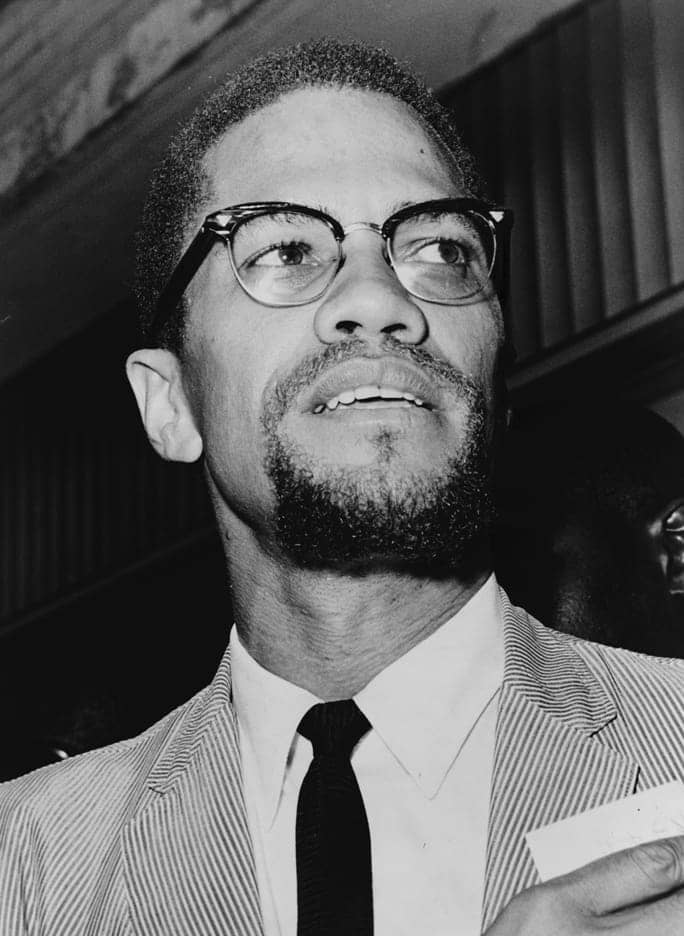
Malcolm X at Queens Court 1964 - Photo: Herman Hiller
The new book by Manning Marable, “Malcolm X: A Life of Reinvention,” will help us to get a deeper understanding of Malcolm X and the times we’re living in now. This will not be a direct result of what Marable has done, but rather of what needs to happen now because of what he has done.1 We can advance our thinking through deep and thorough criticism of this book. We are facing a challenge to our perspective, philosophy and politics for Black liberation. We respect Manning Marable and ourselves by taking him seriously and raising our critique to the highest level. Many will oppose and even resent this review, but I write for the brothers and sisters who will dare to struggle to take the hardcore stance we need for victory.

First came the book, days after Marable’s death, then an avalanche of praise and polemic vaulting Marable into the esteemed ranks of ruling class darling public intellectuals. I collected and sent, to the H-Afro-Am list, nearly 100 reviews and commentaries on this Marable book. They range from “magnificent,” “magisterial” and “a magnum opus of a life’s work based on 20 years of research,” to “sloppy,” “unprofessional” and “speculative based on logical fallacy.” Why such extremely opposite views of this book?

Of course we have been here before with books trying to redefine major historical figures under the pretext of making them more human. This is usually done with innuendo, hearsay and gossip supported by state surveillance reports, all amounting to nothing that can be supported with responsibly sourced data or withstand academic peer review.

The main trend uniting these books is their focus on redirecting the force of revolutionary nationalism towards social democracy reform of a kind that finds its home in the capitalist Democratic Party or towards the figure’s personal or sexual identity, being as influential as political identity. Such work has been written about, among others, Nat Turner (Styron 1976), Paul Robeson (Duberman 1989), Martin Luther King (Garrow 1987, Dyson 2000) and Malcolm X (Perry 1991, Lee 1992). As a generational deviation, this trend is exposed in the 2008 book, “Betrayal,” by Houston Baker. Marable’s book somewhat differs from this trend but nevertheless fits the genre.

It is necessary to critique this book for at least three reasons. First: Marable speaks from within the movement with the legitimacy of being a Black studies professor at an ivy-league school. This reverses the “street cred” marshaled by Spike Lee for his 1992 film, “Malcolm X.” Many have learned from Marable and, given his recent death, are not open to deep and revealing criticism. But this does not serve our movement. Silence never trumps critique. As on Malcolm, so on Marable on Malcolm.

Second: The rulers are making the Marable argument their own, as are the reigning Black public intellectuals, namely Henry Louis Gates, Mike Dyson, Cornel West, Peniel Joseph, Nell Painter etc. It is unprecedented for a book on a leading revolutionary nationalist to be positively reviewed in the main English language capitalist media, i.e., the New York Times, Washington Post, Wall Street Journal, Guardian (UK), Financial Times (UK) and so on. Reviews are in all the major European languages as well. They hyped the book into the New York Times hardback non-fiction bestseller list for five weeks: April 24 at number three on the list, May 1 at six, May 8 at 13, May 15 at 16 and May 22 at 34.

But third and most important of all is the fact that the issues arising from the book are fundamental and may influence both what and how we think. This is my main concern. Elijah Muhammad wrote several books on “How to Eat to Live.” Now we need to focus on how to think to live! And by live, I mean to affirm our radical Black tradition, to critique and resist all forms of oppression and exploitation and to chart a path of social justice toward social transformation.

We need to consider perspective, philosophy and politics in critiquing “Malcolm X: A Life of Reinvention.” Our concern is to probe past the specific inaccuracies, innuendos and judgmental conclusions to get at the basics of how to think to live.

Perspective 

First, the question of perspective: Whose eyes do we use to see? Whom do we intend to hear us? One of the great paradigm shifts of Black studies is to reclaim and reorient the relationship between Black intellectuals and their community. We began to speak to and with each other without necessarily seeking the approval of white authority. We sought peer review from each other and the brothers and sisters off campus. We wanted to understand each other, map our agreements and disagreements, find the intertextuality of our traditions – meaning Black liberation theology, womanism, nationalism, pan-Africanism and socialism – and base our understandings on the dogmas and debates within these traditions.

Marable, at page 492 of “Malcolm X: A Life of Reinvention,” says this of his collaboration with his Viking editor: “Kevin and I communicated almost daily, discussing various versions of chapters, in the effort to build a narrative to reach the broadest possible audience.”

This explains why he regards the Organization of African American Unity (OAAU) as “controversial,” page 2, and not merely what it was: An attempt to bring the united front strategy of the Organization of African Unity to the Black liberation movement. Who considered it controversial? He refers to alleged “anti-semitic slurs,” page 246, without putting this in the context of a necessary struggle against Zionism and the relative power of Blacks and Jews in New York City.

He regards the surveillance of the state as legitimate rather than as flawed in its spreading of disinformation to discredit and disorient. No serious Black liberation perspective would allow this.

On the one hand, Marable contributes interesting summations of Harlem, page 51-64, and Islam, page 79-86, but he is noteworthy for not engaging any of the major writers who have done serious research which has resulted in viewpoints different from his own. A good example of this is Bill Sales’ work on the OAAU, listed in the bibliography but not engaged in the text.

Nor does Marable engage the primary references used by Sales, notably the main state surveillance of the OAAU. And the same goes for James Cone and his definitive comparison of Malcolm X and Martin Luther King. Both Sales and Cone were members of the Malcolm X Work Group, a collective of intellectual activists working collaboratively on research about Malcolm X and holding important symposia in 1987, 1988 and 1989.

Malcolm X Day, Houston.
Perhaps the most cold-blooded negation is his statement that Malcolm has to be resurrected for Black people where, most certainly, he should have said white people. Black people have never forgotten Malcolm X and certainly the state and white intellectuals haven’t either. He was more of an icon in the Black radical tradition than even Martin Luther King Jr. The primary reference for this can be found in the website BrotherMalcolm.net, where there are lists of schools, parks, cultural events, academic lectures and many other things named after Malcolm in communities all over the world. Included are the proceedings of the historic international conference on Malcolm X, “Radical Tradition and Legacy of Struggle,” 1990.  

Perhaps the most egregious omission in this regard is the failure to mention Preston Wilcox. Not only had Preston been a professor at Columbia University, but he was the founder of the Malcolm X Lovers Network. As a community-based archivist, for decades he sent out mailings of the news clippings and ephemera he collected at the community level, flyers of events, petitions, documentation of naming ceremonies, debates, lectures, conferences etc. He was a long time resident of Harlem and left his papers to the Schomberg Center. To ignore Preston Wilcox is to show no respect for the Black community or its community-based intellectuals who have always kept the memory of Malcolm alive.

The perspective of Marable’s book is not from the Black studies approach of respecting our own tradition. Instead, it gives credence to such as the Bruce Perry book on Malcolm, 1991, which was written as a police agent’s attack, filled with lies and innuendo. What was Marable thinking? Or not thinking?

Perhaps the most cold-blooded negation is his statement that Malcolm has to be resurrected for Black people where, most certainly, he should have said white people. Black people have never forgotten Malcolm X

Philosophy 

Now let us take up issues of philosophy. Here, I want to focus on two questions: What is real and how does reality change? In other words, this is an investigation as to whether Marable uses a dialectical materialist philosophy in this book. How was Marable thinking?

First, what is dialectical materialism? Materialism is a philosophical position that affirms the existence of the material world outside of and independent of our consciousness and hence we must be in the world and engage it in order to come to any understanding of it. This means that when you want to speak about the world, you have to provide material evidence so that others can evaluate whether and how your words correspond with material reality.

Dialectics is about the nature of reality, that everything is in motion and that this motion reflects the conflicting tensions between contradictions. Most things have many contradictions, but in general there is always a principle contradiction that dominates the identity of that reality. External contradictions are the conditions for change but internal contradictions are the basis for change.

So to understand something, we have to include both the external and the internal contradictions as part of our analysis. This is a philosophical approach that is essential for understanding the complexity of the world, human society and of course important historical figures.

In sum, we can say that philosophy is not – and should not be portrayed as – a mystery but something that all of us can master. This is clearly a different approach to philosophy than the archaic approaches usually associated to philosophy as an academic discipline. For our purposes here, there are two fundamental philosophical questions:

1. How do we know something? This gets at our grasp of material reality. We all think we know some things, so how do we know what we think we know?
2. And so what? How does our understanding capture the nature of reality such that we understand the motion of how things change and how change comes about?
In this regard, Marable sets a high standard for this book:
“My primary purpose in this book is to go beyond the legend: to recount what actually occurred in Malcolm’s life. I also present the facts that Malcolm himself could not know, such as the extent of illegal FBI and New York Police Department surveillance, acts of disruption against him, the truth about those among his supporters who betrayed him politically and personally and the identification of those responsible for Malcolm’s assassination,” page 12.
First, when you apply the revolutionary mandate, “no investigation, no right to speak,” the book comes up short for a lack of evidence. Why not provide the source and let the reader be the judge? Here are some examples of statements with no evidence presented in the 63 pages of footnotes:

1. Page 12 – “55-year-old audio tapes” are cited as having been reviewed by Marable but no additional information is given such as the number of tapes, dates etc. Good scholarship requires documentation of evidence so it can be checked by others.

2. Page 22 – “Amy Jacques Garvey … may have been involved in Eason’s assassination,” a statement based on the conjecture in a secondary source.

3. Page 36 – “He may have also believed that his mother’s love affair [was] a betrayal of his father.” Here, Marable is practicing psychoanalysis without any data to back this conclusion.

4. Page 123 – He states of the Nation of Islam (NOI) membership: “Until 1961, it would expand more than tenfold, to 75,000 members.” Again, no source, so why should we consider this as fact?

5. Page 137 – “James Warden … son of a labor organizer who may once have been a member of the Communist Party.” He interviewed Warden on three occasions, so why no indication of the source of this? Exactly what was said? James Warden, now Abdullah Abdur Razzaq, stated during the Malcolm X Museum forum on the book, held at the Schomburg Center on May 19, 2011, that he was totally misquoted in the book and that he has the transcripts of his interview to prove it. Wassup?

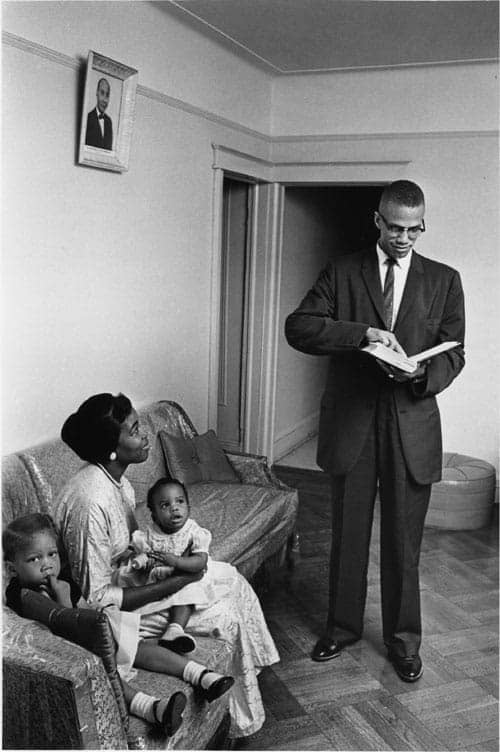
Malcolm with wife, Betty, and two daughters.

6. Page 147 – Referring to his wife, Betty: “Malcolm rarely, if ever, displayed affection toward her.” But then on page 180, Marable writes: “Malcolm conveyed his love for her.” Which is it? And without evidence, how can we believe the amateurish psychoanalysis he presents?  

7. Pages 174-175 – “A fire broke out in Louis’ home … most NOI members believed [Ella] Collins was responsible.” Again, no evidence.

8. Page 247 – Elijah Muhammed “interpreted the [autobiography] as evidence of Malcolm’s vanity but [decided], at least temporarily, to cater to this.” Here, Marable’s father-son Freudian analysis on Elijah Muhammad and Malcolm X remains speculative without even a footnote that exposes the intellectual framework for such an idea. This idea is at least more responsibly argued by Wolfenstein, 1981.

9. Page 256 – Regarding Malcolm’s analysis of the 1963 March on Washington, Marable writes that his “version of events was a gross distortion of the facts – yet it contained enough truth to capture an audience of unhappy black militants.” Note the lower case b. Does Marable think his assessment is so self-evident that it needs no support? Who is he writing to?

10. Page 266 – Regarding the notion that Malcolm was romantically involved with a woman whom Elijah Muhammad got pregnant: “No one else, not even James 67X, has made such a claim.” So why make such a big deal out of this sexual controversy in at least five different places in the book?

11. Page 268 – “Nearly every individual he trusted would betray that trust.” Again, such a global statement without proof can only sow the seeds of distrust in the movement and go against those living who were close to Malcolm.

12. Page 284 – “There is evidence that Malcolm may have met with the leaders of the Communist Party’s Harlem branch.” Now, while this is perfectly possible, why no documentation of the evidence? And what about Bill Epton?

13. Page 294 – “It is likely that no more than 200 members in good standing quit the sect: less than 5 percent of all mosque congregants.” Why use the pejorative word “sect” for the NOI? And again, what is the source of these numbers?

14. Page 423 – “Sharon 6X may have joined [Malcolm] in his hotel room.” Another damning statement with no evidence whatsoever.

15. Page 469 – “The organization’s archival heritage … were [sic] largely destroyed and a new memory, branded by orthodoxy, was imposed.” What is the source for this? There are several organizations who claim to have the archives, so why does Marable think that they are gone? And who imposed what new memory? While many may believe this, a serious work of scholarship would provide some kind of proof.

So the basic trend of these 15 points tells us that this is a poor job of empirical scholarship. Moreover, only about 20 percent of the 63 pages of footnotes come from primary sources. The rest of the footnotes come from published work based on others peoples’ research. Marable hardly ever engages the serious scholarship of others and fails to give any credit to his first project director who guided the day-to-day research effort, Cheryl Greene, who was not even mentioned in the acknowledgments.

Marable states in the acknowledgments: “Elizabeth Mazucci was largely responsible for building the Malcolm X chronology.” In fact, the first chronology on his Columbia University website was lifted entirely from our BrotherMalcolm.net site without any attribution. I had to protest to Marable and when I got no response from him, I wrote to the Columbia administration. The page was taken down, but no one gave me the courtesy of a response. Marable then reposted the chronology with a new format and a couple of new dates added, but still with no acknowledgement of sources. 

Marable and I were among the five founders of the Black Radical Congress but this was hardly the move of a comrade, a brother or an honest scholar.

The overarching philosophical error in this book is suggested by the title: “Malcolm X: A Life of Reinvention.” There are two incorrect aspects to this fundamental, idealist error. First, Marable discounts Malcolm’s own autobiography, writing: “In many ways, the book is more Haley’s than its author’s: because Malcolm died in February 1965, he had no opportunity to revise major elements of what would become known as his political testament,” page 9.

I was at the 1992 Knoxville, Tenn., auction of the papers from the Haley estate and reviewed the documents such as the final copy edited by Malcolm and the missing chapters. After but a quick scan, I don’t believe there is any basis for this authorial challenge, which seems like just another attack on Malcolm X. The autobiography was not of a life invented by Alex Haley. The documents in question were purchased by Detroit attorney Greg Reed and we await their release for a closer examination. Reed has also obtained a trove of documents recovered from the papers of a former member of the NOI in Detroit that will increase the archives we have.

Second, Marable suggests that Malcolm opportunistically invented and re-invented himself as a form of self-promotion, “to package himself to maximum effect,” page 10. He thinks the process was based on intentional agency by Malcolm X himself. Does consciousness determine being, or does being determine consciousness? Marable takes the first approach while I suggest a materialist perspective that follows this observation by Karl Marx: “It is not the consciousness of men that determines their being, but, on the contrary, their social being that determines their consciousness.” We must look to the concrete circumstances of Malcolm’s life and how the interplay of external and internal forces played out in his dialectical transformations.

There is no evidence that Malcolm deliberately reinvented himself. Rather, as with anyone who matures, the stages of Malcolm’s life can be understood as resulting from the dialectic of his consciousness and his concrete experiences. His ideas about himself and the world were negated by his experience, compelling him forward, even against his will at times.

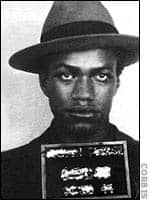
Malcolm Little, 18.
He was a youth who believed in and wanted to be part of society, but the negation of dominant society by his father and his mother and then the negations of Malcolm by his teachers and his foster home experience all made him reject mainstream aspirations and pulled him into life on the street and becoming an outlaw. As an outlaw, the state negated him and put him in the joint, where he continued to be a satanic character. In opposition to this negation, his family and fellow prisoners then provided support and a path into a new form of consciousness and being. He cleaned up and began to recapture consciousness, to follow the path of his father and family.

As Malcolm Little, he remained in small Midwestern towns such as Omaha, Milwaukee and East Lansing. As Detroit Red, he was in large East Coast cities like Boston, New York and Washington D.C. What remained a constant was his eagerness to learn and achieve, first as an affirmation of society, then when negated as a negative force in society.

Once Malcolm X joined the NOI, led by his family members, he combined the lessons of both earlier stages of his life and built its membership up by going among the gangsters, the negated and the most oppressed, raising them into the lifestyle that his parents taught him and that Elijah Muhammad reaffirmed – all of them moral, disciplined and proud people.

At least three more forces changed Malcolm X. First, he was appointed by the NOI to become national minister and travel the county at the same time that the national freedom movement was reaching its peak in terms of consciousness and mobilization. He read and engaged with activists. While he changed many, he was also changed.

Second, the police attacked and killed members of the NOI, especially in Los Angeles, and Malcolm was ready for action that far exceeded what the NOI was prepared to do.

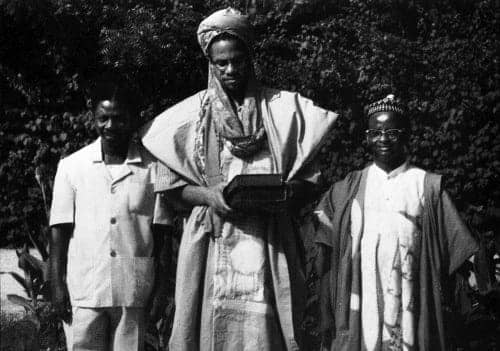
Malcolm X in Africa,1964.

Third, the world situation was ablaze with armed struggle for national liberation from Vietnam to Africa, Cuba and Latin America. He followed these movements very closely. His three great Detroit speeches from 1963, 1964 and 1965 made this very clear. His final break with the NOI was conditioned by these external factors and two more factors internal to the NOI. One was Elijah Muhammad, violating his own moral teachings regarding adultery. The other was Malcolm’s direct violation of the central leadership’s order of silence on the Kennedy assassination.

Elijah Muhammad negated himself; Malcolm, having internalized the external political forces acting on him, negated the order of silence. Malcolm’s new status, free from the confines of the NOI, was reinforced by his continued movement into Sunni Islam via his Hajj and his continued movement into world revolution by extensive trips abroad in Europe and Africa.

My argument is that Malcolm’s life was not an intended self-invention process through his agency, but a global process that summed up the journey so many were to make from being members of the oppressed to embracing Black self-determination and becoming revolutionaries. This is the dialectical materialism of social change in the late 20th century and on that basis people held, and continue to hold, Malcolm in the highest regard and they lived, and continue to live, the life he epitomized.

Politics

Now we come to politics and the strategy and tactics advocated by Malcolm X. Strategy is the long term view of how to seize power and transform society, making clear what forces in society can be counted on and what forces one will have to fight. Strategy also focuses on the goals of a struggle. Tactics are the methods used in the day-to-day struggle in which a lot of flexibility and innovation is needed in the tit-for-tat encounters with the enemy and in mobilizing the masses of people. Tactics are subordinate to strategy and can’t be equated or else one will confuse the zigzag of the struggle with the goal and basic plan for mobilization, organization and victory.

On a global level, Marable gives us a clue of how he invents his own Malcolm X. He states: “The United Nations World Conference Against Racism, held in Durban, South Africa in 2001, was in many ways a fulfillment of Malcolm’s international vision,” page 485. This is ridiculous. Malcolm X would have condemned the Durban meeting just as he did the 1963 March on Washington. Apparently the writer of the epilogue of Marable’s book forgot what the writer of Chapter 4 had written: “Black American leaders, Malcolm now urged, must ‘hold a Bandung Conference in Harlem,’” page 120.

Malcolm’s life was not an intended self-invention process through his agency, but a global process that summed up the journey so many were to make from being members of the oppressed to embracing Black self-determination and becoming revolutionaries.

Durban was a conference in which the imperialists were trying to assert their hegemony over anti-racism and decolonization. Bandung was a third-world gathering to plan unity and resistance in opposition to the imperialists. Compare Wikipedia’s descriptions of each meeting:
Malcolm X never believed an honest discussion could be held with imperialists. He would have predicted what actually happened in Durban: The U.S. imperialists blocked any open debate in order to defend their client state, Israel.

On Malcolm X’s political thinking, Marable writes: “Despite his radical rhetoric, as ‘The Ballot or the Bullet’ makes clear, the mature Malcolm believed that African Americans could use the electoral system and voting rights to achieve meaningful change,” page 484. Here Marable refuses to embrace the dialectical thinking of Malcolm X. First, Malcolm’s thinking was grounded in the radical Black tradition. See what Frederick Douglass wrote 100 years earlier in an article titled “The Ballot and the Bullet,” 1859:

“If speech alone could have abolished slavery, the work would have been done long ago. What we want is an anti-slavery government in harmony with our anti-slavery speech, one which will give effect to our words and translate them into acts. For this, the ballot is needed, and if this will not be heard and heeded, then the bullet. We have had cant enough and are sick of it. When anti-slavery laws are wanted, anti-slavery men should vote for them; and when a slave is to be snatched from the hand of a kidnapper, physical force is needed, and he who gives it proves himself a more useful anti-slavery man than he who refuses to give it, and contents himself by talking of a ‘sword of the spirit,’” reprinted in Douglass 1950, page 457-458.

The ballot or bullet theme in Black radicalism is in fact a fundamental tenet of American politics. It was part of the ideological rationale for the American anti-colonial war of liberation from England. It was stated in the 1776 Declaration of Independence, 235 years ago. Read the full text if you want to understand the tradition on which Malcolm X stands – a radical American tradition.

Malcolm delivers Ballot or Bullet speech in Detroit, Michigan, on April 12, 1964.
Malcolm’s “Ballot or the Bullet” speech was part of his spring 1964 offensive. It is important to be clear on the historical context in which he was giving political leadership. Forces that preceded and surrounded him undoubtedly impacted his thinking:  

1. The increasingly militant struggles in the South, especially those led by Medgar Evers after the brutal murder of Emmett Till in 1955.

2. Robert Williams and his Monroe, North Carolina, armed self-defense strategy as summed up in his book “Negroes with Guns,” 1962.

3. The armed group Deacons for Defense and Justice formed in Louisiana in 1964.

4. The Revolutionary Action Movement, a group led by Max Stanford, who went on to influence the development of the Black Panther Party. This was the only other organization that Malcolm X joined.
President John F. Kennedy was assassinated in November 1963. Vice President and then President L.B. Johnson consolidated his own leadership by staying the course and supporting major civil rights legislation, so the Civil Rights Act of 1964 was signed into law on July 2, 1964.

During the summer of 1964, SNCC led the civil rights organizations that had formed into a coalition called the Council of Federated Organizations (COFO) in 1962 for a major offensive in Mississippi. This was the Mississippi Summer Project. Hundreds of activists poured into the state and confronted the heart of racist state power. The House passed the bill in February 1965, but a Senate filibuster held it up. The Senate filibuster ended on June 19.

Three movement activists – Goodman, Chaney and Schwerner – were martyred by assassination in Philadelphia, Miss., on June 21. Out of the Mississippi Summer Project came a political party, the Mississippi Freedom Democratic Party, MFDP. It was the MFDP that brought Fannie Lou Hamer to Harlem in 1964, where she appeared on a platform with Malcolm X.

From the local precinct level to a delegation going to the national convention, the MFDP fought the racist party organization that excluded Black people. The main civil rights leaders tried to get the MFDP to accept being seated at the convention without voice or vote. The MFDP, with the SNCC, rejected this as a sellout. In the meantime, the bullets kept flying:
  • 1963 – June: assassination of Medgar Evers.
  • 1964 – July: rebellion in Rochester, N.Y. August: rebellion in Philadelphia, Pa.
  • 1965 – February: assassination of Malcolm X. August: rebellion in Watts, Los Angeles.
  • 1966 – June: “Black Power” slogan emerges in militant march in Mississippi. July: rebellions in Cleveland, Ohio and Omaha, Neb. [September: rebellion in Hunters Point, San Francisco. – ed.] October: Black Panther Party is organized in Oakland, Calif.
  • 1967 – June: rebellion in Detroit, Mich. July: rebellions in Newark and Plainfield, N.J. October: assassination of Che Guevara.
  • 1968 – April: assassinations of Black Panther Bobby Hutton and Martin Luther King Jr. and rebellions in Chicago, Ill., and more than 100 other cities. June: League of Revolutionary Black Workers is organized in Detroit.
  • 1969 – December: assassination of Black Panther Fred Hampton.
In 1965-66, the struggle was developing. The defeat of the Watts rebellion led to the ideological advance of the “Black Power” slogan and the new revolutionary organization called the Black Panther Party, followed two years later by workers throwing up a new revolutionary force on the factory floor called the League of Revolutionary Black Workers. The U.S. armed forces put down major urban rebellions and assassination of Black radical leaders continued.

The 1964 presidential campaign brought forward the ultra-right in the form of Barry Goldwater. By 1966, “Black Power” emerged as a key ideological slogan. Electoral victories led to the first major Black mayors of Cleveland, Ohio, and Gary, Ind.

By 1968, things got even more extreme when Alabama Gov. George Wallace, the nation’s leading segregationist politician, ran for president and won the Indiana primary. Richard Nixon was elected president in 1968 and 1972, but was run out of office in disgrace in 1974. A struggle for power was taking place.

Malcolm X laid the basis for understanding these events: the Senate filibuster and racist state power, the murders and the unity between the Klan and the government and the emergence of Black Power in both electoral and more militant forms as well. This was indeed the ballot and the bullet, 20th century edition.

The analysis that Malcolm laid out in his spring 1964 speeches amounts to a theory of the U.S. racist, capitalist state that is based on finding a strategy to fight against it. First, the power of the U.S. ruling class, as based on Southern fascism versus a Black united front; then, armed self-defense for Black liberation as self-determination versus that racist state power.

Marable advances an argument that separates Malcolm from his legacy, a legacy that was in fact us – the Black liberation movement. But no activist in that movement who was in motion at the time will believe his argument. It flies in the face of our experience.

Malcolm X laid the basis for understanding these events: the Senate filibuster and racist state power, the murders and the unity between the Klan and the government and the emergence of Black Power in both electoral and more militant forms as well. This was indeed the ballot and the bullet, 20th century edition.

Why this book, at this time? 
We have reviewed Manning Marable’s book on Malcolm X as far as perspective, philosophy and politics. But we still have an outstanding question – why this book, at this time? President George W. Bush was a right-wing standard bearer. We took to the streets to fight his policies. The resistance to the imperialist war on Iraq and then Afghanistan produced a major antiwar movement with heightened consciousness that developed faster and with a sharper focus than the movement against the Vietnam War.

But now we have the Obama moment. Barack Obama is a Black face on U.S. imperialism. While he has escalated Bush’s war and extended it into Libya, we have no antiwar movement challenging Obama’s legitimacy. The ruling class is using a Black man to advance the cause of neoliberalism. They are concerned more about banks “too big to fail” than unemployment and the suffering of the masses of people.

Maybe I should say Obama is our man doing their work. We voted for him but he lacks the guts to fight for us against the rulers and generals who govern. He seeks to compromise with right-wing Republicans and Democrats captured by the fascist Tea Party that holds 10 percent of the seats in Congress.

Rather than give us the Malcolm X of the Detroit speeches, the Malcolm X we love and respect, Marable tries to cut him down to size with unsubstantiated arguments under the guise of humanizing Malcolm X. In summary, Marable gives us a perspective that is outside of the Black studies tradition in his attempt to sell books to a wide American book-buying public.

Marable gives us a philosophy that is mechanical and not dialectical, idealist and not materialist. And he attempts to turn Malcolm X into a social reformer rather than the revolutionary that he actually was. In short, Marable fabricates a Malcolm X who would not take militant and revolutionary action against the global war, poverty or degradations of today. That’s why we have to speak up: to respect our legacy and affirm our future.

Rather than give us the Malcolm X of the Detroit speeches, the Malcolm X we love and respect, Marable tries to cut him down to size with unsubstantiated arguments under the guise of humanizing Malcolm X.

Bibliography 

Baker, Houston. “Betrayal: How Black Intellectuals Have Abandoned the Ideals of the Civil Rights Era.” New York: Columbia University Press, 2008.
Clarke, John Henrik, ed. “William Styron’s Nat Turner: Ten Black Writers Respond.” Boston: Beacon Press, 1968.
Cone, James. H. “Martin & Malcolm & America: A Dream or a Nightmare.” Maryknoll, N.Y.: Orbis Books, 1991.
Douglass, Frederick. “The Life and Writings of Frederick Douglas, Volume 2.” Philip S. Foner, ed. New York, International Publisher, 1950.
Duberman, Martin Bauml. “Paul Robeson.” New York: Alfred A. Knopf, 1988.
Dyson, Michael Eric. “I May Not Get There With You: The True Martin Luther King, Jr.” New York: Free Press, 2000.
Engels, Frederick. Translated by Emile Burns. “Anti-Duhring.” Moscow: Progress Publishers, 1947. Available at http://www.marxists.org/archive/marx/works/1877/anti-duhring/.
Garrow, David J. “Bearing the Cross: Martin Luther King Jr., and the Southern Christian Leadership Conference.” New York: William Morrow & Company, 1986.
Lee, Spike. “Malcolm X” [movie], 1992.
Marable, Manning. “Malcolm X: A Life of Reinvention.” New York: Viking, 2011.
Muhammad, Elijah. “How to Eat to Live, Volume 1.” Chicago, Muhammad Mosque of Islam No. 2, 1967. Available at http://www.seventhfam.com/temple/books/eattolive_one/eat1index.htm.
Muhammad, Elijah. “How to Eat to Live, Volume 2.” Chicago, Muhammad Mosque of Islam No. 2, 1972. Available at http://www.seventhfam.com/temple/books/eattolive_two/eat2index.htm. 
Perry, Bruce. “Malcolm: The Life of a Man Who Changed Black America.” Barrytown, NY. Station Hill Press, 1991.
Sales, William W. “From Civil Rights to Black Liberation: Malcolm X and the Organization of Afro-American Unity.” Boston: South End Press, 1994.
Stanford, Maxwell C. “Revolutionary Action Movement (RAM): A Case Study of an Urban Revolutionary Movement in Western Capitalist Society.” Master’s thesis. Atlanta University, 1986. Available at http://www.ulib.csuohio.edu/research/portals/blackpower/stanford.pdf.
Styron, William. “The Confessions of Nat Turner: A Novel.” New York: Random House, 1967.
Williams, Robert F. “Negroes with Guns.” New York, Marzani & Munsell, 1962.
Wolfenstein, E. Victor. “The Victims of Democracy: Malcolm X and the Black Revolution.” Berkeley: University of California Press, 1981.


Abdul Alkalimat, Ph.D., is a professor of African American studies at the University of Illinois, the author of “The African American Experience In Cyberspace,” the creator and editor of BrotherMalcolm.net and the compiler of Selected Work on Malcolm X by Abdul Alkalimat. In 1996, he and Bill Fletcher Jr., Manning Marable, Leith Mullings and Barbara Ransby founded the Black Radical Congress. He can be reached at mcworter@illinois.edu.
============================

Monday, June 27, 2011

DARK GIRLS: 
A Black Documentary The Needs Our Support
Below are clips from the upcoming documentary exploring the deep-seated biases and attitudes about skin color---particularly dark skinned women, outside of and within the Black American culture.

This film will be released in Fall/Winter 2011. Please "Like" the Dark Girls page on Facebook,so you will be kept updated with news there. Please support the Sisters and Brothers who have made this important documentary by helping raise money at indiegogo.com/​Dark-Girls-Movie

Directed by Bill Duke and D. Channsin Berry
Produced by Bill Duke for Duke Media
and D. Channsin Berry for Urban Winter Entertainment
Co-Produced by Bradinn French
Line Produced by Cheryl L. Bedford
Edited by Bradinn French 
----------------------------
Dark Girls: Preview from Bradinn French on Vimeo.

Sunday, June 26, 2011

FREE HEALTHCARE AT ALL MAJOR US AIRPORTS!

Thursday, June 16, 2011

More Evidence of Deep Racial Selfahte Among Our Youth

Instead of living in a "postracial" society, we are living in a HYPERRACIAL society that guarantees Black economic, social, cultural and spiritual oppression for the sake of profit maximization and white supremacy.  The successful day-to-day functioning of this hyperracial reality makes sure that the vast majority of the world's people (people of color) also fall in line behind the white capitalist Pied Piper.

We need to find creative ways to break thru the Racist Matrix that traps our youth to help them see that they are not free and ugly, but oppressed and Beautifully Black Geniuses in dire need of Revolution.

Wednesday, June 15, 2011

Racism + "Science"  =  Hole in the Head
An Essential Video Documentary of PreNazi US "Scientific Experiments" In Mississippi
-----------------
Hole In the Head: A Life Revealed

Vertus Hardiman hid a shocking secret under a wig & beanie for over 80 years. He was experimented on at age of 5 by a county hospital in Indiana during 1927. Vertus was one of ten children, all experimented on with radiation that day.

FOR MORE INFORMATTION ON MOVIE AND PRINT RELEASES, PLEASE VISIT THE WEBSITE AND SIGN UP. http://www.smithleonardproductions.com

Tuesday, June 14, 2011

Rescuing the Real Uncle Tom
By DAVID S. REYNOLDS

June 13, 2011

NOTE: Racism- over the years has so distorted what Harriet Beecher Stowe was trying to portray in the central character of her novel, that we now have a term that denotes a groveling sellout of Blackfolk: Uncle Tom. Just like the word "Black" evolved into meaning everything evil/less than/inhuman/impure... so has "Uncle Tom." But, Blackfolk redefined the word "Black" back in the socially, culturally and politically conscious days of the 60's and 70's when we asserted: BLACK POWER! & BLACK IS BEAUTIFUL! Now, we must begin to reverse the proslavery connotation of an anti-slavery character called "Uncle Tom." For Uncle Tom was NOT an Uncle Tom! This little essay helps us along the way.-- SEA

THE novelist Harriet Beecher Stowe, born 200 years ago today, was an unlikely fomenter of wars. Diminutive and dreamy-eyed, she was a harried housewife with six children, who suffered from various obscure illnesses worsened by her persistent hypochondria.

And yet, driven by a passionate hatred of slavery, she found time to write "Uncle Tom's Cabin," which became the most influential novel in American history and a catalyst for radical change both at home and abroad.

Today, of course, the book has a decidedly different reputation, thanks to the popular image of its titular character, Uncle Tom — whose name has become a byword for a spineless sellout, a black man who betrays his race.

And we tend to think of the novel itself as an old-fashioned, rather lachrymose affair that features the deaths of an obsequious enslaved black man and his blond, angelic child-friend, Little Eva.

But this view is egregiously inaccurate: the original Uncle Tom was physically strong and morally courageous, an inspiration for blacks and other oppressed people worldwide. In other words, Uncle Tom was anything but an "Uncle Tom."

Indeed, that's why in the mid-19th century Southerners savagely attacked "Uncle Tom's Cabin" as a dangerously subversive book, while Northern reformers — especially blacks — often praised it. The ex-slave Frederick Douglass affirmed that no one had done more for the progress of African-Americans than Stowe.

The book was enormously popular in the North during the 1850s and helped solidify support behind the antislavery movement. As the black intellectual W. E. B. Du Bois later wrote, "Thus to a frail overburdened Yankee woman with a steadfast moral purpose we Americans, both black and white, owe our gratitude for the freedom and the union that exist today in these United States."

The book stoked fires overseas, too. In Russia it influenced the 1861 emancipation of the serfs and later inspired Vladimir Lenin, who recalled it as his favorite book in childhood. It was the first American novel to be translated and published in China, and it fueled antislavery causes in Cuba and Brazil.

At the heart of the book's progressive appeal was the character of Uncle Tom himself: a muscular, dignified man in his 40s who is notable precisely because he does not betray his race; one reason he passes up a chance to escape from his plantation is that he doesn't want to put his fellow slaves in danger. And he is finally killed because he refuses to tell his master where two runaway slaves are hiding.

As for Little Eva, she bravely accepts her coming death and says she would gladly give her life if that would lead to the emancipation of America's enslaved blacks. Together Tom and Eva form an interracial bond that offers lessons about tolerance and decency.

Unfortunately, these themes were lost in many of the stage versions of "Uncle Tom's Cabin" that inevitably sprung from its immense popularity. Indeed, Stowe's novel yielded the most popular and one of the longest-running plays in American history.

The first dramatization of the novel appeared in 1852, the year it was published, and countless others followed. By the 1890s, there were hundreds of acting troupes — so-called Tommers — that fanned out across North America, putting on "Uncle Tom's Cabin" in every town, hamlet and city. Some troupes even toured internationally, performing as far away as Australia and India.

The play, seen by more people than read the book, remained popular up to the 1950s and still appears occasionally, including a staging last fall at the Metropolitan Playhouse in New York.

But as the story moved from the book to the stage, Stowe's revolutionary themes were drowned in sentimentality and spectacle. Eva's death was frequently a syrupy scene in which the actress was hauled heavenward by rope or piano wire against a backdrop of angels and billowing clouds.

Uncle Tom, meanwhile, was often presented as a stooped, obedient old fool, the model image of a submissive black man preferred by post-Reconstruction, pre-civil rights America.

It was this Uncle Tom, weakened both physically and spiritually, who became a synonym for a racial sellout by the mid-20th century. Black musicians, sports figures, even establishment civil rights leaders were all tarred with the "Uncle Tom" label, often by younger, more radical activists, as a way of demeaning them in the eyes of the African-American community.

But it doesn't have to be that way; Uncle Tom should once again be a positive symbol for African-American progress.

After all, many people who over the years were derided as Uncle Toms — Jackie Robinson, Louis Armstrong and Willie Mays, to name a few — are now seen as brave racial pioneers.

Indeed, during the civil rights era it was those who most closely resembled Uncle Tom — Stowe's Tom, not the sheepish one of popular myth — who proved most effective in promoting progress.

Rosa Parks didn't mind the Uncle Tom label, since she believed that great change could result from nonviolent moral protest. The Rev. Dr. Martin Luther King Jr., though often called an Uncle Tom, also stuck to principled nonviolence.

Their form of protest was just as active as Tom's, and just as strong. Both Stowe and Tom deserve our reconsideration — and our respect.

David S. Reynolds, a professor of American studies and English at the Graduate Center of the City University of New York, is the author of "Mightier Than the Sword: 'Uncle Tom's Cabin' and the Battle for America."

Sunday, June 12, 2011

HOW THE INTERNET IS REVOLUTIONIZING EDUCATION

How the Internet is Revolutionizing Education
Via: OnlineEducation.net

Thursday, June 09, 2011

Open Letter from the Citywide Coalition for Educational Excellence NOW!

BLOOMBERG'S CHANCELLOR CHOICES ONLY LEAD TO MORE MIS-EDUCATION


White Supremacy & Capitalism Rules Bloomberg's Privatization of Public Education

Brecht Forum Lecture Series
The Continuous Study of Race and Class in America
Part of the Course “Hubert Harrison, Theodore W. Allen, and the Continuing Centrality of the Struggle against White Supremacy”
Lecturer: Jeffrey B. Perry, biographer, historian
“White Supremacy and Bloomberg Autocracy on the NYC Public Schools”
Panelists include: Jitu Weusi, Mark Torres, Ernestine Augustus, Sam Anderson, Sean Ahern, Muriel Tillinghast, Chair

To SEE Video, GO TO: 
http://www.politube.org/show/3231

Monday, June 06, 2011

Sometimes Political Cartoons Can Say it Better than a Thousand Words

=======================
========================

===============================


Apartheid Still Lingers Strong in South African Education System


Less than half of Black South African youth graduate from hi school.... Just like the reality for Black students in the US- because US-style Apartheid still lingers strong also.

Wednesday, May 25, 2011

Michelle Alexander Speaks Powerfully On the New Jim Crow


May 21, 2011 was supposed to be the end of the world, well, it was the end of the world as many of us knew it when they heard Michelle Alexander dissect the criminal "injustice" system in America and its progeny---The New Jim Crow and mass incarceration in the age of Colorblindness.

The Campaign to End the New Jim Crow

Support work to end mass incarceration and the emergence of the New Jim Crow! Become part of a movement, and refuse to be silent and inactive!

www.newjimcrow.org
www.allthingsharlem.com/new-jim-crow

 PART II


PART III


PART IV

Sunday, May 22, 2011

The Malcolm X Museum Presents a Discussion of Manning Marable's Malcolm X Biography 
May 19, 2011
Schomburg Center for Research In Black Culture- Harlem, NY
This event was cosponsored by the Museum of Moving Image... and was part of a two day series of movies and discussions concerning Malcolm X and his times.

This particular Thursday night event saw a standing room only crowd eager to listen to and be engaged in lively discussion about a controversial biography.

For 3 hour Video, GO TO: http://politube.org/show/3222

Sunday, May 15, 2011

Malcolm X On Canadian TV in January 1965

Here is a rare view of Brother Malcolm X being interviewed in the last days of his life. He went on CBC's Front Page Challenge on Jan. 5, 1965. It was a very popular infotainment type TV show that- as you can see -was not designed around soundbites and "gotcha" moments that so dominate today's TV news & views shows.

PART II