In 1899, the art critic Layton Crippen complained in the
New York Times
that private donors and committees had been permitted to run amok,
erecting all across the city a large number of “painfully ugly
monuments.” The very worst statues had been dumped in Central Park. “The
sculptures go as far toward spoiling the Park as it is possible to
spoil it,” he wrote. Even worse, he lamented, no organization had “power
of removal” to correct the damage that was being done.
Crippen criticized more than two dozen statues for their aesthetic
failures, mocking Beethoven’s frown and the epicene figure of Bertel
Thorvaldsen. Yet he took pains to single out the bronze monument to J.
Marion Sims, the so-called Father of Gynecology, for its foolish
“combination toga-overcoat.” Would visitors really be so hurt, Crippen
asked, if the Sims statue, then situated in Manhattan’s Bryant Park, was
removed?
A little more than a century later — after it had been refurbished
and moved to Central Park — the Sims statue has once again prompted
angry calls for its removal. This time, the complaint is not that it is
ugly. Rather, East Harlem residents learned that their neighborhood
housed a monument to a doctor whose renown stems almost exclusively from
a series of experimental surgeries that he had performed, without the
use of anesthesia, on a number of young slave women between 1845 and
1849.
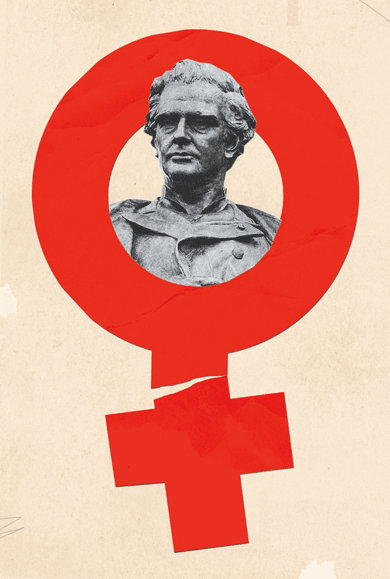
Illustrations by Lincoln Agnew
Sims was attempting to discover a cure for vesicovaginal fistula
(VVF), a common affliction that is caused by prolonged obstructed labor.
The timing, nature, and purpose of his experiments make for an
impossibly tangled knot of ethical dilemmas. Most prominently, they
raise the issue of medical consent. Did Sims obtain consent from his
subjects, as he later claimed — and if he did, could a slave truly
provide it? What woman would agree to be operated on, without
anesthesia, upwards of thirty times? On the other hand, given the
horrific nature of VVF, wouldn’t most women endure additional horrors in
pursuit of a cure? And without a willing patient, would delicate
surgery on a wound barely visible to the eye even be possible? What of
the fact that if Sims managed to cure the women, they would be promptly
returned to the plantations, where little awaited them but backbreaking
work, use as breeders of additional slaves, and state-sanctioned rape?
All these questions came to the surface a couple of months ago, when
activists long opposed to the Sims statue linked it to the Confederate
war memorials being torn down in cities across America. They staged a
protest in front of the statue in August, and an image from the event —
four women of color in blood-soaked gowns, representing Sims’s
experimental subjects — went viral. Newspaper accounts across the
country soon followed. Would the monument to Sims be the very first in
New York City to go to the chopping block?
1 Two partial exceptions to this rule are Richard Serra’s Tilted Arc, which was removed in 1989, and Frederick MacMonnies’s Civic Virtue Triumphant over Unrighteousness, which
 was relocated to Green-Wood Cemetery in 2012. In both cases, however,
city officials insisted that the decision was practical: Tilted Arc was removed because it was said to block foot traffic, and Civic Virtue for restoration purposes.
That, too, is a more complicated question than it seems. What Crippen
noted in 1899 is still true today. Even minor alterations to works of
public art in New York City are subject to an arcane system of approval,
and there is no formal mechanism in place for citizens to challenge the
decisions of earlier times. The governing assumption is that if a
memorial has realized permanent form, it represents a consensus that
should be preserved. Not a single statue in the history of New York City
has ever been permanently removed as a result of official action.
1
Illustration of Dr. J. Marion Sims with Anarcha by Robert Thom.
Courtesy of Southern Illinois University School of Medicine, Pearson
Museum.
In 1845, Marion Sims was a
thirty-two-year-old doctor with ten years of experience in the South’s
Black Belt. He served Alabama’s free black population; he contracted to
care for the slaves of local plantation owners; and his office and home
in downtown Montgomery included a small backyard facility he called the
Negro Hospital. Tending to the medical needs of current and former
slaves was an economic necessity in an area where two thirds of the
population was black. Indeed, Sims was a slaveholder himself: he had
accepted an enslaved couple as a wedding present from his in-laws, and
he came to own as many as seventeen slaves before he moved to New York
City in 1853. Letters to his wife (“Negroes and children always expect
liberal presents on Christmas”) betray a rank paternalism typical of
antebellum Southerners.
Medicine had been a default vocation rather than a calling. Sims’s
mother steered him toward the cloth, his father toward the law, and the
latter complained, when his son settled on medicine, that there was no
“honor” or “science” in it. Sims attended medical schools in South
Carolina and Philadelphia, and soon settled on surgical innovation as
the best path to a lucrative practice and a permanent legacy. At the
time, this involved learning new procedures from medical journals, and
Sims made a name for himself by treating clubfoot and crossed eyes.
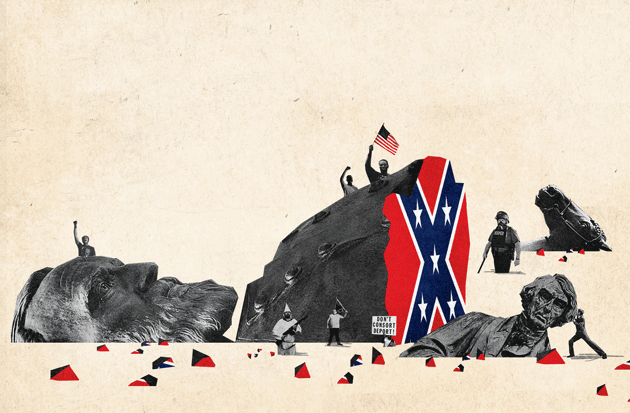
Source
photographs: bust of Confederate general Stonewall Jackson © Drew
Angerer/Getty Images; statue of Chief Justice Roger Brooke Taney ©
Dennis MacDonald/Alamy Stock Photo; statue of a horse in the Confederate
Army © Jerry Jackson/Baltimore Sun/TNS via Getty Images
More grandiosely, he announced that he had devised a better method
for dislodging foreign objects from the ear, and that he had discovered
the cure for infant lockjaw. He would later apologize for the first
claim, acknowledging that others had preceded him in syringing the ear.
But he went to his grave insisting that his cure for lockjaw was his
“first great discovery in medicine.” He couldn’t have been more wrong.
Zealous in his belief that most maladies were by nature mechanical, Sims
had attempted to cure a number of suffering slave babies by prying up
their skull plates with an awl. Shortly after Sims died, in 1883,
scientists identified lockjaw as a bacterial infection, also known as
tetanus.
By Sims’s account — as related in
The Story of My Life
(1885), published posthumously and excerpted in this magazine — his next
great discovery came just two months after the first. In the summer of
1845, he was asked to treat three young female slaves with holes inside
their vaginas. A few days after delivery, fistula sufferers experience a
sloughing away of dead tissue, most often leaving an opening between
the vaginal canal and the bladder. Once afflicted, women are cursed with
a perpetual leak of urine from their vaginas, frequently resulting in
severe ulceration of the vulva and upper thighs.
These were the first cases of VVF that Sims had encountered. It’s not
surprising, given his later confession that he had initially “hated
investigating the organs of the female pelvis.” A little research
revealed that doctors throughout history had been stymied by the
affliction. The basic problem, surgically speaking, was that you had
little room to see the wound you were attempting to close, let alone to
stitch sutures in the secreting tissue. Sims concluded that all three of
the women were untreatable, but the last, having traveled from Macon
County, was permitted to spend the night in his Negro Hospital, the idea
being that she would leave by train the following afternoon.
There the story might have ended — except that the next morning, Sims
was called to attend to an emergency. A white seamstress had dislocated
her uterus in a fall from her horse. Sims grudgingly made his way to
her home and placed her facedown with her buttocks awkwardly elevated in
what doctors called the knee-chest position. The idea was to vigorously
push her uterus back into place. Sims was first surprised when the
woman’s entire womb seemed to vanish, leaving his fingers flailing about
in an apparent void — yet somehow this worked, her pain was immediately
relieved. He was surprised again when the woman, lowering herself onto
her side, produced a blast of air from her vagina.
The seamstress was mortified, but Sims rejoiced. The accident
explained what had happened — and offered great promise besides. The
position of her body and the action of his fingers against her perineum
and the rear of the vaginal wall caused an inrush of air that inflated
her vagina. Sims immediately thought of the young woman still waiting
for a train in his backyard clinic. Might not the ballooning action of
the vagina enable a doctor to clearly observe a fistula, and thereby
cure a condition that had baffled the world’s leading medical minds for
centuries?
Sims rushed home, stopping on the way to purchase a large pewter
spoon that he believed would function more efficiently than his fingers.
Two medical students assisted him with the woman — her name was either
Lucy or Betsey, depending on how you read Sims’s account — and as soon
as they put her in the knee-chest position and pulled open her buttocks,
her vagina began to dilate with a puffing sound. Sims sat down behind
her, bent the spoon, and turned it around to insert it handle first. He
elevated her perineum and looked inside. He could see the fistula as
plainly as a hole in a sheet of paper. Years later, Sims described the
moment as if he had summited a mountain or landed on the surface of the
moon.
“I saw everything,” he wrote, “as no man had ever seen before.”
This was the first of many epiphanies
in a life that would come to be characterized, by Sims himself and by
others after him, as having proceeded along the lines of a fantastical
romance. For the next four years, the fairy tale goes, Sims labored to
cure those first three slaves, along with a number of other fistula
sufferers whom he sought out in neighboring communities. Progress was
incremental, levying a tax on the young physician’s soul and wallet (he
paid the cost of room and board for his enslaved subjects). Finally, in
1849, he managed to successfully close a fistula — and soon thereafter,
he grandly claimed, he cured all the slaves in his care. At least some
portion of the fame he coveted now came his way: the tool and the
position he used to cure fistulas have been known ever since as the Sims
speculum and the Sims position.
What followed was a period of collapse, probably from dysentery.
Assuming he was gravely ill, and concerned that he “might die without
the world’s reaping the benefits of my labors,” Sims published “On the
Treatment of Vesico-Vaginal Fistula” in
The American Journal of the Medical Sciences
in 1852. The paper was an immediate success. Sims claimed that his
surgery was easier to perform and produced more consistent results than
had any previous techniques. Citing health reasons (Alabama colleagues
thought him more ambitious than ill), he moved to New York City the next
year, and soon proposed establishing Woman’s Hospital. This would be
one of the first institutions in the world devoted to those conditions
“of the female pelvis” that he had once deplored.
A pattern emerged. As Sims saw it, he would be presented with a
series of women suffering from mysterious maladies — and, devising his
own cures or improving on the cures of others, he would conquer each
illness in turn. In addition to being crowned the Father of Gynecology,
Sims attached his name to dozens of tools and procedures. His fame
became international when he spent the Civil War years abroad, spreading
the gospel of his work and tending to the medical needs of empresses
and countesses. For the rest of his life, he remained a
continent-hopping cosmopolite, attending conferences and practicing
medicine in New York City, London, Paris, Geneva, and Vienna.
The effort to erect a monument to Sims began less than a month after his death in 1883. A Baltimore physician wrote a letter to
the Medical Record, the day’s leading organ for surgeons and doctors, to suggest that a statue be commissioned and erected in Central Park.
The editor agreed. The magazine announced that it would raise the
necessary funds from doctors — and from the many women who owed their
health and happiness to Sims’s “amelioration of their numerous and
distressing ailments.” Prominent surgeons offered pledges and praise,
and suggested that a Sims Memorial Fund Committee, made up “partly of
gentleman and partly of ladies,” be formed to take charge of the effort.
It was perhaps inevitable that Sims would wind up in bronze. The
rhetorical mold had first been cast in 1857, by a woman named Caroline
Thompson, who gave a speech to the New York state legislature after
being treated by Sims. Boasting a fatality rate near zero, Woman’s
Hospital was attempting to expand and become a state institution, and
Thompson told legislators that a vote in favor would “build for [them] a
monument in the hearts of women more durable than granite.”
The fund drive for the Central Park monument began in 1884. The
Medical Record
published the name of each donor and the amount of each donation, most
often $1, as they came in from across the country. When sufficient funds
were raised, the committee hired Ferdinand von Miller II, a German
sculptor who lived in an Italian castle. He eagerly set to work, and the
Sims memorial arrived in the United States in April 1892. At once the
committee approached the Department of Public Parks about the statue,
kicking off a cursory period of municipal assessment. Consistent with
the practice at the time, no public comment was invited.
A Central Park placement was initially denied. Instead, the statue
was unveiled in Bryant Park in October 1894. A “goodly number of ladies”
attended the ceremony, it was reported, but in the end not a single
woman served on the Sims Memorial Fund Committee, and only a tiny
portion of the monument’s donations had come from the surgeon’s former
patients — a tip-off, perhaps, that the hearts of women were less
receptive to Sims’s legacy than they were supposed to be.
Criticism of Sims began early and never
quite went away. His assistant in Alabama, Nathan Bozeman — who would
himself become a gynecologist of international renown — alleged that
Sims’s fistula cure had been successful only half the time. Others noted
that every aspect of the cure, including both the Sims speculum and the
Sims position, had been anticipated by other practitioners.
No matter. In the wake of Sims’s death and for many decades
afterward, the voices questioning his legacy were drowned out by a
chorus of hagiographers, whose fact-free defense of their idol amounts
to a study in mass delusion. In addition to the New York monument, there
were statues in South Carolina and Alabama, a Sims-branded medical
school and foundation (defunct and extant, respectively), and comically
laudatory profiles (“Savior of Women”) in dozens of publications. He was
included on short lists of civilizational greats alongside George
Washington, and likened to the divine figures in Homer and Virgil. He
was dubbed the Architect of the Vagina. The apotheosis peaked in 1950
with a radio-theater adaptation of the only book-length biography of
Sims, with the Oscar-winning actor Ray Milland playing the title role in
Sir Galahad in Manhattan.
In recent decades, however, this began to change. A series of
scholarly books — all of them brilliant but problematic — steadily
chiseled away at the Sims edifice. In the late 1960s, a young scholar
named G. J. Barker-Benfield produced a dissertation on how the
“physiological minority” of Wasp males had come to dominate
nineteenth-century America, later published as
The Horrors of the Half-Known Life
(1976). Smart and copious, the book included several chapters on Sims,
viewing him with refreshing skepticism. “Woman’s Hospital,”
Barker-Benfield wrote, “was founded very largely as a demonstration
ground for Sims’s surgical skill. He needed food and fame.” Yet
Barker-Benfield flubbed numerous details of the story, conflating, for
example, the displaced uterus of the seamstress with the damaged vagina
of the first enslaved patient. And only the profoundly Freudian
predilection of so much midcentury American scholarship can explain the
author’s claim that Sims harbored a “hatred for women’s sexual organs” —
one that he overcame by “his use of the knife.”
Twenty years later, in
From Midwives to Medicine, Deborah
Kuhn McGregor recounted the history of Woman’s Hospital as an emblem of
the male establishment’s hostile takeover of obstetrics, a jurisdiction
traditionally overseen by women. This exhaustive volume is often on the
mark: “Although J. Marion Sims is pivotal in the history of gynecology,
he did not create it by himself.” But McGregor, too, commits casual
errors: she mistakenly describes the VVF wound as a “tear” (a peeve of
clinical specialists), and creates confusion with equivocal language and
even imprecise grammar. Worse, a story that is fraught with horror and
drama is reduced to stale summary by the truth-destroying academic
conviction that to be dull is to be serious.
Both Barker-Benfield and McGregor failed to penetrate the membrane
that separates the world of academic squabbles from that of the people
who walk past the Sims statue every day. They did inspire a new
generation of scholarship, but a tendency to fight fire with fire
resulted in an inferno of questionable claims. Sims was soon described
by one detractor as “Father Butcher,” a sadistic proto-Mengele. Even
before the debate’s most indignant voices chimed in, Sims’s biography
had become a kind of post-truth zone. His defenders engaged in flagrant
invention, creating a saintly caricature that outstripped even Sims’s
own efforts to inflate his reputation; his detractors introduced
inaccuracies and exaggerations that morphed into outright falsehoods as
they ricocheted from source to source.
Forty years after its dedication, the
Sims statue, along with a statue of Washington Irving, was removed from
Bryant Park. The year was 1932, and the nation was about to observe the
bicentennial of George Washington’s birth. To commemorate the occasion,
Sears, Roebuck and Company erected in the park a temporary replica of
Federal Hall, from which Washington delivered his first inaugural. The
statues, which were in the way of this patriotic simulacrum, were
dragged away.
Robert Moses was named the commissioner of parks a short time later.
He disliked statues in general, and almost immediately proposed a
dramatic overhaul of Bryant Park that did not include the reinstallation
of the Sims and Irving monuments. This was fortuitous, as the statues
had been misplaced — five tons of granite and metal had somehow gone
missing. The good luck turned into headache, however, when the Art
Commission (which was later renamed the Public Design Commission, and
today has final say over all public-art decisions in New York City)
rejected his proposal. The statues had to come back.
Reports differ on what came next. Some say the statues turned up by accident in a Parks Department storage yard. Moses told the
New York Times
a different story: a protracted effort led searchers to a storage area
beneath the Williamsburg Bridge, where they found the monuments wrapped
in tarpaulins. Moses reiterated his belief that the “city could get
along very well” without them. Still, to keep Sims from mucking up his
plans, he consented to a request from the New York Academy of Medicine
that the monument be installed across from its Fifth Avenue location, in
a niche on the outer wall of Central Park.
Again, the public was afforded no opportunity to comment. The statue
was rededicated on October 20, 1934. The speakers echoed those who had
first lobbied for a Sims monument, hailing his supposed innovations
without ever really addressing what such a memorial was for. In 1884,
another celebrated surgeon, Samuel Gross, had argued in his letter of
support for a Sims statue that monuments are not intended for the dead.
Rather, they should act as a stimulus for the living to “imitate the
example” of the figure memorialized. But what sort of inspiration would
the Sims statue provide? After all, the man in the strange bronze
overcoat was, as the
Medical Record noted, distinguished mostly for his readiness to employ “the one needful thing, the knife.”
Sims would have yet another memorial
before the roof fell in. In the late 1950s, the pharmaceutical giant
Parke-Davis commissioned the artist Robert Thom to produce a series of
forty-five oil paintings illustrating the history of medicine. One
painting depicted Sims’s fistula experiments: clutching his trademark
speculum, the doctor stands in his ramshackle clinic before two acolytes
and the three worried slave women who would serve as his initial
subjects.
Parke-Davis was sold in 1970 to another pharmaceutical giant,
Warner-Lambert, which appears to have had no qualms about the painting:
the company granted permission for the image to be used on the cover of
McGregor’s
From Midwives to Medicine. In 2000, however, Warner-Lambert was purchased by Pfizer — and Pfizer
did have qualms. Harriet Washington’s
Medical Apartheid,
the next scholarly book to take aim at Sims, begins with an account of
her attempt to secure the rights to the image. She, too, hoped to use
Thom’s painting on the jacket of her book. Pfizer asked to review the
manuscript before making a decision, and she refused to comply. Later,
she submitted a request to use a smaller version of the image in the
book’s interior and never got an answer.
2
2 In 2007, Pfizer donated all forty-five paintings
to the University of Michigan. The painting of Sims is currently in
storage. A less prominent painting of Sims was commissioned by the
University of Alabama in 1982. It was removed from public view in 2005
after a visiting lecturer from Harvard complained about it.
Medical Apartheid is a vast and sweeping work, which ranges
from gynecology to eugenics, radiation, and bioterrorism. It is notable
for having won the 2007 National Book Critics Circle award in general
non-fiction, among several other honors. Yet even though only a small
portion of
Medical Apartheid is devoted to Sims, a number of
errors crop up: for example, the author describes the bronze statue of
Sims as a “marble colossus,” misstates the original location of Woman’s
Hospital, claims that only one of Sims’s slave subjects was ever cured,
and wrongly suggests that Sims once etherized wives to enable
intercourse.
Nevertheless,
Medical Apartheid finally penetrated the
scholar-public divide, and efforts got under way to have the statue
removed. They began with a woman, fired up by Washington, handing out
flyers in East Harlem. Viola Plummer, now chief of staff to New York
State Assemblyman Charles Barron, had been working with several
colleagues on health care disparities, and who knows how they first came
to focus on the Sims statue? It was back during the Bush
Administration, Plummer recalled, when there was torture and
waterboarding going on, and maybe the details of Sims’s experiments, as
recounted in
Medical Apartheid, resonated with all that. Or
maybe it was because a statue was a tangible thing, so perhaps you could
actually do something about it.
A bronze likeness of Dr. James Marion Sims stands at the entrance of
Central Park at Fifth Avenue and 103rd Street in Manhattan. Two women
protesters painted their clothes as part of their demonstration in August 2017.
Plummer’s pamphlets caught the eye of a group called East Harlem
Preservation, which put her petition online. Eventually, it attracted
enough media attention that the New York City Parks Department sent
someone to explain to the members of Community Board 11, also involved
by that point, that the city had a policy of not removing art for
content. Removing a statue, any statue, would amount to expunging
history.
Albeit on a lark rather than a mission, the department had been
thinking about its statuary for a while. In 1996, Commissioner Henry
Stern — a colorful character who bestowed code names on Parks staffers,
his own being Starquest — launched an effort to erect signs to
contextualize each of the statues, busts, and monuments under Parks
supervision, of which there were more than 800. A statue should be more
than a grave site, Stern’s thinking went. It should tell a story.
One of the people carrying out this mission was the new art and
antiquities director, Jonathan Kuhn (code name: Archive), who continues
on in the same position today. In 1996, the Sims statue was for Kuhn
little more than a punch line — he proudly told the
New York Times
that the city’s statues included a “fifteenth-century martyr, a sled
dog, and two gynecologists.” The signage effort coincided with the
digital revolution, so only a few summaries were ever installed in
Central Park as physical signs. The Sims summary was one of the many
that appeared only online.
The original version of this summary, which has since been finessed
and corrected, was notable for vagueness and factual errors. First, it
repeated the common but inaccurate claim that Sims innovated the use of
silver wire as an antibacterial suture material. The text also asserted
that the statue had been funded by donations from “thousands of Sims’s
medical peers and many of his own patients,” and as late as 2016, the
Parks website specified 12,000 individual donors. The actual numbers are
much more modest: 789 male doctors, forty-one women, and twenty-eight
medical societies. In any case, nobody at the department paid much
attention to the Sims summary. It was one headache among many, and why
quibble with a memorial to a man whose “groundbreaking surgical
methods,” as the original summary read, “earned him worldwide
notoriety”?
In 2007, at roughly the same time that
Viola Plummer was handing out letters in East Harlem, Mary Bassett, then
the deputy commissioner of the New York City Department of Health and
Mental Hygiene, also read
Medical Apartheid. Bassett was
uniquely positioned to appreciate what is undeniably the most
scruples-testing aspect of the Sims legacy. A physician herself, she had
spent nearly two decades in Zimbabwe, where the epidemiological
nightmare of VVF rages on today. Largely eradicated in the West because
of the prevalence of caesarean section, the condition still blankets the
African continent, with estimates of as many as 100,000 new sufferers
annually. There has been a recent rise in clinics dedicated to the
disorder, whose victims often wind up divorced, ostracized, depressed,
and suicidal. These clinics all descend from a single source: the Addis
Ababa Fistula Hospital, in Ethiopia, which was founded in 1974 by the
Hamlins, an Australian couple, both gynecologists, who planned their
facility by carefully studying Sims’s
The Story of My Life.3
3 A brick from the original Woman’s Hospital was
transported to Ethiopia and used in the construction of the Hamlin
fistula clinic.
The advent of African fistula clinics aside, Bassett believed that
Sims’s surgical subjects must have perceived his initial experiments as a
form of torture. Rather than handing out flyers, Bassett invited
Harriet Washington to give a talk at a health department gathering. It
was Washington’s lecture on Sims and the broader history of medical
experimentation that got staffers brainstorming about what could be done
about the statue. They came up with the idea of a contextualizing
plaque to be added to the statue itself, which would tell the story of
Sims’s initial procedures.
Kuhn dismissed the idea of a plaque. Instead, he suggested, they
should propose additions to the existing online summary. That’s
basically what happened. In 2008, the department added nine lines to the
text — which, true to form, introduced more historical errors. For one
thing, the revised summary claimed that Sims had been on hand to tend to
President Garfield’s gunshot wound: false. More meaningfully, the new
text noted that during the period of Sims’s fistula experiments, he had
“declined or could not use anesthesia.”
This skirts one of the most contentious aspects of the Sims debate.
During the mid-1840s, when he experimented on the enslaved women, ether
had just been introduced as a surgical anesthetic; it was not approved
for safe use until 1849. As for chloroform, it would make its debut in
1847 and become widely known for killing patients in the hands of
inexperienced physicians. Sims’s detractors have argued that he reserved
anesthesia for his white patients. This isn’t true, and for his part,
Sims claimed that the pain of fistula surgery did not merit the risk of
anesthesia in any patient.
4
4 Even after anesthesia came into common use, Sims
varied from his stance only in VVF cases where the damage extended to
the urethra or the neck of the uterus. It is critical to note, however,
that Sims did sometimes display a shockingly callous disregard for the
suffering experienced by his slave subjects. To further complicate
matters, Sims’s detractors have also accused him of believing that
African women had a special genetic endowment that made them resistant
to pain. In fact, it was his biographer, Seale Harris, who made this
claim a hundred years later in Woman’s Surgeon: The Life Story of J. Marion Sims (1950).
Beyond the error-speckled lines added to the online text, nothing
happened. Adrian Benepe, who succeeded Henry Stern, was more concerned
with health initiatives, such as smoking in public parks. For that
matter, Benepe later recalled, it wasn’t like there had ever been a
grand public chorus rising up to complain about the Sims statue. And
when you’re the commissioner, that’s what you do: you deal with things
that take up a lot of media and public attention. The Sims controversy?
It wasn’t even in the same ballpark as what PETA did to Mayor Bill de
Blasio over the Central Park horses in 2014.
Since the 1990s, one of the most
prominent figures in the Sims controversy has been L. Lewis Wall. Wall’s
résumé makes you feel like you’ve wasted your life. He holds two
doctorates, is a professor of medicine, social anthropology, and
bioethics, and founded the Worldwide Fistula Fund, which has launched
clinical programs to combat the scourge in Niger, Ethiopia, and Uganda.
Wall has performed hundreds of fistula surgeries in Africa, and has seen
firsthand the struggles of aid efforts — including local corruption and
political exploitation. Just as onerous, in his view, was “fistula
tourism”: non-African doctors making blitzkrieg trips to Africa to rack
up “good cases.” Wall responded with two articles, “A Bill of Rights for
Patients with Obstetric Fistula” and “A Code of Ethics for the Fistula
Surgeon.”
The latter manifesto stands in stark contrast to Sims’s lifelong
hostility toward medical ethics. He always hated rules, and a petulant
inability to follow even those he had agreed to has been viewed by his
champions as an element of his puckish persona. Yet Sims did sometimes
pay for his rule-flouting tendencies. In 1870 — thirteen years before
assisting with the Sims Memorial Fund Committee — the New York Academy
of Medicine put him on trial for ethics violations.
Sims had written
publicly about the condition of the theater star Charlotte Cushman, whom
he had once seen in private practice. In doing so, he violated his
patient’s confidence and ignored an ethical prohibition against doctors
seeking publicity — hardly a first for Sims, who had a ringmaster’s
flair for self-promotion and had once socialized with P. T. Barnum.
5
Sims was found guilty. He was given a formal reprimand, which would
subsequently be characterized by his detractors as a draconian penalty
and by his supporters as a slap on the wrist.
5 There is no evidence yet to suggest that pomposity
 and narcissism are hereditary conditions. Let’s recall, however, that
our current president’s tasteless retreat at Mar-a-Lago was designed by
the grandson of J. Marion Sims.
Judging from this, one might suspect that Wall would have pitched his
tent in the camp of Sims’s critics. Instead, as the debate turned
rabid, Wall kicked back against Sims’s detractors. No, he argued, Sims
did not
deliberately addict his experimental subjects to opium.
As to anesthesia, Wall calmly noted, the exterior of human genitals is
indeed sensitive, but that the inner lining of the vagina is not nearly
as innervated as one might expect.
Wall is not above reproach. For example, he decided on the basis of
the little information available that Sims’s experiments were “performed
explicitly for therapeutic purposes.” This conclusion overlooks the
social and economic realities of the South, and the less than altruistic
reasons that a plantation owner might send a woman suffering from a
fistula in search of a cure: the sexual exploitation of slaves, and the
financial benefits to be reaped from breeding additional human chattel.
In any event, in the zero-sum game of journalism, Wall found himself
positioned as Sims’s highest-profile defender, even though he had been
the first to suggest that there should be a monument to Anarcha, Betsey,
and Lucy.
It is worth noting that while Sims is
remembered primarily for his VVF surgeries, these account for only a
small fraction of his lengthy practice. Indeed, after he moved to New
York City, he left the bulk of fistula procedures to Thomas Addis Emmet,
who became his assistant in 1856 and further perfected the process,
curing many patients that his superior regarded as lost causes.
Over the
next two decades, Sims would dabble with a range of horrific
procedures, including clitoridectomy (performed at least once, in 1862)
and so-called female castration. Indeed, Sims later became a fervent
champion of “normal ovariotomy,” in which one or both healthy ovaries
were removed as specious cures for dysmenorrhea, diarrhea, and epilepsy.
He performed the operation a dozen times himself, killing several women
and mutilating others.
Earlier in his career, however, Sims turned his attention to
procreation. He hoped to make advances that would ensure the
perpetuation of honorable families and powerful dynasties. His
investigations into sterility would result in his prescribing
intercourse at particular times of the day, and then swabbing his
patients’ vaginas (to count sperm under a microscope) at such
increasingly rapid postcoital intervals that critics wondered exactly
what kind of bargain had been struck between husband and physician.
Sims signed on to a simple anatomical tenet of the day: if the neck
of a woman’s uterus did not offer a clear pathway, then the egress of
menstrual matter from the womb, and the ingress of sperm into it, could
be impaired. In his view, this could lead to sterility and painful
menses. His solution (and he was not the first to suggest it) was to
surgically open the passage with one of a variety of multibladed
dilating tools, some of which were activated with a spring mechanism
once inserted into the patient’s womb: the blades popped open and made
multiple incisions as the device was drawn out again.
In 1878, he published a kind of summa, “On the Surgical Treatment of
Stenosis of the Cervix Uteri,” reflecting at length on a procedure that
Sims estimated he had performed as many as a thousand times. Like his
early publications, this one seemed designed to ensure that nobody could
snatch away credit that was properly his. In this case, Sims wished to
cement his claim to a particular incision made to the cervical canal.
“The antero-posterior incision belongs to Sims,” he declared, “and not
to Emmet, or any one else.”
The paper was presented to the American Gynecological Society that
same year, and while Sims was not present, other doctors spoke up to
praise or critique his claims. The most interesting response came from
Fordyce Barker, President Grant’s personal physician, who had championed
Sims from the moment of his arrival in New York City, launching the
young doctor’s career (and canonization) with a public description of
his “brilliant” fistula operation.
Twenty-five years later, Barker rose to offer a less enchanted view.
He began by noting that it was unclear whether a womb with a narrow neck
was even pathological. In recent years, many unnecessary operations had
been performed, often with injurious results. Worse, the procedure had
been adopted by untrained physicians or downright charlatans. In any
event, how could it be that Sims had performed these operations five
times as often as many other capable surgeons?
His skills were
undeniable, Barker concluded, but it was for precisely this reason that
his arguments should be scrutinized, for it had been the tendency of the
profession to accept the dicta of such men unquestioned.
Four years later, Barker accepted the chairmanship of the Sims Memorial Fund Committee. He died before the statue was dedicated.
In March 2014, the Sims debate reignited with another
New York Times
article, which described the limbo into which the controversy had
fallen after 2011. Now the Parks Department and Community Board 11,
which had been fighting the Sims case for seven years, agreed to meet
and settle things once and for all.
The city, still resistant to removing the statue, sought out experts
to make its case. They enlisted Robert Baker, a professor of philosophy
at Union College and the author of
Before Bioethics (2013).
Baker acknowledged Sims to be precisely the kind of doctor that had
necessitated the bioethics revolution: bioethics holds that
science-minded physicians shouldn’t be trusted to monitor their own
ethical behavior. Yet in
Before Bioethics, Baker takes Sims at
more than his word. For example, Baker claims that Sims freed his slaves
before he moved to New York City in 1853. This is patently untrue: he
leased his slaves before he left Alabama, and during his difficult first
year in the city, they likely formed an important part of his income.
Baker even argues that
The Story of My Life should be forgiven
for its use of the word “nigger” because Sims only uses it when quoting
other people. Actually, that’s not true — but even if it were, who
cares?
It was Baker who provided the department with a three-page
“deposition” on the controversy.
This document reads like a disheveled
Wikipedia entry. Baker’s claim about Sims’s own slaves is there, along
with an inaccurate assertion that Sims repeatedly sought consent for
surgery from his enslaved patients. The document also notes that Sims
offered credit to his slave subjects and that they came to serve as his
assistants. These assertions are true, yet all they do is add another
twist to the complicated knot of consent. Slaves cannot provide consent
for surgery — they do not have true agency. Similarly, should a slave be
applauded for performing labor that she is in any event compelled to
perform? Regardless, Baker concluded that additional information about
the three slaves on or near the Sims monument would be an appropriate
way to “follow Sims’s example [and honor] the courage of these African
American women.”
Parks also contacted the art historian (and former vice president of
the New York City Art Commission) Michele Bogart, whose position
couldn’t have been clearer: she was vehemently opposed to the removal of
the Sims statue. Bogart didn’t know a lot about Sims. In her view,
however, the details didn’t matter: you simply didn’t remove art for
content. Bogart didn’t buy the claims that modern sensibilities had been
injured. Get over it, she thought. It boiled down to expertise. What
Bogart believed — and she was undeniably an expert — was that the Sims
statue had stood in New York City for more than 120 years, and that even
false history was of historic interest if it managed to persevere.
The meeting was held in June 2014. Baker’s deposition was read aloud
to members of the Parks subcommittee, and Bogart briefly addressed the
importance of using city monuments as educational tools. A deputy
commissioner apologized for the years it had taken to produce a
response, then reiterated that the statue would not be removed. However,
the department was ready to consider a freestanding sign, and the
committee voted unanimously that Parks, in a timely manner, should
return when a complete plan had been formed. In other words, it was back
to bureaucratic limbo, where the argument over the Sims statue — which
had long since become a symbol of how the fraudulent past becomes
official history — had resided for nearly a decade.
In May 1857, Sims was approached in
private practice by a forty-five-year-old woman possessed of
irritability of the bladder and uterine displacement. She was a curious
case, married at twenty but still a virgin. Sims attempted an
examination, only to find that the slightest touch to her vagina caused
her to shriek, spasm, and cry. A second examination, under the influence
of ether, revealed minor uterine retroversion — but her vagina was
perfectly normal. Medical books threw no light on the matter. The only
rational treatment, Sims concluded, would be to cut into the muscles and
the nerves of the vulval opening. Alas, the woman’s “position in
society” made her an unsuitable candidate for such an experimental
procedure.
Fifteen months later, Sims was sent a similar case from Detroit, a
young virgin with the same dread of having her vagina touched. This
time, he decided, the risk was justified: her husband had threatened
divorce. Cutting into the hymen offered the young woman no relief, but
incisions into the mucous membrane and the sphincter muscle were
slightly more effective. By that point, her mother concluded that Sims
was experimenting on her daughter — which, of course, he was — and
yanked her from his care.
A few weeks later, another case fell into his hands, followed by two
more. By now, Sims had a name for the condition: vaginismus. He had also
devised a cure, aimed primarily at permitting coitus between husband
and wife: amputate the hymen in full, then make several deep,
two-inch-long incisions into the vaginal tissue and the perineum. As
with his cervical stenosis surgery, this would be followed by the
insertion of glass or metal dilating plugs as the wounds healed. Several
years later, in
Clinical Notes on Uterine Surgery (1866)
—
sometimes characterized as modern gynecology’s inaugural text — he
claimed to have encountered thirty-nine instances of vaginismus and
achieved a perfect cure in every case.
Sims’s claims were challenged even before he finished making them.
English doctors rejected the notion that the condition had never before
been described, and London’s
Medical Times and Gazette noted
that British surgeons would no sooner resort to excision for a mild case
of vaginismus than they would cut off a patient’s eyelid because he had
a twitch. French doctors agreed. They had been researching the
condition since at least 1834. They regarded the “Sims operation” as too
bloody and dangerous, and one French doctor dismissed it as too
mechanical, “
too American.”
American doctors eventually rejected the procedure as well, using it
for only the most severe cases. They also came to dispute Sims’s claim
to thirty-nine perfect cures. Years later, one Woman’s Hospital surgeon
insisted that he was aware of only a single cure, and vividly recalled
two patients who had been left in far worse shape after the procedure.
Another doctor remembered cases in which failed Sims operations —
performed by surgeons other than Sims — were followed by so many futile
attempts at treatments that the women’s vaginas looked as though they
had been splashed with nitric acid. A year before the Sims statue was
erected, A.J.C. Skene — the
other gynecologist in New York
City’s statuary pantheon — claimed that he had never seen a case of
vaginismus for which the Sims operation “would have been of any value.”
 |
| J Marion Sims with his medals of "Honor". |
The debate over the Sims monument has tended to focus on his VVF
experiments — but that’s only the beginning of the story. After Sims
exploited a vulnerable population to achieve a minor victory that he
successfully parlayed into international fame, he claimed credit for a
series of bogus breakthroughs and performed thousands of surgeries,
often at the behest of distressed husbands, which left many women
mutilated or dead. This does not make Sims a Gilded Age Mengele. Mengele
killed his Jewish subjects by degrees, extracting data along the way,
while Sims was always attempting to ameliorate
something. Good
intentions, however, don’t erase the enormous pain and injury that he
inflicted, nor the sense of violation — one felt by women today every
time they pass the statue on the sidewalk.
The anti-Sims movement has never had
the fervor of a student uprising. And for more than a decade, it lacked
even the figurehead of a vigilante arrested for defacing the statue in a
pique of righteous inspiration. That shouldn’t matter. Not all scholars
of public art agree that statues should remain in place forever.
Experts of a different kidney, such as Erika Doss, a professor of
American studies at the University of Notre Dame, are perfectly
comfortable with monuments being “defaced, despoiled, removed, resisted,
dismantled, destroyed and/or forgotten” when they represent “beliefs no
longer considered viable.” These acts of symbolic vandalism embody
Emerson’s insistence that good men must not obey laws too well.
Like history itself, activism seems to move very slowly at times,
then abruptly accelerates. In June 2016, the long-awaited language for
what had evolved into a freestanding-sign-plus-plaque solution was
presented to Community Board 11. The expectation was that the board
would provide yet another rubber stamp for yet another round of evasive
action. Instead, a subcommittee balked — and after another presentation,
two weeks later, the full board voted to remove the statue. Then the
Confederate flag came down over the South Carolina statehouse, and
Confederate statues vanished in New Orleans, Baltimore, Orlando, St.
Louis — and in the wake of Charlottesville came a growing sense that the
nation could no longer tolerate commemorations of its most shameful
moments. And finally, on August 19, protesters congregated around the
Sims statue and demanded that the city remove it.
In the media storm that followed, Mayor de Blasio instituted a
ninety-day period of reevaluation for the city’s sprawling statuary.
After years of telling activists that there was no way to remove
statues, the city invented one. Still, it wasn’t enough for one
protester, who at last seized the initiative and spray-painted
racist across the statue’s back and gave it red, villainous eyes.
Surely this Emersonian good man —
if it was a man — had been
prodded into action by the activists, one of whom condemned
“imperialist slaveholders, murderers, and torturers like J. Marion
Sims.” But truth be told, that’s not quite right, either. For all his
crimes, Sims was not a torturer or a murderer. Which means that his
detractors are on the right side of history, but for the wrong, or
incomplete, reasons. And maybe that doesn’t matter. For ten years, the
Parks Department and the city itself resisted removing the statue not
because they cared about Sims but because they feared a precedent that
would bring a cascade of other statues down as well.
That’s exactly what
should happen, in New York and elsewhere. In an age defined by
changing values and an evolving notion of what constitutes a fact, the
Sims statue stands as a monument to truth’s susceptibility to lies and
political indifference. Removing it represents an awareness that history
is fluid, but bronze is not.


